Every harvest season, the world’s farms generate mountains of leftover plant material—straw, stalks, husks, and stems—that contain enormous reserves of organic carbon. Yet much of this bounty is wasted, burned, or left to decompose slowly in fields, because the tough fibers that make up plant cell walls are notoriously resistant to breakdown. A new study published in the journal Biochar offers a strikingly elegant solution: pairing a specially engineered form of charcoal with a wood-decaying fungus to rapidly convert agricultural residues into humic substances, the dark, carbon-rich compounds that give fertile soils their structure, water-holding capacity, and productivity. The research, led by a team publishing from Shenyang Agricultural University’s Biochar Editorial Office, demonstrates that a simple material modification—loading biochar with manganese—can dramatically accelerate one of nature’s slowest and most important chemical processes.
Humic substances are the backbone of healthy soil organic matter. These complex, aromatic, oxygen-rich molecules form gradually as plant litter is decomposed and reassembled by microbes and fungi, a process known as humification. In natural settings, humification can take months or years, which is precisely why agricultural wastes rich in lignocellulose—the combined matrix of lignin, cellulose, and hemicellulose that gives plants their rigidity—recycle so sluggishly. Lignin in particular is a formidable barrier: its irregular, cross-linked network of phenolic units is one of the most recalcitrant polymers in the biosphere. Breaking it open efficiently is the key step that unlocks the smaller phenolic and sugar molecules that fungi and bacteria can then rebuild into humic materials. Accelerating that bottleneck has long been a goal of researchers working on sustainable waste management and soil restoration.
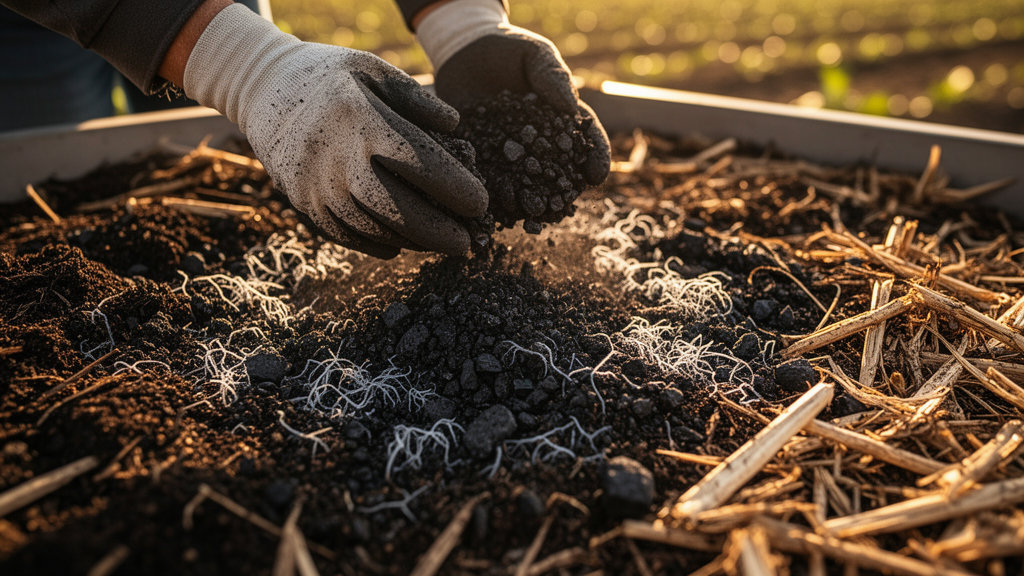
The research team approached the problem by combining two biological and materials innovations. The first is Phanerochaete chrysosporium, a white-rot fungus famous for its ability to secrete powerful extracellular enzymes—lignin peroxidases, manganese peroxidases, and laccases—that can oxidize lignin and other stubborn plant polymers. The second is manganese-modified biochar, a porous carbon material derived from bamboo and treated with manganese, a transition metal that plays a central role in oxidative enzymatic chemistry. Biochar itself is already valued in agriculture for improving soil properties and sequestering carbon, but the researchers hypothesized that modifying its surface with manganese could turn it into an active participant in fungal decomposition rather than a passive soil additive.
To test the idea, the team ran a 35-day fermentation experiment using wheat straw, one of the most abundant agricultural residues on the planet. They compared the performance of the fungus alone against the fungus grown with 5 percent manganese-modified biochar added to the culture. The differences were remarkable. Lignin degradation increased by 93.4 percent in the presence of the modified biochar, cellulose degradation rose by 77.0 percent, and hemicellulose degradation climbed by 30.9 percent compared with the fungus-only control. In other words, the engineered charcoal did not merely support the fungus—it substantially amplified the fungus’s capacity to dismantle the very polymers that make crop residues so difficult to recycle.
Even more consequential for soil health were the changes in the end products of decomposition. Humic acid content in the treated cultures increased by 47.7 percent, and an indicator of humic substance polymerization—a measure of how far the organic molecules have been assembled into larger, more stable structures—rose by 112.4 percent. This dual effect is what makes the finding significant from a practical standpoint. Many approaches can speed up the breakdown of plant waste, but far fewer simultaneously push the resulting fragments toward the complex, aromatic, long-lived compounds that actually improve soil. The manganese-modified biochar system achieved both: faster destruction of recalcitrant fibers and faster construction of valuable humic materials from the pieces.
To understand how this synergy works at the molecular level, the researchers deployed an unusually comprehensive analytical toolkit, combining advanced molecular characterization, interpretable machine learning, and multi-omics techniques that track gene expression and metabolites simultaneously. The machine learning component allowed the team to identify which molecular features most strongly predicted humification outcomes, while the omics data revealed which fungal genes and metabolic pathways were activated under each treatment. This integrated approach is part of a broader trend in environmental science, in which researchers move beyond measuring bulk outcomes—how much lignin disappeared, how much humic acid formed—to mapping the specific chemical reactions and biological programs that drive those outcomes.
The mechanistic picture that emerged is one of coordinated, multi-layered enhancement. First, the manganese-modified biochar promotes fungal growth itself, providing the organism with a more favorable environment for proliferation. Second, it stimulates the activity of the enzymes responsible for degrading resistant plant fibers, the enzymatic machinery that white-rot fungi deploy outside their cells. Third, manganese-associated oxidation reactions contribute directly to the chemical attack on lignocellulose, helping to liberate smaller organic molecules that serve as raw building blocks for humic substances. In effect, the biochar acts as both a scaffold and a chemical catalyst, amplifying the fungus’s natural capabilities at several points along the decomposition pathway.
The molecular analyses added further detail about the chemistry of the resulting humic materials. The treatment promoted specific transformation reactions, including deamination, the removal of amino groups; dealkylation, the stripping of alkyl side chains; and the progressive breakdown of lignin into its constituent phenolic units. These reactions steer the decomposition products toward more aromatic, oxygen-rich, and structurally complex humic-like substances. The researchers identified pathways involving polyphenols and quinones—classes of reactive organic compounds well known as intermediates in humus formation—as particularly important routes in this transformation. Meanwhile, the gene expression and metabolite analyses showed enhanced activity in the fungal pathways associated with plant fiber degradation and with the production of humification precursors, confirming that the biological and chemical dimensions of the process were advancing in tandem.
The implications extend well beyond the laboratory. Agricultural waste is produced in staggering quantities worldwide, and finding higher-value uses for it is a central challenge of the circular economy. As the research team put it, agricultural waste is not simply something to dispose of; it is a valuable carbon resource that can be transformed into materials that support healthier soils. A technology that converts straw and other lignocellulose-rich residues into stabilized humic substances could simultaneously address waste management problems, reduce the burning of crop residues and the air pollution it causes, rebuild degraded soils, and lock organic carbon into forms that persist in the ground rather than escaping into the atmosphere as carbon dioxide. Because both biochar production and fungal fermentation are comparatively low-technology processes, the approach could potentially be adapted to composting operations and regional waste-processing facilities rather than remaining confined to specialized laboratories.
The authors are careful to note that important questions remain before the technology can move into the field. Further research is needed to evaluate the release of manganese from the modified biochar, its long-term environmental safety, and the economic feasibility of the process under practical operating conditions. Manganese is an essential plant micronutrient, but its mobility and bioavailability in soils depend on concentration and chemical form, so field-scale trials will need to confirm that the material behaves as safely as laboratory results suggest. Cost analyses will likewise determine whether the benefits of accelerated humification justify the expense of producing and applying the modified biochar. Even so, by uncovering the molecular mechanisms behind accelerated humification—linking a modified carbon material, a metal cofactor, and a lignin-devouring fungus into a single coordinated system—the study provides a scientific foundation for transforming agricultural residues into valuable organic resources, and a compelling example of how materials science and microbiology can jointly advance sustainable waste management.
Subject of Research: Manganese-modified biochar enhancement of white-rot fungal humification of agricultural lignocellulosic waste
Article Title: Turning agricultural waste into soil-building substances: Manganese-modified biochar gives fungi a powerful boost
Article References: Turning agricultural waste into soil-building substances: Manganese-modified biochar gives fungi a powerful boost. (n.d.). Original publication
Image Credits: AI Generated
DOI: Not provided
Keywords: biochar, manganese, white-rot fungi, humic substances, humification, agricultural waste, lignocellulose, wheat straw, soil fertility, organic waste recycling, Phanerochaete chrysosporium, multi-omics
News Source: Alan Morgan. (October 15, 2026). Manganese-Modified Biochar Supercharges Fungi That Turn Farm Waste Into Soil Gold. Scienmag.