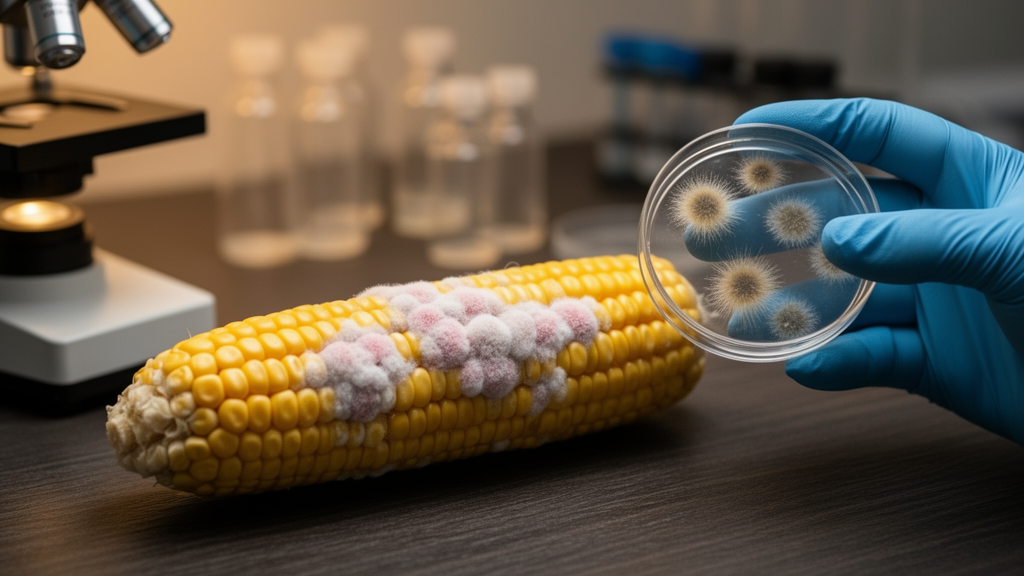
A detailed investigation of maize ear rot in southern India has mapped, with unusual completeness, which Fusarium species are behind the disease, how aggressive they are, and what their genomes say about the toxins they can produce. The study, published in Scientific Reports by a team led by K. N. Pallavi and M. K. Prasannakumar of the University of Agricultural Sciences in Bangalore, combined classical morphology, multilocus DNA phylogenetics, pathogenicity assays, toxin-gene screening, chemical confirmation of fumonisins, and whole-genome sequencing. The result is an integrated picture of a pathogen community in which one species, Fusarium verticillioides, overwhelmingly dominates, and its dominance appears to be written directly into its genetic toolkit.
Maize ear rot is far more than a cosmetic blemish on cobs. The disease reduces yield, degrades grain quality, and — most importantly for human and animal health — opens the door to mycotoxin contamination, the toxic secondary metabolites that Fusarium fungi deposit in infected kernels. Fumonisins, the signature toxins of F. verticillioides, are linked to serious health problems in livestock and are suspected carcinogens in humans, while trichothecenes produced by F. graminearum suppress immune function and cause vomiting and feed refusal. Because contaminated grain cannot simply be cleaned after harvest, understanding which species are present in a production region, and which toxin genes they carry, is the foundation of any rational food-safety strategy.
The researchers collected and analysed 54 Fusarium isolates from maize ears showing ear rot symptoms across Karnataka, a major maize-growing state. Identification began with colony and spore morphology but did not stop there, because Fusarium species are notoriously difficult to separate by appearance alone. The team instead built multilocus phylogenies, sequencing several conserved genetic loci and comparing the resulting DNA fingerprints across isolates to place each strain on an evolutionary tree. This approach resolved the collection into six distinct Fusarium species, but the headline finding was the lopsided composition: F. verticillioides accounted for 43 of the 54 isolates, or 79.63 percent of everything recovered from diseased ears.
That numerical dominance was matched by disease-causing power. When representative isolates were inoculated onto maize, most of the collection produced high pathogenicity, with disease severity exceeding 75 percent. The two most agriculturally important species were tested in detail: F. verticillioides reduced seed germination to 65 percent, and F. graminearum pushed it down to 62 percent, while both caused substantial stalk and ear rot symptoms in the infected plants. In practical terms, the fungi are not merely colonising senescing tissue opportunistically; they are active, aggressive pathogens capable of damaging the crop at multiple stages, from germination of the next season’s seed to the integrity of the developing ear.
The link between prevalence and toxicity emerged when the team screened every isolate for mycotoxin biosynthesis genes. The fumonisin gene cluster in F. verticillioides includes FUM1, the polyketide synthase gene that catalyses a key early step in assembling the fumonisin molecule, and its presence is a reliable indicator of a strain’s potential to produce the toxin. Strikingly, FUM1 was detected in all 43 F. verticillioides isolates — every single one. The genetic potential for fumonisin production is therefore not a minority trait in this population but a universal feature, which helps explain why this species so thoroughly dominates the ear rot complex in the region.
Genetic potential, however, is only meaningful if the toxin actually accumulates in grain. To verify this, the researchers used liquid chromatography coupled with mass spectrometry, or LC–MS, a technique that separates individual metabolites and identifies them by their mass-to-charge signatures with high specificity. Analysis of kernels infected with a tested F. verticillioides isolate confirmed high fumonisin accumulation, closing the loop between gene, pathogen, and chemical hazard. For food-safety monitoring, this is the crucial evidence: the dominant pathogen in Karnataka’s maize is not just present and aggressive, it is demonstrably loading harvested grain with a regulated toxin.
The F. graminearum isolate told a different toxicological story. Rather than fumonisin genes, it carried the genetic machinery for trichothecene biosynthesis, including TRI7 and TRI13 — genes whose sequence characteristics determine which chemotype of trichothecene a strain can produce. The presence of NIV-associated versions of these genes indicates the isolate belongs to the nivalenol chemotype, one of the major trichothecene classes. Although this species was far rarer in the collection than F. verticillioides, its presence matters because trichothecenes and fumonisins pose distinct health risks and are regulated separately, so a shift in the species balance of a region would change the entire contamination profile of the grain supply.
To understand what makes F. verticillioides such an effective pathogen at the molecular level, the team sequenced the whole genome of isolate PMER18. The assembly yielded a genome of roughly 40 megabases — in the typical range for filamentous fungi — and achieved 98.0 percent completeness on the BUSCO benchmark, a quality metric that checks for the presence of a set of single-copy genes expected in any healthy fungal genome. A near-complete assembly means the annotation is trustworthy: the researchers could mine it for gene families involved in disease without worrying that key regions were missing or fragmented.
That mining produced a rich catalogue of virulence-associated features. The genome encodes putative pathogenicity genes, a substantial complement of CAZymes — carbohydrate-active enzymes that degrade plant cell wall polymers such as cellulose, hemicellulose, and pectin, allowing the fungus to physically penetrate and feed on host tissue — alongside membrane transporters that can export toxins and shield the fungus from plant defence compounds, and a set of candidate effector proteins. Effectors are molecules secreted by pathogens to manipulate or suppress host immunity, and identifying candidates in the genome provides a shortlist for future functional studies. Together these elements sketch the mechanistic basis of the species’ success: enzymatic tissue breakdown, chemical self-protection, and immune subversion, all coupled to an intact fumonisin production line.
The broader significance of the study lies in its integration. Diversity surveys, pathogenicity tests, toxin-gene screens, chemical confirmation, and genome analysis are often published separately; by combining them on the same isolate collection, the authors have produced a framework that connects field observation to molecular mechanism and, ultimately, to risk assessment. For plant breeders, the near-universal FUM1 presence in the dominant species argues that fumonisin resistance should be a breeding priority in the region. For regulators and grain handlers, the LC–MS confirmation of kernel contamination defines the monitoring target. And for pathologists, the genome of PMER18 supplies a reference for tracking virulence evolution. As climate patterns shift and maize systems intensify, this kind of unified pathogen profile — knowing exactly which fungi are present, how aggressive they are, what toxins they can make, and which genes enable it all — is precisely the evidence base that integrated disease management requires.
Subject of Research: Diversity, pathogenicity, mycotoxin gene profile, and genomics of Fusarium species causing maize ear rot in Karnataka, India
Article Title: Characterisation of mycotoxin-producing Fusarium species associated with maize ear rot and its pathogenomics and mycotoxin gene profile
Article References: Pallavi, K. N., Prasannakumar, M. K., Harish, J., Karan, R., Manjunatha, C., Devanna, P., & Sarangi, A. N. (2026). Characterisation of mycotoxin-producing Fusarium species associated with maize ear rot and its pathogenomics and mycotoxin gene profile. Scientific Reports. https://doi.org/10.1038/s41598-026-74277-x
Image Credits: AI Generated
DOI: 10.1038/s41598-026-74277-x
Keywords: Fusarium verticillioides, maize ear rot, mycotoxins, fumonisins, FUM1, trichothecenes, plant pathology, whole-genome sequencing, CAZymes, pathogenicity, Karnataka, food safety
News Source: Alan Morgan. (October 15, 2026). Fungal Genomes Reveal Why a Maize Pathogen Dominates Ear Rot and Poisons Kernels. Scienmag.