Forensic researchers in Nepal have documented a rare case of intimate partner homicide-suicide in which a man in his mid-30s killed his wife, also in her mid-30s, with a traditional Nepalese khukuri blade before taking his own life by cutting his throat. The case, published in the Egyptian Journal of Forensic Sciences, is described by its authors as only the second published homicide-suicide case from Nepal and the first involving intimate partners. Beyond its rarity, the case carries two forensically distinctive features: wound patterns produced by a culturally specific traditional weapon that the authors say have not previously been described in the homicide-suicide literature, and ritualistic behaviour by the perpetrator immediately preceding his suicide, including plant material placed on his body and a handwritten suicide note left on a pillow in the bedroom.
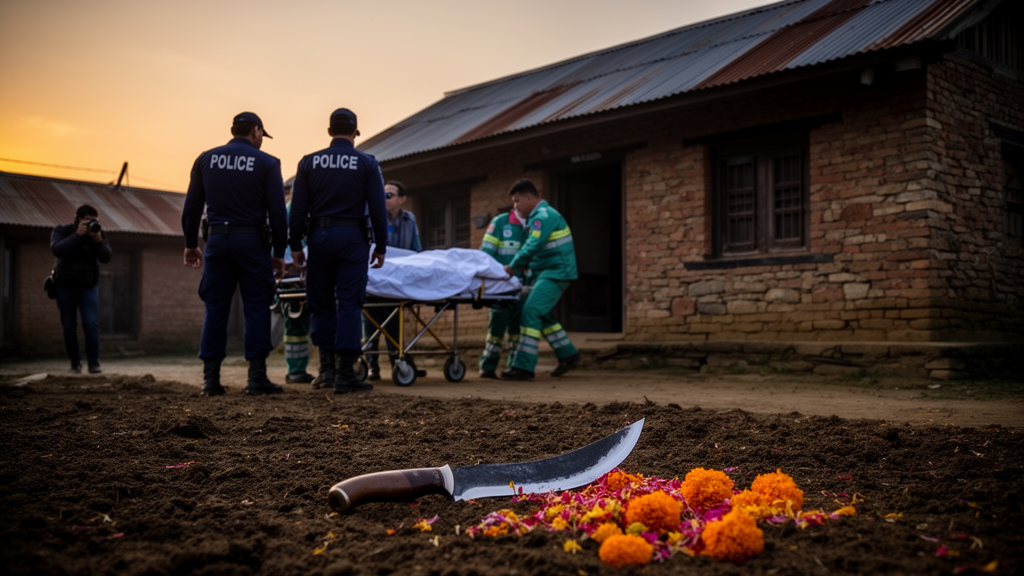
The bodies were discovered by a pre-adolescent son on the veranda of the family home in a rural hilly area of eastern Nepal at about 11:30 am, after the couple had last been seen alive at 8:00 am that same day. A blood-stained khukuri, a single-edged traditional weapon with an inward-curving steel blade and wooden handle, was found near the father’s body, with blood stains more prominent over the cutting edge and the handle. The exact dimensions of the weapon were not recorded at the time of examination, but based on visual comparison it was described as a medium-sized khukuri broadly consistent with a blade length of 10 to 14 inches and a weight of 450 to 750 grams, typical for this weapon class. No other potential weapons were identified at the scene, and large quantities of blood were present on the veranda floor, with pooling around both bodies. Scene examination identified no evidence of disturbance suggesting third-party involvement, and medico-legal autopsies were performed the following day, after police concluded the scene investigation.
According to family accounts recorded in the police case file, the father had described his marriage as irreconcilable to his two sons days before the incident and had instructed them to care for themselves. He was reported to be right-handed and to have participated in traditional spiritual practices in recent weeks. There was no documented history of diagnosed psychiatric illness, prior violent behaviour, or previous suicide attempts, although family members reported behavioural withdrawal, hopelessness about the marital conflict, and heightened engagement in spiritual practices in the weeks before the incident. The authors emphasise that no formal medical or psychiatric records existed for either decedent, meaning these observations rest entirely on family statements rather than clinical documentation.
The autopsy of the female victim revealed two deep incised wounds on the neck, one on the anterior aspect and one on the posterior aspect. The anterior wound was oblique, extending from the laryngeal prominence to the right mandibular angle, measuring 10.5 by 3 centimetres, with depth reaching the laryngeal lumen. Incised structures included soft tissue, muscles, a portion of the thyroid cartilage, the median thyrohyoid ligament, the thyrohyoid membrane, and the right external jugular vein, while the right common carotid artery was spared. The posterior wound was horizontal, located one centimetre above the hairline, measured 13 by 3 centimetres, and included a cut mark on the second cervical vertebra. This wound showed undermining along the lower margin and bevelling along the upper margin, features the pathologists interpreted as consistent with a bladed implement striking at an oblique angle. The atlas and axis vertebrae showed no fracture, and notably, no defence injuries were found on the forearms, hands, or fingernails, a finding the authors consider consistent with a surprise attack or rapid incapacitation.
Internal examination of the victim showed blood-stained froth in the tracheo-bronchial tree and pallor of the thoracic and abdominal viscera consistent with exsanguination. The cause of death was opined to be exsanguination due to sharp-force injuries to the neck with severance of the right external jugular vein, deep soft tissue injury, and laryngeal penetration. Although the common carotid artery was intact, the pathologists concluded that significant external haemorrhage, airway compromise from the laryngeal injury, and blood aspiration likely contributed to death. The manner of death was opined to be homicide.
The male perpetrator’s autopsy revealed a horizontal cut-throat wound extending from the left lateral to the anterior aspect of the neck at the level of the laryngeal prominence, measuring 10.5 by 2 centimetres, situated 7.4 centimetres below the chin and 9.3 centimetres above the sternal notch. The wound was deeper on the left side and shallower on the right, a direction the pathologists interpreted as consistent with a right-handed person acting upon himself. The margins and angles were clean-cut, and the wound involved clean transection of the underlying soft tissues, muscles, the left internal jugular vein, the left common carotid artery, the thyroid cartilage at the level of the thyroid notch, and the glottic part of the larynx, while the right-sided vessels were spared. Two superficial linear hesitation cuts were also present, one measuring 4 by 0.5 centimetres above the fatal wound and another measuring 11 by 0.5 centimetres below it. No defence injuries were noted, consistent with self-inflicted trauma. The cause of death was opined to be exsanguination due to the incised neck wound with severance of the left internal jugular vein and left common carotid artery, and the manner of death was opined to be suicide, supported by the hesitation marks, the handwritten note, and the absence of defensive injuries.
A striking and unusual finding concerned the perpetrator’s body: crushed green leaves were found within his right nostril, and a dried paste of similar material was present on his forehead, four centimetres above the right eyebrow, and within his scalp hair. Although the plant material was not botanically identified or retained for analysis, the authors note that its gross appearance and distribution are consistent with ritual use rather than incidental contamination. They point out that Ocimum sanctum, known as tulsi or holy basil, holds a uniquely sacred status in Hindu ritual practice and is commonly used in purification rites, daily worship, and death and funeral rituals. Given the plant material’s placement and the family’s report of the perpetrator’s increasing spiritual and religious engagement in the weeks preceding the incident, the authors consider the perpetrator’s Hindu faith a plausible context for this behaviour. They suggest these possible ritualistic elements, observed after the homicide and preceding the suicide, point to a delusional framework or culturally influenced psychopathology that could have been exacerbated by stress or untreated mental illness, while acknowledging that alternative explanations, including post-mortem placement of the material by family members before scene documentation, cannot be entirely excluded on the available evidence.
The authors argue that the combination of findings strongly supported the determination of homicide-suicide rather than a suicide pact or double homicide: the homicidal sharp-force injuries in the wife, hesitation cuts in the husband, the handwritten suicide note, the blood-stained khukuri at the scene, and the absence of evidence suggesting third-party involvement. They distinguish this from pact suicide, which they define as a consensual, voluntary agreement in which two or more people die by suicide together, a distinction they describe as a crucial medico-legal challenge in cases involving multiple unnatural deaths. The suicide note, found on the pillow and advising the sons to take care of themselves, is interpreted as pointing not only to premeditation but also to the psychological deterioration the perpetrator had been experiencing. The authors also note that the familial nature of homicide-suicide inflicts lasting psychological harm on surviving children and dependants, a point of particular gravity in this case given that the couple’s son discovered the bodies.
Placing the case in context, the authors observe that international studies consistently identify intimate partner conflict as the most common context of homicide-suicide, although methods and associated psychosocial factors differ between regions, and that data from low- and middle-income countries, particularly South Asia, remain scarce. They cite a meta-analysis by Panczak and colleagues finding that most homicide-suicide perpetrators use sharp-force or firearms, with prior threats or interpersonal tension as common precursors, and that many perpetrators had prior interactions with health services even though psychiatric diagnoses were often absent. Harper and Voigt’s work, cited in the paper, found that up to 60 percent of perpetrators had identifiable psychopathology, with undiagnosed mental illness a recurring theme. The authors also reference a review noting that in collectivist societies, family reputation, supernatural beliefs, and fatalism can influence the motives behind such acts, and that despite documented case studies from South Asia, the phenomenon remains underrepresented in the international literature.
The case report carries significant limitations that the authors describe candidly. Histopathological and toxicological analyses were not performed due to resource constraints in the medico-legal infrastructure of rural Nepal, so the possible role of alcohol, sedatives, or other psychoactive substances could not be established for either decedent. The authors note that alcohol intoxication is substantially associated with severe self-inflicted sharp-force injuries overall, underscoring the significance of this diagnostic gap, though they stress that the forensic determination of homicide and suicide rests on convergent physical evidence, including wound morphology, scene findings, hesitation marks, the absence of defensive injuries, and the suicide note, none of which depends on toxicological confirmation. No fingerprint or DNA linkage to the weapon was reported, and no psychological autopsy was conducted. The authors also caution that the observed wound characteristics are in keeping with injuries inflicted by a khukuri but are not pathognomonic, and the use of other sharp-force implements cannot be excluded. Concluding that cultural practices and untreated psychiatric illness likely contributed to the outcome, they call for more systematic research into the epidemiology and risk factors for homicide-suicide in South Asian populations, and argue that the case illustrates the need for improved forensic capacity, including routine toxicological analysis, in low-resource settings, while highlighting the potential value of early psychiatric risk identification and culturally informed outreach, though they explicitly state that broader policy conclusions cannot be drawn from a single case.
Subject of Research: A forensic case report of a sharp-force intimate partner homicide-suicide from rural Nepal involving a traditional khukuri weapon and possible ritualistic elements.
Article Title: Sharp-force homicide-suicide in an intimate partner relationship: a case from Nepal with possible ritualistic elements
Article References: Karn, A., Atreya, A., Jha, S., & Sah, S. K. (2026). Sharp-force homicide-suicide in an intimate partner relationship: a case from Nepal with possible ritualistic elements. Egyptian Journal of Forensic Sciences, 16(1), Article 91. https://doi.org/10.1186/s41935-026-00591-0
Image Credits: AI Generated
DOI: 10.1186/s41935-026-00591-0
Keywords: homicide-suicide, forensic pathology, Nepal, intimate partner violence, khukuri, dyadic death, autopsy, suicide note, ritualistic behaviour, South Asia, medico-legal investigation, sharp-force injury
News Source: Ophelia Keating. (October 28, 2026). Man Killed His Wife with a Khukuri, Then Took His Own Life: A Rare Nepalese Case Report. Scienmag.