Bacteriophages, also called phages, are viruses that infect and kill bacteria, their natural hosts. But from a macromolecular viewpoint, phages can be viewed as nutritionally enriched packets of nucleotides wrapped in an amino acid shell. A study published October 26th in the open access journal PLOS Biology by Jeremy J. Barr at Monash University, Victoria, Australia, and colleagues suggests that mammalian cells internalize phages as a resource to promote cellular growth and survival.
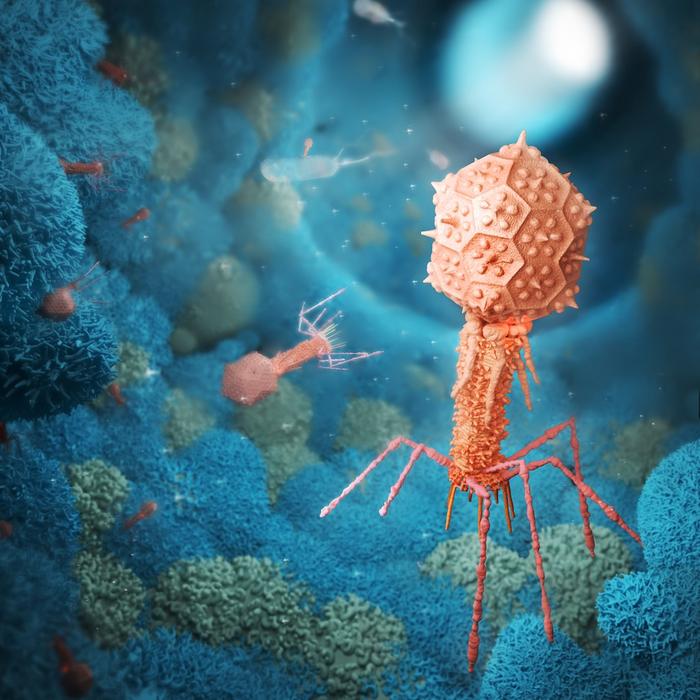
Credit: T2Q and Barr Lab (CC-BY 4.0, https://creativecommons.org/licenses/by/4.0/)
Bacteriophages, also called phages, are viruses that infect and kill bacteria, their natural hosts. But from a macromolecular viewpoint, phages can be viewed as nutritionally enriched packets of nucleotides wrapped in an amino acid shell. A study published October 26th in the open access journal PLOS Biology by Jeremy J. Barr at Monash University, Victoria, Australia, and colleagues suggests that mammalian cells internalize phages as a resource to promote cellular growth and survival.
Phage interactions with bacteria are well known, and interactions between bacteria and their mammalian host can lead to a range of symbioses. However, the impact of bacteriophages on mammalian cellular and immunological processes is not well understood. In order to investigate how mammalian cells’ immune responses interact with and are modulated by interactions with phages, researchers applied the well-studied phage T4 to mammalian cells in vitro and analyzed the cellular responses using luciferase reporter and antibody microarray assays. The phage-free supernatant served as a comparative control.
The researchers found that T4 phages did not activate DNA-mediated inflammatory pathways, but triggered a sequence of signaling pathway events that promote cellular growth and survival. Future studies are needed, however, to determine why cells use phage particles as resources, and whether they have specifically evolved via adaptation to benefit from this internalization.
According to the authors, “This preliminary study provides novel insights into the impact phages have on mammalian systems, with broader potential implications across the fields of immunology, phage therapy, microbiome, and human health.”
Barr adds, “This work provides new insights into the additional benefits that bacteriophages may have on their mammalian hosts. This is of particular importance given the increased use of phage therapy to treat antibiotic-resistant infections.”
#####
In your coverage, please use this URL to provide access to the freely available paper in PLOS Biology: http://journals.plos.org/plosbiology/article?id=10.1371/journal.pbio.3002341
Citation: Bichet MC, Adderley J, Avellaneda-Franco L, Magnin-Bougma I, Torriero-Smith N, Gearing LJ, et al. (2023) Mammalian cells internalize bacteriophages and use them as a resource to enhance cellular growth and survival. PLoS Biol 21(10): e3002341. https://doi.org/10.1371/journal.pbio.3002341
Author Countries: France, Australia, Canada
Funding: This work was funded by the Australian Research Council DECRA Fellowship (DE170100525 to JJB), National Health and Medical Research Council (NHMRC: 1156588 to JJB & 1125704 to GWM), and the Perpetual Trustees Australia award (2018HIG00007 to JJB). The funders had no role in study design, data collection and analysis, decision to publish, or preparation of the manuscript.
Journal
PLoS Biology
DOI
10.1371/journal.pbio.3002341
Method of Research
Experimental study
Subject of Research
Cells
COI Statement
Competing interests: I have read the journal’s policy and the authors of this manuscript have the following competing interests: JJB has a patent application related to this work (WO2018129536A1).