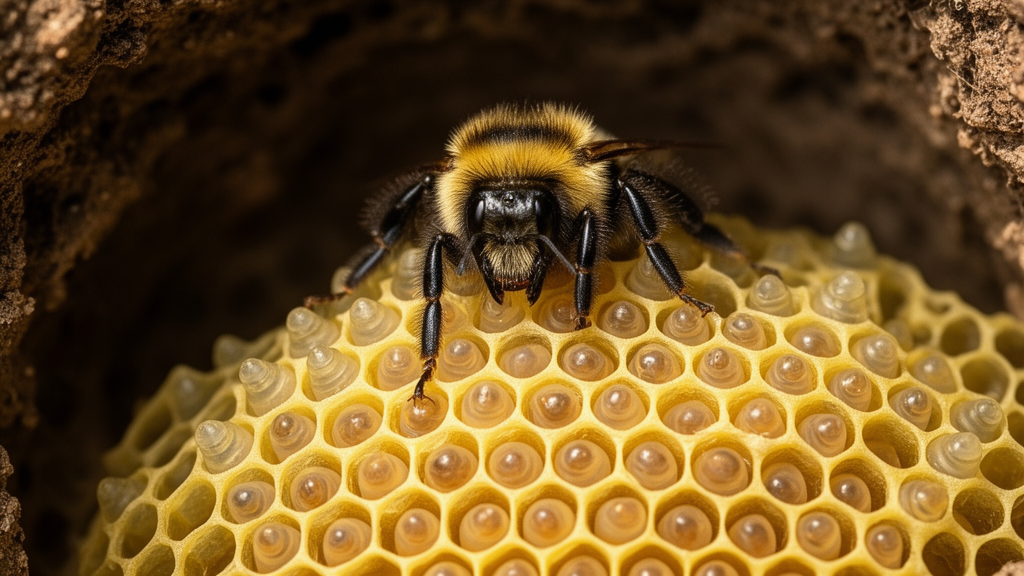
A new study published in the journal Royal Society Open Science reveals that male bumblebees actively help incubate developing young, upending decades of scientific consensus that their contribution to the hive is limited to supplying DNA. Lead study author and University of California, Riverside entomologist Meghan Moore reported that queens placed in nests alongside males began laying eggs twice as quickly and produced up to 1.5 times more brood than those without male support. Moore highlighted that these quantified benefits arrive at a critical period when wild bumblebee populations face significant threats from environmental pollution and habitat loss.
With the exception of an isolated study conducted in the 1980s by Sydney Cameron, now a professor emerita at the University of Illinois at Urbana-Champaign, researchers have long assumed that male bumblebees depart shortly after emerging to mate with queens, leaving all nest maintenance and brood rearing to female workers. Cameron’s earlier findings were largely ignored by the broader scientific community. Moore did not initially plan to overturn accepted wisdom regarding male insects, but she grew curious about Cameron’s historical findings while using a thermal camera to take photographs of nests for an unrelated experiment.
While reviewing the thermal heat maps from that initial experiment, Moore observed unexpected bright white spots indicating concentrated heat originating from males inside the nest. The images revealed males hovering directly over eggs and larvae in a distinct incubation posture, straddling the clutch and making contact with their thoraxes. In bumblebees, thoracic heat is generated when the flight muscles powering the wings are activated. Moore noted her surprise at the discovery, explaining that the prevailing literature had characterized males as mere flying bags of sperm whose sole function was mating, a characterization disproved by the new thermal observations.
To investigate the initial thermal findings under controlled conditions, Moore and Hollis Woodard, an entomology professor at UC Riverside, designed an experiment using laboratory-reared incipient bumblebee nests. Each trial nest was established with a single mated queen and either zero, one, three, or five males, while completely omitting female workers. The researchers tracked each colony for approximately one month, utilizing thermal imaging to record body temperatures, evaluate the adoption of incubation postures, measure the rate of queen egg-laying, and document the final number of young produced by each nest.
The experimental measurements showed that males adopting the incubation posture exhibited clearly elevated thorax temperatures of approximately 34.8 degrees Celsius, compared to their usual baseline of about 31 degrees Celsius, confirming active heat generation for brood incubation. Moore also observed that the male bees incubated the young at lower temperatures than queens typically do. She suggested that maintaining these slightly reduced temperatures might serve as a physiological adaptation to preserve the viability of stored sperm, although the authors emphasized that further empirical research is required to verify this hypothesis.
The research team outlined several caveats regarding the experimental design, noting that the laboratory conditions were artificial because natural incipient nests typically contain a queen and female workers rather than retained males. Furthermore, the laboratory setup prevented males from leaving the nest, and scientists still do not know how long males typically remain inside wild nests. Woodard pointed out that finding bumblebee nests in natural habitats is exceptionally difficult, and observing internal nest dynamics in the wild is even harder, making laboratory assays the most viable proxy. Although the researchers have not determined the primary motivation driving male brood care, Moore addressed the absence of female workers by noting that a separate, smaller study detected male caretaking behavior even when female workers were present in the nest.
Moving forward, the scientists are planning additional investigations to examine how nurturing behaviors influence male physiology. Woodard stated that caring for sibling brood requires significant energy expenditure, raising fundamental questions about the biological trade-offs and costs borne by male bees. While researchers continue to assess whether males provide similar assistance in the wild, the current findings demonstrate that male bumblebees are capable of engaging in brood care and directly influencing nest development during the critical early stages of colony establishment.
The visual evidence from thermal imaging, credited to Moore at UC Riverside, captures queens and males actively generating heat to incubate brood within the nest. By straddling the eggs and activating the thoracic muscles that also power their wings, these male babysitters maintain elevated body temperatures to nurture developing young. Rather than acting solely as genetic contributors, the males provide tangible physical assistance that helps hives thrive. This physiological confirmation shows that male bumblebees can participate directly in colony welfare, challenging decades of scientific assumption that nest maintenance falls exclusively to female workers.
The researchers also highlighted the broader implications of their paper, titled “Male bumblebees are capable of providing brood care and impacting nest development in incipient nests.” With wild bumblebee populations currently imperiled by environmental pollution and habitat loss, uncovering previously unrecognized cooperative behaviors offers valuable context for pollinator survival. To share these discoveries beyond academic channels, Moore discussed the experimental results and the unexpected role of males in the maternity ward during a guest appearance on the UC Riverside entomology podcast Can I Bug You.
Subject of Research: Male bumblebee brood incubation and effects on incipient nest development
Article Title: Boy bumblebees are more than flying sperm sacs
Article References: Boy bumblebees are more than flying sperm sacs. Original publication (Bibliographic details unavailable.)
Image Credits: AI Generated
DOI: Not provided
Keywords: bumblebee brood care, male bumblebees, incubation posture, thorax temperature, thermal imaging, queen egg laying, nest development, incipient nests, colony reproduction, University of California Riverside, Royal Society Open Science, Meghan Moore, Hollis Woodard, Sydney Cameron, insect thermoregulation, sperm viability
News Source: Drew Townsend. (November 20, 2026). Male Bumblebees Help Incubate Developing Brood and Accelerate Nest Growth. Scienmag.