• HOME
  • NEWS
  • EXPLORE
    • CAREER
      • Companies
      • Jobs
    • EVENTS
    • iGEM
      • News
      • Team
    • PHOTOS
    • VIDEO
    • WIKI
  • BLOG
  • COMMUNITY
    • FACEBOOK
    • INSTAGRAM
    • TWITTER
Thursday, August 13, 2026
BIOENGINEER.ORG
No Result
View All Result
  • Login
  • HOME
  • NEWS
  • EXPLORE
    • CAREER
      • Companies
      • Jobs
        • Lecturer
        • PhD Studentship
        • Postdoc
        • Research Assistant
    • EVENTS
    • iGEM
      • News
      • Team
    • PHOTOS
    • VIDEO
    • WIKI
  • BLOG
  • COMMUNITY
    • FACEBOOK
    • INSTAGRAM
    • TWITTER
  • HOME
  • NEWS
  • EXPLORE
    • CAREER
      • Companies
      • Jobs
        • Lecturer
        • PhD Studentship
        • Postdoc
        • Research Assistant
    • EVENTS
    • iGEM
      • News
      • Team
    • PHOTOS
    • VIDEO
    • WIKI
  • BLOG
  • COMMUNITY
    • FACEBOOK
    • INSTAGRAM
    • TWITTER
No Result
View All Result
Bioengineer.org
No Result
View All Result
Home NEWS Science News Chemistry

Making a fast ion transporter

Bioengineer by Bioengineer
April 17, 2019
in Chemistry
Reading Time: 2 mins read
0
Share on FacebookShare on TwitterShare on LinkedinShare on RedditShare on Telegram

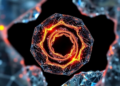
Credit: NINS/IMS

Na+/H+ antiporters exchange sodium ions and protons across cellular membrane to control pH, ion concentrations and cell volume, which is linked to a wide spectrum of diseases from heart failure to autism. Researchers now design a faster Na+/H+ antiporter based on the simulations.

An international team of researchers, research associate professor Kei-ichi Okazaki at Institute for Molecular Science and groups of professors Gerhard Hummer and Werner Kühlbrandt at Max Planck Institute of Biophysics, revealed an ion transport mechanism of the archaeal Na+/H+ antiporter PaNhaP in atomic detail by molecular dynamics simulations. Based on the simulations, they discovered a pair of residues that serves as a gate to the ion-binding site. Furthermore, they found that a mutation weakening the gate makes the transporter twice as fast as the wild type. The work was published in Nature Communications on April 15, 2019.

“It was surprising that the mutation makes the transporter faster,” Okazaki says, “the speed-up suggests that the gate balances competing demands of fidelity and efficiency.” The gate was discovered through simulations where they applied a method called transition path sampling to overcome the enormous time-scale gap between seconds-scale ion exchange and microseconds simulations. The simulations captured the ion transporting events, which is not possible with conventional simulations.

“We would like to understand design principles of transporters, how they recognize their substrates and how they control transport speeds,” Okazaki says, “these mechanistic understandings can help develop drugs to cure transporter-related diseases in future.”

###

Media Contact
Kei-ichi Okazaki
[email protected]

Original Source

https://www.ims.ac.jp/en/news/2019/04/17_4308.html

Related Journal Article

http://dx.doi.org/10.1038/s41467-019-09739-0

Tags: BiochemistryBiomechanics/BiophysicsChemistry/Physics/Materials SciencesMolecular Physics
Share12Tweet8Share2ShareShareShare2

Related Posts

Gluons Carry the Proton’s Baryon Number, Study Finds

Gluons Carry the Proton’s Baryon Number, Study Finds

August 13, 2026
Laboratory differences may mislead scientific AI models, researchers warn

Laboratory differences may mislead scientific AI models, researchers warn

August 13, 2026

Physics-guided AI creates low-noise amplifiers using 62% less power than expert designs

August 13, 2026

Locking therapeutic strategy could make cancer treatment more precise

August 13, 2026
Please login to join discussion

POPULAR NEWS

  • Study exposes gaps in agricultural sustainability monitoring

    29 shares
    Share 12 Tweet 7
  • Study reveals how pioneering osprey pairs drive population recovery

    29 shares
    Share 12 Tweet 7
  • Antibodies, antiretrovirals and CCR5 blockade limit HIV reservoir seeding in infant macaques

    29 shares
    Share 12 Tweet 7
  • Carbon Reduction Goals Decouple Emissions from Land-Use Efficiency: Driving Forces Revealed

    29 shares
    Share 12 Tweet 7

About

We bring you the latest biotechnology news from best research centers and universities around the world. Check our website.

Follow us

Recent News

Study exposes gaps in agricultural sustainability monitoring

Study reveals how pioneering osprey pairs drive population recovery

Antibodies, antiretrovirals and CCR5 blockade limit HIV reservoir seeding in infant macaques

Subscribe to Blog via Email

Enter your email address to subscribe to this blog and receive notifications of new posts by email.

Join 85 other subscribers
  • Contact Us

Bioengineer.org © Copyright 2023 All Rights Reserved.

Welcome Back!

Login to your account below

Forgotten Password?

Retrieve your password

Please enter your username or email address to reset your password.

Log In
No Result
View All Result
  • Homepages
    • Home Page 1
    • Home Page 2
  • News
  • National
  • Business
  • Health
  • Lifestyle
  • Science

Bioengineer.org © Copyright 2023 All Rights Reserved.