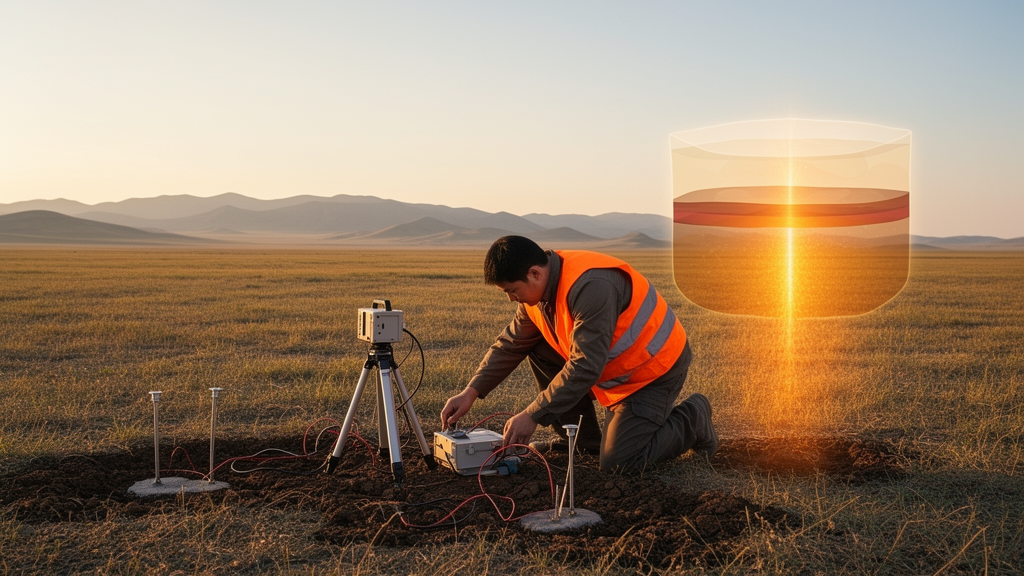
A dense array of 107 magnetotelluric sites across the northern Songliao Basin has yielded a three-dimensional resistivity model that traces the basin’s geothermal system from shallow sediments down to the upper mantle. The survey, described in an open-access study published in Geothermal Energy on 14 October 2026, was designed to investigate the deep thermal driving mechanisms and heat transfer processes in a basin influenced by the superposition of multiple structural systems within the eastern Central Asian Orogenic Belt. The researchers constructed their model using a nonlinear conjugate gradient inversion algorithm.
The model distinguishes several depth-dependent electrical structures. High-conductivity anomalies of roughly 5 ohm-meters in the shallow sedimentary layers are interpreted as the geothermal caprock and shallow reservoirs, the insulating and storage layers closest to the surface. Beneath them, high-resistivity bodies of about 1000 ohm-meters at depths near 5 kilometers are inferred to represent the crystalline basement, which the authors suggest may act as a deep geothermal reservoir. These contrasting layers form the basic architecture on which the basin’s heat is captured and stored.
At greater depths, the imaging reveals block-like conductive anomalies of approximately 5 ohm-meters in the lower crust and upper mantle. The study interprets these as two heat sources, likely associated with mantle upwelling and deep crustal magmatic activity. Vertically distributed conductive zones of similar conductivity in the upper crust delineate major fault systems, which the researchers identify as pathways along which fluids and heat migrate upward from the deep sources toward the reservoirs above.
By comparing the spatial configuration of heat sources and reservoirs, the team identified four types of heat transfer models across the basin. The central downwarp stands out as the most energetically charged zone: it is characterized by a dual-reservoir and multi-source configuration and corresponds to the strongest heat flow observed in the survey area. This linkage between structural setting and thermal output offers a concrete example of how basin geometry controls where geothermal potential concentrates.
A key comparative finding concerns temperature control. Comparison between heat flow and formation temperatures indicates that deep thermal reservoirs exert a stronger control on the subsurface temperature distribution than shallow reservoirs do. In practical terms, the depth and connectivity of the deep heat sources, rather than the shallow storage layers alone, appear to govern how hot the basin’s subsurface becomes. The authors state that these findings provide new insights into the geothermal system architecture of the Songliao Basin and offer a framework for understanding heat transfer processes in similar sedimentary basins. As with any resistivity-based interpretation, the identification of heat sources and reservoirs rests on inferred electrical anomalies rather than direct sampling, and the study is presented as an early-access, peer-reviewed accepted article whose version of record may undergo further edits.
Subject of Research: Deep geothermal system structure and heat transfer in the northern Songliao Basin imaged with magnetotellurics
Article Title: Deep control factors of geothermal fields in the northern Songliao Basin based on magnetotelluric survey
Article References: Niu, P., Han, J., Hou, H., Jia, X., Li, Z., Liu, L., Xin, Z., & Wu, Y. (2026). Deep control factors of geothermal fields in the northern Songliao Basin based on magnetotelluric survey. Geothermal Energy. https://doi.org/10.1186/s40517-026-00411-7
Image Credits: AI Generated
DOI: 10.1186/s40517-026-00411-7
Keywords: Songliao Basin, geothermal energy, magnetotelluric survey, resistivity model, heat sources, crystalline basement, fault systems, heat transfer, mantle upwelling, sedimentary basin, Deep, control
News Source: Violet Maxwell. (October 28, 2026). Magnetotelluric Survey Maps Deep Heat Sources Beneath the Northern Songliao Basin. Scienmag.