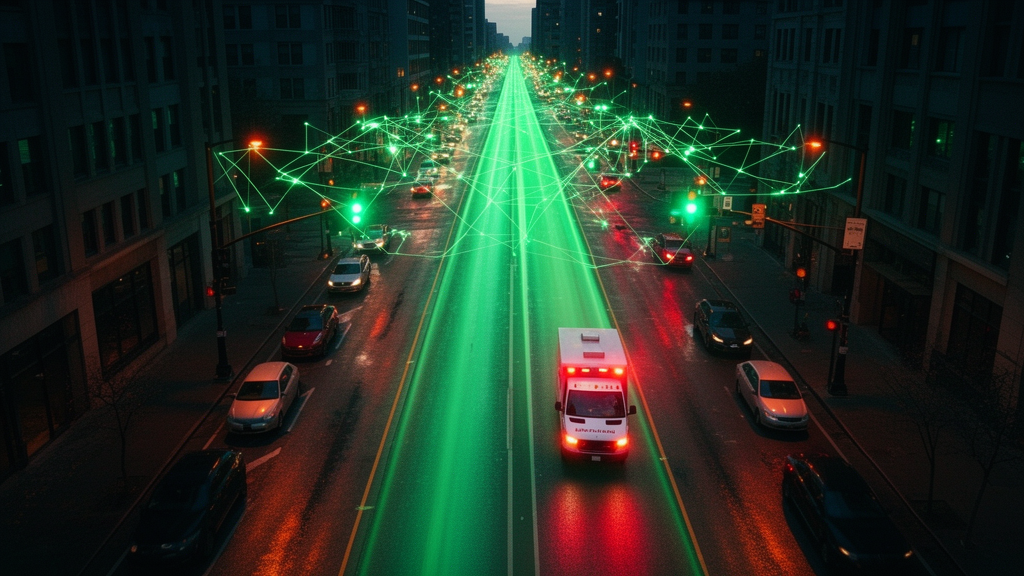
For a patient in cardiac arrest, every minute stuck at a red light matters: survival probability drops by roughly 7 to 10 percent for each minute that passes without intervention. For acute stroke, every 30 minutes of delay reduces the chance of functional independence by about 20 percent. Yet ambulances in congested cities still lose critical time at signalised intersections, because most existing priority systems either cannot talk to the traffic lights at all or demand expensive hardware on every vehicle and at every junction.
The framework, called the Integrated Smart Traffic and Emergency Communication System (ISTECS), is described in a study published on 26 October 2026 in Discover Internet of Things by J. Nikitha, A. Parkavi and M. N. Pushpalatha. It combines four subsystems: a multimodal deep learning detector, a Raspberry Pi-based signal controller, a three-role mobile coordination application, and an experimental in-ambulance patient monitoring module. The authors position the work as an engineering demonstration evaluated under controlled laboratory and simulation conditions, with live urban field deployment named as the primary next step.
The detection layer is the statistical core of the system. A YOLOv11-Small visual detector processes video frames from roadside traffic cameras while a convolutional neural network classifies three-second audio segments as siren or urban noise. A confidence-based adaptive fusion algorithm then merges the two outputs using a weighted score whose weights shift with conditions: equal weighting in standard daytime settings, more reliance on audio at night or in low visibility, and more reliance on vision when ambient noise is high. On an independent held-out validation set of 1,080 images, the fused system reached 98.4 percent accuracy with a 95 percent confidence interval of 97.7 to 98.9 percent, a 97.8 percent F1-score, and an inference latency of 21 milliseconds.
Those numbers were earned against stiff competition. All candidate models were trained on the same data split under identical augmentation, with three independent runs per model using different random seeds; variance stayed below 0.2 percentage points. The fusion approach beat a retrained YOLOv8 baseline by 4.2 percentage points and the best prior fixed-weight multimodal system by 2.3 percentage points, margins the authors say exceed the statistical margin of error. Notably, the transformer-based RT-DETR detector achieved comparable accuracy of 95.2 percent but needed 108 milliseconds per inference, roughly six times slower than YOLOv11-S, which the authors argue rules it out for real-time edge deployment at intersections.
Once detection is confirmed, the IoT layer takes over. A Raspberry Pi 4 Model B at each monitored intersection subscribes to MQTT message topics and, on receiving a trigger, actuates a four-channel relay wired to the traffic signal controller, holding the approach lane green until a reset command or timeout arrives. Measured over 50 trials, the detection pipeline needed 55 to 90 milliseconds to dispatch an MQTT command, and the relay actuation added another 120 to 180 milliseconds, for a total camera-to-green-signal latency of 175 to 270 milliseconds. That sits within the 200 to 500 millisecond phase transition window of standard adaptive traffic controllers. Because the Raspberry Pi acts locally, the relay still works if the cloud connection drops, a resilience property the authors contrast with cloud-dependent vehicle-to-infrastructure systems.
The third subsystem is a cross-platform mobile application, built in React Native, that links ambulance crews, police officers and hospital staff through separate dashboards secured with role-based access control. Ambulance staff can send a two-tap emergency SOS with GPS coordinates and patient information, police can issue a one-tap Clear Path override that actuates the same Raspberry Pi relays, and hospitals receive structured patient alerts and telemedicine sessions. The police override is designed as a permanent human-in-the-loop fallback: if cameras fail, audio fails, or the AI layer errs, a human operator can still clear the intersection through the local network path.
The fourth component is more cautious in its claims. A closed-circuit camera in the ambulance patient compartment streams video to a YOLOv11 model configured to flag four conditions: visible bleeding, loss of consciousness, a hand-on-chest posture suggesting a possible cardiac event, and slumping or convulsive posture. Confirmed detections push a structured alert to the hospital dashboard so staff can prepare before arrival. The authors are explicit that this module is a proof of concept only: no clinically labelled dataset was used, no precision or recall metrics are reported, and quantitative validation awaits an ethically approved clinical dataset, since filming patients in transit raises consent and regulatory questions that must be resolved with healthcare authorities first.
The training data came entirely from public sources plus ambient recordings. The visual set comprised 5,400 images, half ambulances and half not, drawn from four Creative Commons licensed Roboflow repositories, deduplicated by hashing and split 80:20. The audio set contained 3,900 three-second clips, half siren recordings from Kaggle databases and half urban noise including around 400 clips recorded on public roads in Bengaluru with a calibrated smartphone microphone. An ablation study attributed 0.8 percentage points of the accuracy gain to the adaptive weighting scheme and 2.6 percentage points to multimodal fusion over vision alone. Across nine test combinations of three traffic densities and three illumination levels, fusion accuracy never fell below 97.1 percent, and adaptive weighting recovered 2.8 percentage points in the hardest case of dense traffic and low light.
The authors are candid about limits. The evaluation took place in a controlled laboratory environment with a three-phase signal controller, not in live traffic; performance in dense fog, heavy rain or construction noise has not been tested; the mobile application assumes stable 4G or 5G connectivity; and city-scale scalability, which would require a distributed MQTT broker cluster, containerised backend scaling and a migration from SQLite to a distributed database, remains future work. The false positive rate on the validation set was kept below 2 percent by threshold calibration.
Subject of Research: An AI-driven IoT framework for ambulance detection and traffic signal preemption in smart cities
Article Title: An AI-driven IoT-enabled intelligent transportation framework for emergency response in smart cities
Article References: Nikith, J., Parkavi, A., & Pushpalatha, M. N. (2026). An AI-driven IoT-enabled intelligent transportation framework for emergency response in smart cities. Discover Internet of Things, 6(1), Article 234. https://doi.org/10.1007/s43926-026-00512-6
Image Credits: AI Generated
DOI: 10.1007/s43926-026-00512-6
Keywords: intelligent transportation systems, ambulance detection, deep learning, YOLOv11, IoT, traffic signal preemption, Raspberry Pi, multimodal fusion, emergency medical services, smart cities, edge computing, siren classification
News Source: Blake Davidson. (October 28, 2026). AI traffic system clears the road for ambulances in under 300 milliseconds. Scienmag.