For patients with liver cancer, one of the most frustrating paradoxes of modern oncology is that the very treatment designed to save them can also poison them. Intra-arterial chemotherapy, in which powerful drugs such as doxorubicin are threaded directly through a catheter into the artery feeding a liver tumor, is meant to concentrate the poison where it is needed. Yet in practice, between 50 and 75 percent of the drug escapes past the tumor’s capillary bed and spills into the hepatic veins, entering the general circulation. That systemic leakage causes severe side effects, including irreversible heart failure, and it caps the dose that physicians can safely deliver. A new computational study published in Bioengineering & Translational Medicine offers a detailed engineering roadmap for a device that could catch those runaway drugs before they ever reach the heart.
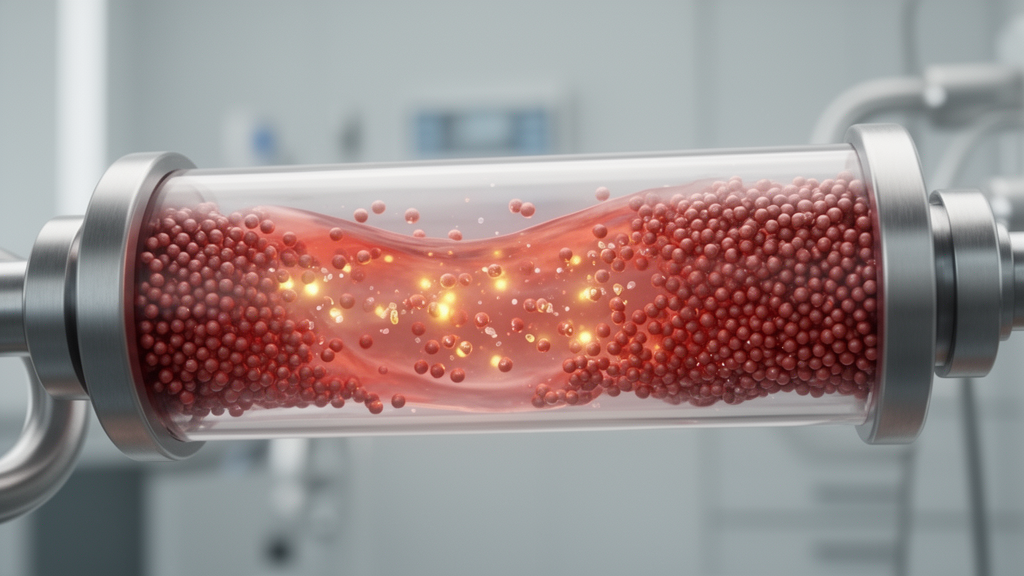
The concept, developed by researchers including Won-Seok Heo, Steven W. Hetts and Vitaliy L. Rayz as part of the broader Chemofilter Consortium effort, is deceptively simple: place a temporary filter inside the vein draining the liver, let it capture the excess chemotherapy bound to magnetic nanoparticles, and then pull the whole device back out through a sheath in the jugular vein. The drug-laden particles are trapped on the filter and removed with it, preventing re-elution into the bloodstream. What has been missing until now is a principled way to decide how such a filter should be built. The new work supplies that missing piece by combining fluid dynamics simulations, magnetic field modeling and dimensionless scaling laws into a predictive design framework.
The heart of the approach is a tug-of-war between two forces. Drug-carrying particles, which range from roughly 10 nanometers to 100 micrometers in the models, are pulled toward the magnets by a magnetophoretic force that scales with the particle’s volume and the magnetic field gradient. At the same time, viscous drag from the flowing blood pushes them along, and that drag scales only linearly with particle diameter. Because the magnetic force grows faster with size than the drag does, the ratio of the two forces scales with the square of the particle diameter. This single insight, formalized in a dimensionless parameter called MH, the ratio of magnetophoretic force to hydrodynamic drag, turns out to govern nearly everything about how well a filter performs.
By applying dimensional analysis, the team collapsed fifteen physical variables, including vessel and magnet geometry, blood viscosity, flow velocity, magnetic flux density and particle properties, into just five independent dimensionless numbers. Further analysis showed that several of them, such as the density ratio, the vessel Reynolds number and the particle inertia ratio, have negligible influence on capture efficiency under clinically relevant conditions. What remains is a compact relationship in which capture efficiency depends on the force ratio MH, the magnet-to-vessel cross-sectional area ratio, the magnet aspect ratio, the number of magnets and the number of filter stages. The resulting characteristic curves fit the simulation data with coefficients of determination as high as 0.987, meaning engineers can now predict how a filter will behave before ever building one.
The simulations also revealed striking differences between device architectures. Cylindrical magnets can be magnetized along their axis or across their diameter, and they can be deployed in series along the vessel centerline, in parallel near the vessel wall, or in staggered multi-stage arrays. Series filters, acting like a single elongated magnet, captured only about 3 to 6 percent of passing particles. Parallel arrangements, in which three diametrically magnetized magnets sit 120 degrees apart near the wall, performed roughly 2.7 times better, reaching capture efficiencies around 13 percent. The reason is geometric: magnets near the wall sit in the slow-moving boundary layer where drag is weak, and their diametrical magnetization spreads the magnetic field across a wider swath of the vessel cross-section, pulling particles in from regions a centerline magnet cannot reach.
Stacking these parallel stages into multi-stage filters produced even better results. Two-stage filters captured roughly 26 to 28 percent of particles, three-stage designs reached 33 to 35 percent, and four-stage filters approached 40 to 42 percent in the baseline hepatic vein configuration. Crucially, the team used the Maxwell stress tensor to calculate the magnetic forces that neighboring magnets exert on one another, a critical safety consideration since a filter whose magnets snap together inside a vein would be catastrophic. They found that connecting stages with the same magnetization direction cancels out inter-magnet interactions, cutting the force on the device to as little as 46 millinewtons, while alternating connections drove forces above 280 millinewtons without improving capture. The safest and most effective design, vertical type (i) with same-direction connections, was narrowed down systematically from dozens of candidate configurations.
One of the study’s most counterintuitive findings is that capture efficiency has nothing to do with the force between the magnets themselves. Two three-stage designs with nearly identical capture rates of about 34.5 percent differed in inter-magnet force by a factor of six. What actually determines capture is the local product of the magnetic flux density and its gradient, the quantity that drives the magnetophoretic force on each individual particle. Filters with stronger localized field gradients, quantified through the vector field B·∇B, consistently outperformed those with stronger bulk fields. This means designers can optimize particle capture and structural stability independently, a decoupling that dramatically simplifies the engineering problem.
The predictive curves also expose the clinical challenge clearly. In the hepatic vein, where flow averages about 5 centimeters per second, the force ratio MH can reach 1.8, and a four-stage filter is predicted to capture up to 80 percent of drug-loaded particles. In the much larger and faster inferior vena cava, where flow runs 6 to 9 times quicker and the vessel is at least 1.5 times wider, MH drops to around 0.2 and capture falls to roughly 8 percent for a single-stage device and 26 percent even for four stages. The lesson is that filtration should happen in the hepatic vein, close to the source of the leaking drug, where the physics is most favorable. The scaling exponent of roughly 0.52 to 0.55 on MH also implies that capture efficiency scales approximately linearly with particle diameter, which is why the team systematically tested particles from 0.5 to 2 micrometers, large enough to steer magnetically but small enough to avoid clogging capillaries.
The computational results were validated against previously published in vitro experiments, which showed the same trends, including a 14 to 17 percent improvement in capture for diametrically magnetized series filters compared with axially magnetized ones. The model does have simplifications: blood was treated as a Newtonian fluid in a rigid vessel with steady flow, and red blood cells, platelets and particle aggregation were not explicitly modeled. The authors argue these omissions affect absolute numbers more than the underlying scaling relationships, since flow unsteadiness modulates the force ratio without changing the fundamental physics. They also note that because the filter is deployed only for the duration of drug infusion and then removed, and because patients receive anticoagulants during the procedure, thrombosis risk can be managed with established clinical practices and antithrombogenic coatings.
The broader significance of this work lies in what it replaces. Developing an intravascular device traditionally means iterating through expensive animal experiments, each one testing a single configuration. A validated scaling framework flips that process: researchers can now screen dozens of magnet arrangements, sizes and stage counts computationally, identify the handful of designs worth testing, and reserve animal studies for final validation. If the approach survives large-animal testing and eventual clinical trials, it could allow oncologists to escalate chemotherapy doses well beyond current safety limits, shortening treatment courses and improving outcomes for hepatocellular carcinoma patients, for whom liver cancer remains the third leading cause of cancer death in developed nations. A tiny magnetic sieve, guided by nineteenth-century dimensional analysis and twenty-first-century multiphysics simulation, may soon stand guard between a tumor and the rest of the body.
Subject of Research: Endovascular magnetic filtration devices for capturing excess chemotherapeutic drugs from hepatic venous blood flow
Article Title: Endovascular magnetic filters for removing excess chemotherapeutic drugs from blood flow using dimensionless scaling laws
Article References: Heo, W.-S., Hetts, S. W., & Rayz, V. L. (2026). Endovascular magnetic filters for removing excess chemotherapeutic drugs from blood flow using dimensionless scaling laws. Bioengineering & Translational Medicine, Article e70151. https://doi.org/10.1002/btm2.70151
Image Credits: AI Generated
DOI: 10.1002/btm2.70151
Keywords: magnetic filtration, chemotherapy, hepatocellular carcinoma, doxorubicin, magnetophoresis, dimensionless scaling laws, endovascular device, drug capture efficiency, SPIONs, hemodynamics, intra-arterial chemotherapy, computational modeling
News Source: Nathaniel Bowman. (October 9, 2026). Magnetic filters could scrub leftover chemotherapy from blood before it harms the body. Scienmag.