• HOME
  • NEWS
  • EXPLORE
    • CAREER
      • Companies
      • Jobs
    • EVENTS
    • iGEM
      • News
      • Team
    • PHOTOS
    • VIDEO
    • WIKI
  • BLOG
  • COMMUNITY
    • FACEBOOK
    • INSTAGRAM
    • TWITTER
Sunday, May 10, 2026
BIOENGINEER.ORG
No Result
View All Result
  • Login
  • HOME
  • NEWS
  • EXPLORE
    • CAREER
      • Companies
      • Jobs
        • Lecturer
        • PhD Studentship
        • Postdoc
        • Research Assistant
    • EVENTS
    • iGEM
      • News
      • Team
    • PHOTOS
    • VIDEO
    • WIKI
  • BLOG
  • COMMUNITY
    • FACEBOOK
    • INSTAGRAM
    • TWITTER
  • HOME
  • NEWS
  • EXPLORE
    • CAREER
      • Companies
      • Jobs
        • Lecturer
        • PhD Studentship
        • Postdoc
        • Research Assistant
    • EVENTS
    • iGEM
      • News
      • Team
    • PHOTOS
    • VIDEO
    • WIKI
  • BLOG
  • COMMUNITY
    • FACEBOOK
    • INSTAGRAM
    • TWITTER
No Result
View All Result
Bioengineer.org
No Result
View All Result
Home NEWS Science News Chemistry

Magma is the key to the moon’s makeup

Bioengineer by Bioengineer
April 29, 2019
in Chemistry
Reading Time: 2 mins read
1
IMAGE
Share on FacebookShare on TwitterShare on LinkedinShare on RedditShare on Telegram

IMAGE

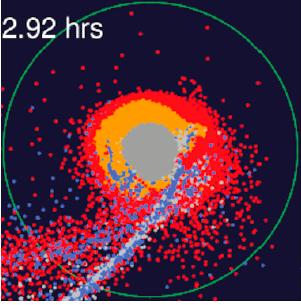
Credit: Hosono, Karato, Makino & Saitoh

New Haven, Conn. – For more than a century, scientists have squabbled over how the Earth’s moon formed. But researchers at Yale and in Japan say they may have the answer.

Many theorists believe a Mars-sized object slammed into the early Earth, and material dislodged from that collision formed the basis of the moon. When this idea was tested in computer simulations, it turned out that the moon would be made primarily from the impacting object. Yet the opposite is true; we know from analyzing rocks brought back from Apollo missions that the moon consists mainly of material from Earth.

A new study published April 29 in Nature Geoscience, co-authored by Yale geophysicist Shun-ichiro Karato, offers an explanation.

The key, Karato says, is that the early, proto-Earth — about 50 million years after the formation of the Sun — was covered by a sea of hot magma, while the impacting object was likely made of solid material. Karato and his collaborators set out to test a new model, based on the collision of a proto-Earth covered with an ocean of magma and a solid impacting object.

The model showed that after the collision, the magma is heated much more than solids from the impacting object. The magma then expands in volume and goes into orbit to form the moon, the researchers say. This explains why there is much more Earth material in the moon’s makeup. Previous models did not account for the different degree of heating between the proto-Earth silicate and the impactor.

“In our model, about 80% of the moon is made of proto-Earth materials,” said Karato, who has conducted extensive research on the chemical properties of proto-Earth magma. “In most of the previous models, about 80% of the moon is made of the impactor. This is a big difference.”

Karato said the new model confirms previous theories about how the moon formed, without the need to propose unconventional collision conditions — something theorists have had to do until now.

For the study, Karato led the research into the compression of molten silicate. A group from the Tokyo Institute of Technology and the RIKEN Center for Computational Science developed a computational model to predict how material from the collision became the moon.

###

The first author of the study is Natsuki Hosono of RIKEN. Additional co-authors are Junichiro Makino and Takayuki Saitoh.

Media Contact
Jim Shelton
[email protected]
Tags: Geology/SoilGeophysicsGeophysics/GravityPlanets/MoonsSpace/Planetary Science
Share14Tweet8Share2ShareShareShare2

Related Posts

Miniature Sensor Uses Light to Detect Touch — Chemistry

Miniature Sensor Uses Light to Detect Touch

May 8, 2026
Iron Minerals Determine Whether Dissolved Organic Matter Fuels Microbes or Becomes Long-Term Carbon Storage — Chemistry

Iron Minerals Determine Whether Dissolved Organic Matter Fuels Microbes or Becomes Long-Term Carbon Storage

May 8, 2026

Kate Evans Appointed Associate Lab Director for Biological and Environmental Systems Science at ORNL

May 8, 2026

Advancing Multiscale Modeling and Overcoming Operational Challenges in Autothermal COâ‚‚-to-Methanol Reactors

May 8, 2026
Please login to join discussion

POPULAR NEWS

  • Research Indicates Potential Connection Between Prenatal Medication Exposure and Elevated Autism Risk

    840 shares
    Share 336 Tweet 210
  • New Study Reveals Plants Can Detect the Sound of Rain

    727 shares
    Share 290 Tweet 181
  • Scientists Investigate Possible Connection Between COVID-19 and Increased Lung Cancer Risk

    68 shares
    Share 27 Tweet 17
  • Salmonella Haem Blocks Macrophages, Boosts Infection

    61 shares
    Share 24 Tweet 15

About

We bring you the latest biotechnology news from best research centers and universities around the world. Check our website.

Follow us

Recent News

Evaluating Digoxin Use in Patients with Symptomatic Rheumatic Heart Disease

Evaluating the Effectiveness and Safety of Digitalis Glycosides in Treating Heart Failure

Urdu Fall Risk Questionnaire Adapted for Elderly

Subscribe to Blog via Email

Enter your email address to subscribe to this blog and receive notifications of new posts by email.

Join 82 other subscribers
  • Contact Us

Bioengineer.org © Copyright 2023 All Rights Reserved.

Welcome Back!

Login to your account below

Forgotten Password?

Retrieve your password

Please enter your username or email address to reset your password.

Log In
No Result
View All Result
  • Homepages
    • Home Page 1
    • Home Page 2
  • News
  • National
  • Business
  • Health
  • Lifestyle
  • Science

Bioengineer.org © Copyright 2023 All Rights Reserved.