• HOME
  • NEWS
  • EXPLORE
    • CAREER
      • Companies
      • Jobs
    • EVENTS
    • iGEM
      • News
      • Team
    • PHOTOS
    • VIDEO
    • WIKI
  • BLOG
  • COMMUNITY
    • FACEBOOK
    • INSTAGRAM
    • TWITTER
Monday, August 24, 2026
BIOENGINEER.ORG
No Result
View All Result
  • Login
  • HOME
  • NEWS
  • EXPLORE
    • CAREER
      • Companies
      • Jobs
        • Lecturer
        • PhD Studentship
        • Postdoc
        • Research Assistant
    • EVENTS
    • iGEM
      • News
      • Team
    • PHOTOS
    • VIDEO
    • WIKI
  • BLOG
  • COMMUNITY
    • FACEBOOK
    • INSTAGRAM
    • TWITTER
  • HOME
  • NEWS
  • EXPLORE
    • CAREER
      • Companies
      • Jobs
        • Lecturer
        • PhD Studentship
        • Postdoc
        • Research Assistant
    • EVENTS
    • iGEM
      • News
      • Team
    • PHOTOS
    • VIDEO
    • WIKI
  • BLOG
  • COMMUNITY
    • FACEBOOK
    • INSTAGRAM
    • TWITTER
No Result
View All Result
Bioengineer.org
No Result
View All Result
Home NEWS Science News Chemistry

Macroscopic quantum interference in an ultra-pure metal

Bioengineer by Bioengineer
June 26, 2020
in Chemistry
Reading Time: 2 mins read
0
IMAGE
Share on FacebookShare on TwitterShare on LinkedinShare on RedditShare on Telegram

IMAGE

Credit: © MPI CPfS

That visible light holds the character of a wave can be demonstrated in simple optics experiments, or directly witnessed when rainbows appear in the sky. Although the subtle laws of quantum mechanics, that is, wave mechanics, ultimately govern all the processes of electron transportelectrons in solids, their wave-like nature of the electrons is not often apparent to the casual observer. A classical picture of electrons as solid particles goes surprisingly far in explaining electric currents in metals. As high school students see in experiments with water waves, and we observe and use with light waves in many optical devices, interference is a fundamental property associated with wave-like behavior. Indeed, Davisson and Germer’s famous observation of interference in experiments with dilute beams of electrons, nearly a century ago, gave key experimental support to the correctness of the then-new quantum theory.

In experiments on solids, however, signatures of quantum interference are rare and hard to observe. This is essentially because there are so many electrons, and so many ways in which they can be ‘scrambled up’, that most interference effects are invisible to experiments that probe distances of more than a few atomic spacings.

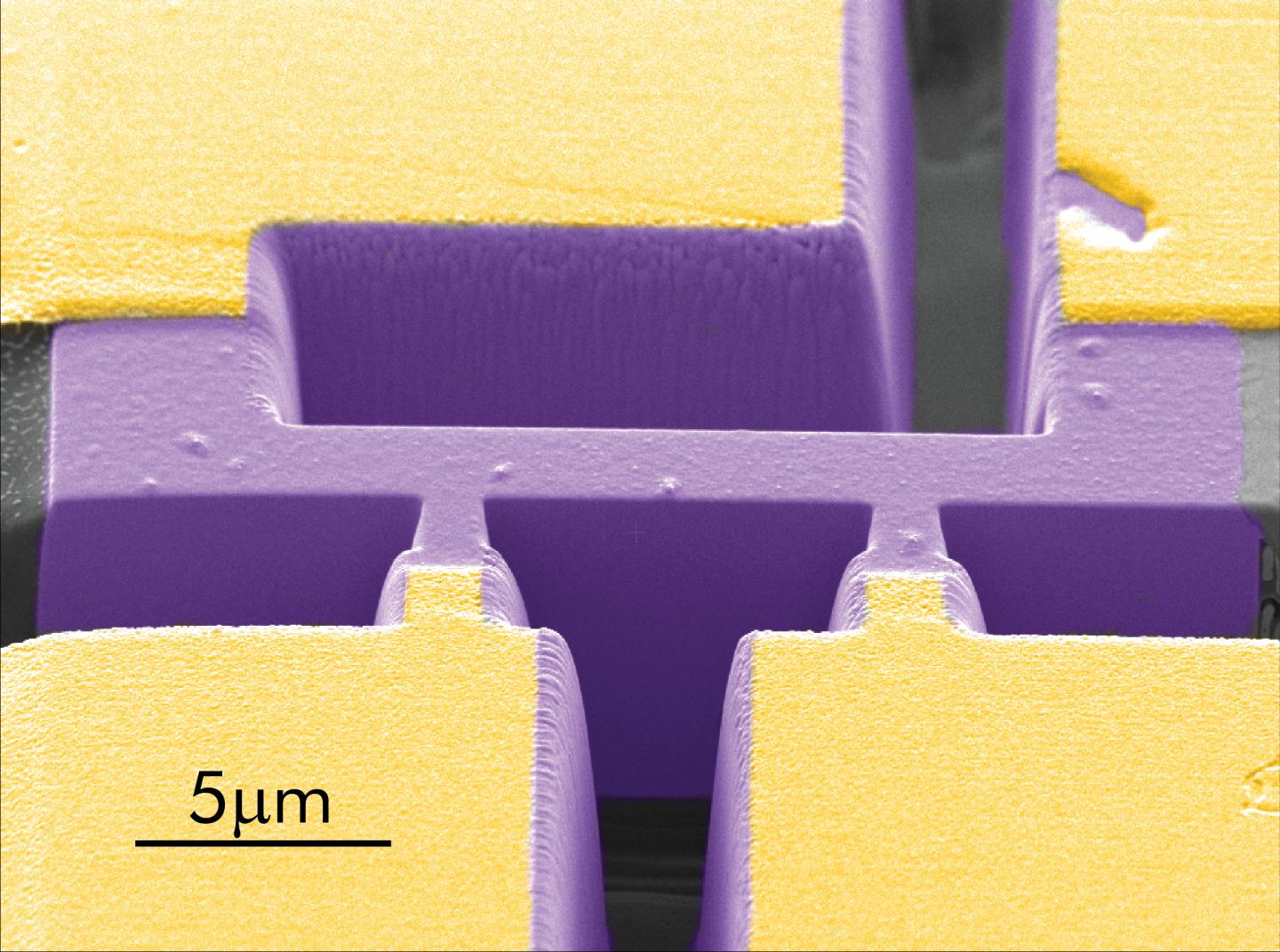
One of the themes of research in the Physics of Quantum Materials department is the study of exotic strange layered metals from a structural class with the equally strange name ‘delafossites’, stemming from the famous French crystallographer Gabriel Delafosse. They are notable because they conduct electricity incredibly well. Indeed, at room temperature one of them, PtCoO2, is the best electrical conductor ever discovered. As part of our research on the delafossites, we were studying how the conduction perpendicular to the layers depends on magnetic field, in crystals that had been sculpted into particular geometries using a focused ion beam (see Fig. 1). To our complete surprise, we observed strong oscillations in this conductivity, of a kind that are a signature of some kindsignaling of interference (see Fig. 2). After a long period of follow-up experiments at this institute and in the new group of our former colleagues Philip Moll and Carsten Putzke, now at EPFL in Lausanne, we collaborated with theorists Takashi Oka and Roderich Moessner in our neighbour institute in Dresden and Ady Stern from the Weizmann Institute in Israel to propose an explanation for what is going on. Remarkably, it requires a form of quantum coherence over macroscopic distances of up to 50000 atomic lattice spacings. It is only observable because of the remarkable purity of the delafossites, whose origin we established in another set of experiments, also published recently. High quality materials continue to hold a wealth of surprises and delights for those who make and study them!

###

Media Contact
Carsten Putzke
[email protected]

Original Source

https://www.cpfs.mpg.de/3209163/20200611

Related Journal Article

http://dx.doi.org/10.1126/science.aay8413

Tags: Chemistry/Physics/Materials SciencesMaterials
Share12Tweet8Share2ShareShareShare2

Related Posts

Scientists Transform Plastic Bottles Into Cookies

Scientists Transform Plastic Bottles Into Cookies

August 24, 2026
KAIST discovers pathway to faster-charging, longer-lasting electric vehicle batteries

KAIST discovers pathway to faster-charging, longer-lasting electric vehicle batteries

August 24, 2026

Scientists uncover design rules for high-performance thermoelectric materials

August 22, 2026

Bringing Optical Fibre Materials to Photonic Chips

August 22, 2026
Please login to join discussion

POPULAR NEWS

  • How Plant-Specific and Conserved PAF1 Complex Mechanisms Respond to Replication Stress

    29 shares
    Share 12 Tweet 7
  • Experimental sheep infection reveals Crimean-Congo hemorrhagic fever virus spread and diagnostic clues

    29 shares
    Share 12 Tweet 7
  • Randomized Trial Tests Stochastic Vibration and Early Weight Gain in Opioid-Exposed Newborns

    29 shares
    Share 12 Tweet 7
  • China Study Ranks Indoor VOC Sources by Their Attributable Disease Burden

    29 shares
    Share 12 Tweet 7

About

BIOENGINEER.ORG

We bring you the latest biotechnology news from best research centers and universities around the world. Check our website.

Follow us

Recent News

How Plant-Specific and Conserved PAF1 Complex Mechanisms Respond to Replication Stress

Experimental sheep infection reveals Crimean-Congo hemorrhagic fever virus spread and diagnostic clues

Randomized Trial Tests Stochastic Vibration and Early Weight Gain in Opioid-Exposed Newborns

Subscribe to Blog via Email

Enter your email address to subscribe to this blog and receive notifications of new posts by email.

Join 85 other subscribers
  • Contact Us

Bioengineer.org © Copyright 2023 All Rights Reserved.

Welcome Back!

Login to your account below

Forgotten Password?

Retrieve your password

Please enter your username or email address to reset your password.

Log In
No Result
View All Result
  • Homepages
    • Home Page 1
    • Home Page 2
  • News
  • National
  • Business
  • Health
  • Lifestyle
  • Science

Bioengineer.org © Copyright 2023 All Rights Reserved.