Aging does not happen at the same pace for everyone. Two 80-year-olds can stand in the same clinic waiting room, yet one may climb stairs without hesitation while the other struggles to rise from a chair. For geriatricians, capturing that hidden variation has long been a central challenge, because the tools used to assess older patients tend to compress rich, multidimensional physical data into a handful of coarse scores. A new study published in BMC Geriatrics by Elodie Piche of Université Côte d’Azur and the Centre Hospitalier Universitaire de Nice, together with Frédéric Chorin, Lyne Daumas, Emeline Michel, Olivier Guerin, and Raphael Zory, offers a fresh answer. Instead of averaging performance into a single number, the researchers let an unsupervised machine learning algorithm sort 368 older adults into natural groups based on 23 different physical performance measures, and then asked whether those groups mapped onto clinically meaningful realities such as frailty, falls, and cognitive complaints.
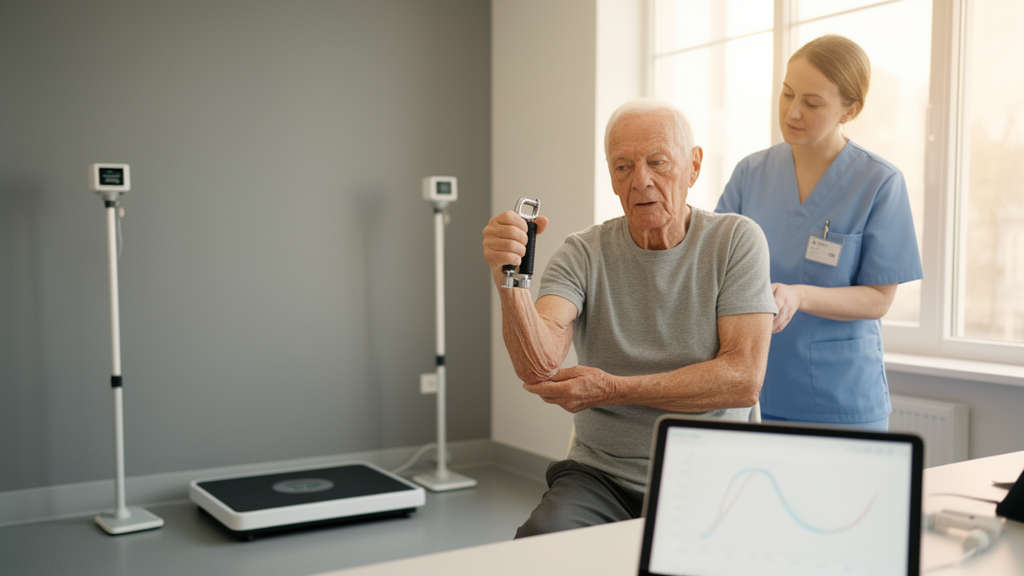
The study’s methodology is worth unpacking, because it represents a departure from the traditional hypothesis-driven approach to geriatric assessment. Rather than deciding in advance which variables matter most, the team fed 23 physical performance measures into a K-means clustering algorithm, a workhorse of unsupervised machine learning that partitions data points into groups by minimizing the distance between each point and the center of its assigned cluster. The measurements were anything but superficial. Gait was captured with the Optogait optical system, which tracks foot contact and stride timing with millisecond precision. Muscle force and power were quantified with a Biodex isokinetic dynamometer, which measures joint moments across angular velocities ranging from 30 to 180 degrees per second. Body composition was assessed bioelectrically with the QuadScan 4000, and grip strength was tested with a hand dynamometer. Balance was evaluated through unipodal stance tests on each leg, both with eyes open and eyes closed, and gait analysis included double support phases and sit-to-stand performance.
When the algorithm finished its work, three distinct clusters emerged, which the researchers labeled High Physical Performance, Moderate Physical Performance, and Low Physical Performance. This tripartite structure was not imposed by the investigators; it arose from the data itself, suggesting that the physical decline of aging may follow a small number of characteristic trajectories rather than a smooth, uniform gradient. The clusters differed significantly across most of the 23 measures, but the most discriminative features turned out to be muscular power and joint moments, the isokinetic measures of how forcefully and rapidly the muscles can move a joint. Velocity-based measures such as maximal velocity and optimal velocity, by contrast, contributed little to separating the groups, a finding that carries practical implications for which tests clinicians should prioritize.
The clinical validation is where the study becomes genuinely striking. The researchers cross-referenced the clusters against a battery of established geriatric outcomes: Fried’s frailty phenotype, which classifies patients as non-frail, pre-frail, or frail based on criteria such as weight loss, exhaustion, weakness, slowness, and low activity; self-reported falls; memory complaints; sex; and living situation. The Low Physical Performance cluster contained significantly more frail individuals, more people who had fallen, and more patients living alone, a combination that paints a coherent picture of vulnerability. At the opposite end, the High Physical Performance cluster was composed predominantly of younger, non-frail men. The Moderate cluster occupied the expected middle ground. In other words, a purely data-driven sorting of movement measurements reproduced the clinical categories that geriatricians care about, without ever being told to look for them.
One result, however, complicates the picture in an instructive way. Memory complaints did not differ significantly across the three clusters, despite the strong conceptual links between physical and cognitive decline in aging research. The study’s title promised insight into cognitive health, and the honest answer is that physical performance clustering, at least in this cohort, did not stratify patients by subjective memory problems. This null finding matters. It suggests that while the body’s mechanical decline and the brain’s decline are correlated at the population level, the specific physical signatures captured here do not serve as a proxy for perceived cognitive impairment. Clinicians hoping to screen for cognitive concerns through gait and strength testing alone will need to look elsewhere, or at least supplement such tests with dedicated cognitive assessment.
The emphasis on muscular power rather than raw strength connects the study to an emerging concept in gerontology that the authors explicitly invoke: powerpenia. Just as sarcopenia describes the age-related loss of muscle mass, powerpenia describes the loss of the ability to generate force quickly. The distinction is not academic hair-splitting. Lifting a grocery bag slowly and lifting it quickly require similar strength, but rising from a chair, catching oneself mid-stumble, or stepping onto a curb all depend on rapid force production. Power declines faster with age than maximal strength, and the finding that maximal power and joint moments were the most discriminative features in the clustering analysis reinforces the idea that the speed of force generation, not just its magnitude, is what separates resilient older adults from vulnerable ones. Isokinetic dynamometry, which measures torque at controlled angular velocities, provides a laboratory-grade window into this quality.
The technical details of the isokinetic protocol deserve attention because they hint at why velocity-based power measures outperformed pure velocity measures in the clustering. The dynamometer recorded maximal joint moments at six angular velocities, from a slow 30 degrees per second to a fast 180 degrees per second, alongside maximal velocity and optimal velocity, the velocity at which power output peaks. The slow-velocity moments reflect a muscle’s fundamental force capacity, while the fast-velocity moments probe how well that capacity survives high-speed demands. That the clustering algorithm leaned heavily on these moment measures suggests that the shape of the force-velocity relationship, rather than any single point on it, encodes the functional status of the neuromuscular system. This aligns with decades of exercise physiology showing that aging preferentially depletes fast-twitch motor units, eroding high-speed performance first.
What makes the study methodologically notable is its use of unsupervised rather than supervised learning. A supervised classifier would have been trained on labels such as frail or non-frail, effectively encoding the existing diagnostic framework and inheriting its blind spots. K-means, by contrast, knows nothing about frailty, falls, or living situation; it simply finds structure in the measurements. The fact that this blind structure aligned with clinical outcomes is a form of independent validation, and it raises the possibility that the clusters capture something real about physiological aging that existing categorical diagnoses only approximate. It also opens the door to identifying subgroups that current frameworks miss, patients who are not yet frail by Fried’s criteria but whose multidimensional performance profile already resembles those who are.
The practical implications extend to prevention. Falls are the leading cause of injury-related death in adults over 65, and frailty is associated with hospitalization, dependency, and mortality, yet both are notoriously difficult to detect before they manifest. A clustering-based assessment, if validated prospectively, could flag at-risk individuals earlier and more precisely than single-threshold tests, and it could tailor interventions accordingly: power-focused resistance training for those whose profiles are dominated by powerpenia, balance work for those with unipodal stance deficits, or comprehensive geriatric evaluation for those in the low-performance cluster who also live alone. The study was supported by the French National Research Agency under the France 2030 program, approved by the Comité de Protection des Personnes Sud Méditerranée, and registered as trial NCT02690402, reflecting the rigor of a prospective clinical design.
Caveats remain. The cross-sectional design shows association, not prediction; the clusters describe the present state of the cohort, and longitudinal follow-up will be needed to show that cluster membership forecasts future falls, frailty progression, or cognitive decline. The predominance of men in the high-performance cluster also raises questions about sex-specific patterns that larger and more balanced cohorts will need to resolve. And K-means, while robust, requires choices about the number of clusters and the scaling of variables, choices that can shape the output. Still, the core message stands: the way an older adult moves, measured across 23 dimensions and sorted without human preconceptions, tells a clinically coherent story about who is thriving and who is at risk. As populations age worldwide, turning that story into routine, data-rich assessment may become one of geriatric medicine’s most valuable tools.
Subject of Research: Physical performance clustering to identify frailty, fall risk, and cognitive health profiles in older adults
Article Title: Physical performance clustering as a marker of frailty, fall risk, and cognitive health in older adults
Article References: Piche, E., Chorin, F., Daumas, L., Michel, E., Guerin, O., & Zory, R. (2026). Physical performance clustering as a marker of frailty, fall risk, and cognitive health in older adults. BMC Geriatrics. https://doi.org/10.1186/s12877-026-08383-w
Image Credits: AI Generated
DOI: 10.1186/s12877-026-08383-w
Keywords: frailty, muscular power, geriatric assessment, clustering analysis, fall risk, K-means, isokinetic dynamometry, sarcopenia, powerpenia, gait analysis, older adults, machine learning
News Source: Beatrice Stafford. (October 8, 2026). Machine Learning Reveals How Muscle Power Predicts Frailty and Falls in Aging. Scienmag.