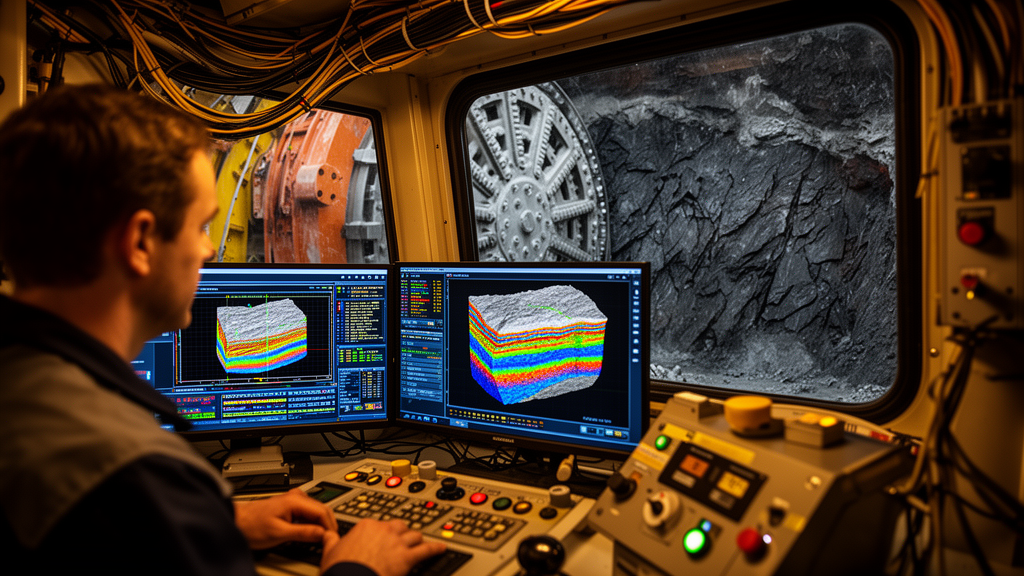
Engineers digging China’s first large-scale underground laboratory for high-level radioactive waste disposal have taught a machine learning model to read a tunnel boring machine’s own sensor stream and work out what kind of rock it is grinding through. In a study published in GeoEnergy Communications, researchers report that a light gradient boosting machine, one of four ensemble algorithms they tested, classified the rock mass along the Beishan underground research laboratory’s spiral ramp with an accuracy of 94.468 percent and a macro-averaged F1-score of 92.756 percent on an independent test set. Because the model’s decisions can be traced with SHAP analysis, the team could show exactly which machine behaviors, from thrust demand to gripper pressure, carried the geological signal.
The Beishan URL, located in the Xinchang area of Jiuquan City in Gansu Province, is China’s first underground research facility dedicated to studying the geological disposal of high-level radioactive waste. Its spiral ramp stretches roughly 7.47 kilometers, providing the main access to experimental levels at depths of 280 and 560 meters. The first 494.2 meters were blasted, but the remaining 6.98 kilometers were bored by an open-type hard rock tunnel boring machine called Beishan No. 1, built by China Railway Construction Heavy Industry Corporation. The machine’s cutterhead measures 7.03 meters across and carries 55 disc cutters, and it can push with up to 23,500 kilonewtons of force while spinning at up to 10 revolutions per minute.
The ground itself is demanding. The tunnel runs through granodiorite whose intact rock exceeds 170 megapascals in average uniaxial compressive strength, with peak values up to 235 megapascals, and whose Cerchar abrasivity index between 4.3 and 5.3 marks it as highly abrasive. Rock quality designation values top 90 for about 86 percent of the tunnel length, indicating generally intact rock, though local fault zones and fracture-rich sections interrupt the picture, and groundwater stored in fractures produces conditions ranging from dry to dripping. Maximum in situ stress reaches roughly 20 megapascals. Geologists classified the rock mass along the alignment into four classes following the Chinese standard GB/T 50218-2014, with Class II dominating at 65.84 percent of tunnel length, Class I at 21.69 percent, Class III at 11.99 percent, and Class IV at a mere 0.48 percent.
Raw TBM monitoring data, however, are messy. Records shut down for cutter replacement, machine adjustment, steering correction, and maintenance, and transient disturbances blur the connection between sensor readings and geology. The researchers therefore built a preprocessing pipeline that first discards any data point where total thrust, cutterhead torque, cutterhead rotation speed, or penetration rate is not strictly positive, removing shutdown and idle periods. The cleaned records were then split into excavation cycles, with a new cycle starting whenever the gap between consecutive valid records exceeded 180 seconds, and only cycles lasting at least 300 seconds and advancing between 0.3 and 1.8 meters were kept. This yielded 4,715 complete excavation cycles from monitoring records spanning July 28, 2023 to December 3, 2025, sampled at 1 hertz from more than 70 onboard operational parameters.
The heart of the method is stable segment extraction. Because thrust and torque directly reflect the mechanical resistance of excavation, the team scanned each cycle with a sliding window of 30 samples and flagged windows where the rolling standard deviations of both normalized signals fell below a threshold of 0.09. Consecutive candidate windows were merged, segments shorter than 60 seconds were discarded, outliers were removed with the interquartile range method, and a linear regression check rejected any remaining segment with obvious monotonic drift. Applied to 4,421 excavation cycles, the algorithm produced 14,157 valid stable segments, each representing a period of relatively steady rock-machine interaction. The authors note the slope threshold operates on normalized signals rather than physical units, serving as a conservative refinement rather than the main stability boundary.
Feature selection followed. Computing mean values of all recorded parameters within each stable segment produced 70 candidate features, and the team ranked them by two complementary metrics: Pearson correlation, which captures linear relationships with the rock mass class label, and mutual information, which also captures nonlinear dependencies. Summing the two normalized ranks identified 13 features, including total thrust, propulsion cylinder pressures, gripper-system pressure, gripper displacement, TBM roll deviation, shield displacement, back-up drag pressure, and cutterhead rotation speed. Because Class IV samples were so scarce, the task was reformulated as a three-class problem, with Class IV merged into Class III. In the final segment-level dataset, Class II accounted for 62.16 percent of samples, Class I for 25.99 percent, and Class III for 11.85 percent.
Four ensemble tree-based models were then trained on a stratified 70:30 split with no artificial class balancing, and hyperparameters were tuned by 5-fold cross-validation on the training data. LightGBM came out on top with 94.468 percent accuracy, 94.346 percent macro-averaged precision, 91.339 percent macro-averaged recall, and the 92.756 percent macro F1-score. XGBoost followed at 93.974 percent accuracy and 92.038 percent F1-score, GBDT reached 93.244 percent and 90.707 percent, and random forest trailed at 91.525 percent and 88.185 percent. LightGBM’s macro F1-score beat random forest by roughly 4.57 percentage points, a gap the authors attribute to its stronger handling of uneven class distributions.
The remaining errors were not random. Class II was easy to identify, with recall near 97 percent for every model, but Class III proved harder, with recall of only 69.583 percent for random forest and 76.740 percent for GBDT, rising to 84.692 percent for LightGBM. Most misclassifications occurred between adjacent classes: LightGBM predicted 75 Class III samples as Class II, 86 Class I samples as Class II, and 30 Class II samples as Class III. Feature distribution comparisons showed that thrust, propulsion cylinder pressure, and rear support pressure decline from Class I to Class III but with overlapping ranges between neighbors, and misclassified samples clustered in those overlap zones. Bidirectional confusion between Classes II and III tracked thrust values that resembled the predicted class more than the true one, reflecting a continuous transition in machine response across adjacent ground conditions.
Alignment geometry, surprisingly, was not a handicap. Sample-weighted accuracy on curved segments reached 95.272 percent, higher than the 92.612 percent on straight segments, and both section types showed a consistent pattern of lower accuracy in the first segments, dipping to 89.085 percent for the first straight segment and 91.667 percent for the first curved one, before most later segments exceeded 95 percent. The authors suggest that frequent parameter adjustments and transitional geology early in excavation widen the feature-space overlap, while curved sections may produce more consistent TBM response patterns despite steering operations. Alignment alone, they conclude, is not the dominant factor; the interplay of feature overlap, operational stability, and local geological variability matters more.
SHAP analysis then opened the black box. Globally, the five most influential features were TBM roll deviation, total thrust, gripper-system pressure, gripper displacement, and back-up drag pressure, with macro-averaged SHAP values of 0.874, 0.845, 0.790, 0.783, and 0.779 respectively, pointing to machine attitude, excavation resistance, and support-system response as the model’s main clues. Class-specific contributions differed: Class I recognition leaned hardest on total thrust with a SHAP value of 1.473, Class II on gripper displacement and back-up drag pressure, and Class III on back-up drag pressure, thrust, gripper-system pressure, and roll deviation. The authors caution that the framework was developed using selected excavation sections of a single project, so its generalization to other geologies, machine types, and tunnels still requires validation, and they plan to test it on newly excavated sections and external projects while adding dynamic temporal features and uncertainty-aware prediction methods.
Subject of Research: Interpretable machine learning for automatic rock mass classification from TBM operational data at the Beishan underground research laboratory
Article Title: Interpretable machine learning for automatic rock mass classification in TBM tunneling: a case study of Beishan URL
Article References: Xue, J., Wang, J., Chen, L., Zhao, X., Ma, H., Liu, J., Li, Y., Sun, J., & Shao, J. (2026). Interpretable machine learning for automatic rock mass classification in TBM tunneling: a case study of Beishan URL. GeoEnergy Communications, 2(1), Article 14. https://doi.org/10.1007/s44421-026-00025-6
Image Credits: AI Generated
DOI: 10.1007/s44421-026-00025-6
Keywords: TBM tunneling, rock mass classification, machine learning, LightGBM, SHAP interpretability, Beishan URL, nuclear waste disposal, stable segment extraction, ensemble learning, geotechnical engineering, granodiorite, sensor data
News Source: Blake Davidson. (October 28, 2026). Machine Learning Reads TBM Data to Classify Rock Mass Automatically. Scienmag.