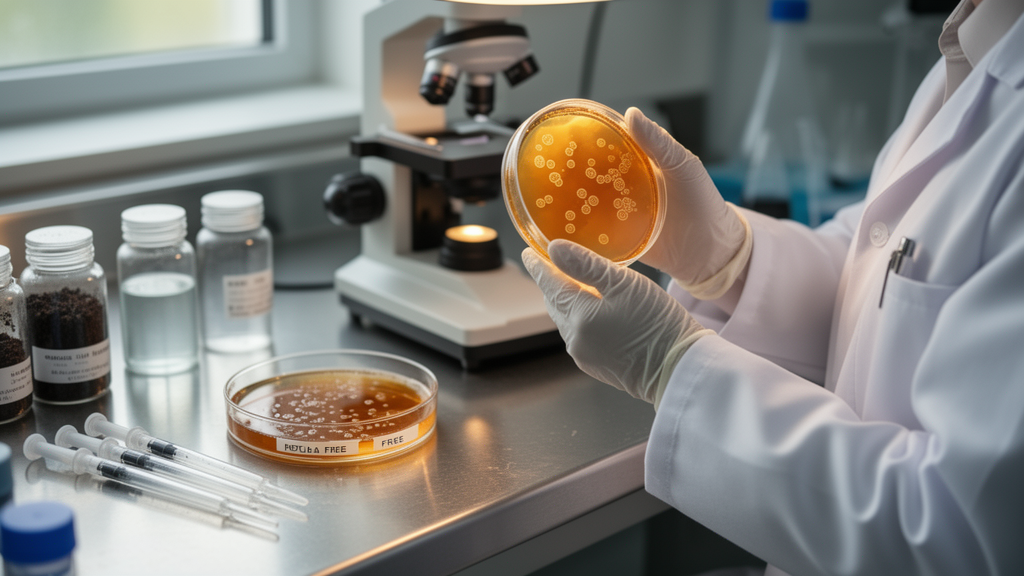
Two previously unknown species of actinobacteria have been formally described after a comprehensive taxonomic study, one recovered from the depths of a German drinking water reservoir and the other from soil on a mountain in Tunisia. The strains, designated DSM 43699T and JZT32T, have been proposed as the type strains of Micromonospora aquaegermanicae sp. nov. and Plantactinospora tunisiensis sp. nov., respectively, in a paper published in the Annals of Microbiology. Beyond their novelty on the tree of life, both organisms carry a rich arsenal of biosynthetic gene clusters, and one of them produced detectable antimicrobial activity against a panel of pathogenic bacteria and yeast in laboratory assays.
The story of strain DSM 43699T began decades before its genome was ever sequenced. The bacterium was isolated from a water sample collected at a depth of 15 metres at Buoy A in the Wahnbach Dam, a lake serving as a drinking water reservoir near Siegburg in North Rhine-Westphalia, Germany. It was deposited in the German Collection of Microorganisms and Cell Cultures (DSMZ) in 1981, where it waited for more than four decades before modern genomic methods could settle its identity. The second strain, JZT32T, is a far more recent acquisition. It came from a soil sample collected at Djebel Zaghouan in Tunisia, where researchers suspended one gram of soil in buffer, plated the supernatant on Trypticase Soy Agar supplemented with the antifungal agents cycloheximide and nystatin, and incubated the plates at 28 degrees Celsius for two weeks.
Classifying new bacteria is not a matter of a single test. The researchers applied a polyphasic approach, combining morphology, growth characteristics, chemical fingerprints of the cell wall and membrane, 16S rRNA gene sequencing, and whole-genome comparisons. The morphological and phenotypic features of the two strains were consistent with members of the genera Micromonospora and Plantactinospora, both belonging to the family Micromonosporaceae. According to the List of Prokaryotic names with Standing in Nomenclature, as consulted in February 2026, Micromonospora currently comprises 136 validly named species while Plantactinospora counts only nine, which makes each new member of the smaller genus a notable addition.
Initial molecular identification revealed how deceptive 16S rRNA gene sequences can be in this family. Strain DSM 43699T showed its highest 16S rRNA gene sequence similarity, 99.2 percent, to Micromonospora rifamycinica AM105T, while strain JZT32T reached 98.6 percent similarity to Plantactinospora veratri NEAU-FHS4T. Both values sit above the commonly cited 98.65 percent threshold for prokaryotic species demarcation, which might suggest the strains were merely close relatives of known species. But the authors caution that such similarity does not confirm definitive species identity, and several validly named species share identical 16S rRNA sequences. For strain JZT32T the situation was even more striking: its 16S sequence matched Plantactinospora soli KLBMP 9567T at 100 percent, a result that on its own would have obscured rather than revealed its distinctness.
The decisive evidence came from the genomes. Strain DSM 43699T has a genome of 7.2 megabases with a G plus C content of 72.5 mol percent, sequenced on an Illumina NovaSeq 6000 platform, while strain JZT32T carries a 10 megabase genome with 72.0 mol percent G plus C, sequenced with long reads on a PacBio Sequel IIe system. In phylogenomic analyses using the Type Strain Genome Server, strain DSM 43699T formed a distinct branch closely related not to M. rifamycinica but to Micromonospora matsumotoensis DSM 44100T, whereas strain JZT32T clustered with P. soli KLBMP 9567T. Digital DNA-DNA hybridisation values between the new strains and their closest phylogenomic neighbours came to 57.6 percent and 61.9 percent respectively, and average nucleotide identity values were 90.7 percent and 93.8 percent. All of these figures fall well below the accepted thresholds of 70 percent for dDDH and 95 to 96 percent for ANI, confirming that each strain represents a separate species.
For strain JZT32T, the genomic comparison carried an unusual complication. The genome of its closest neighbour, P. soli KLBMP 9567T, showed a contamination level of 13.69 percent, exceeding the 10 percent maximum recommended for taxonomic use, and the genome of P. sonchi NEAU QY2T fared similarly at 11.03 percent. Because such contamination could compromise phylogenomic conclusions, the team turned to multilocus sequence analysis of five housekeeping genes, atpD, gyrB, recA, rpoB and trpB. The resulting neighbour-joining tree matched the genome-based picture, placing JZT32T in a well-supported clade with P. soli. The genetic distance between the two, 0.02, sits far above the 0.007 threshold used for species delineation in this group, providing independent support for the new species designation. Access regulations also shaped the study design: P. soli, originating from a sample collected after China’s accession to the Nagoya Protocol, was excluded from laboratory experiments due to access and benefit-sharing rules.
Chemotaxonomic profiling added further distinguishing detail. Both new strains contain meso-diaminopimelic acid in their cell walls, a hallmark of these genera. Strain DSM 43699T carries glucose, mannose, ribose and xylose as whole-cell sugars with trace amounts of arabinose and rhamnose, a pattern that differs from its neighbour M. matsumotoensis, which instead has arabinose, galactose, xylose and 3-O-methylrhamnose. Its polar lipid profile includes diphosphatidylglycerol, phosphatidylethanolamine, phosphatidylinositol, aminophospholipids, glycophospholipids and other phospholipids, and its predominant menaquinones are MK-10(H4) and MK-10(H6). Strain JZT32T yielded a surprise: its polar lipid profile contains phosphatidylcholine, a lipid never previously reported in any Plantactinospora species. It grows as chrome yellow colonies on GYM agar, utilises cellulose, D-mannitol, myo-inositol, raffinose and rhamnose as sole carbon sources, and tolerates up to 2.5 percent sodium chloride, though weakly. The authors note that minor phenotypic differences from P. soli should be interpreted with caution because the biochemical tests were not run under identical conditions.
The most eye-catching results came from mining the genomes for secondary metabolite biosynthetic gene clusters. Using antiSMASH version 8.0, the researchers predicted 22 such clusters in strain DSM 43699T and 20 in M. matsumotoensis, many showing low similarity to characterised clusters, including putative pathways related to lassopeptides, linaridin, rustmicin, sporolide A/B, quinolidomicin A, neomediomycin B, griseochelin, ossamycin, linearmycin and frankiamicin. The genome of strain JZT32T harboured 15 predicted clusters, compared with 13 in P. soli and 15 in P. mayteni, most again with low similarity to known clusters, including NRPS and PKS gene sets putatively associated with compounds related to depsibosamycin B/C/D, atratumycin and maduramicin. This genus matters for such chemistry: after Streptomyces, Micromonospora is considered one of the most important producers of bioactive secondary metabolites, including the aminoglycosides gentamicin and sisomicin as well as ansamycins, macrolides and peptide antibiotics.
To test whether genomic promise translates into actual activity, the team prepared crude extracts from both strains grown in several media and challenged them against Gram-negative bacteria, Gram-positive bacteria and yeast. Extracts of strain DSM 43699T showed antimicrobial activity against E. coli ΔtolC JW5503-1, Proteus vulgaris DSM 2140, multidrug-resistant Staphylococcus aureus DSM 18827, Enterococcus faecium DSM 20477T and Candida albicans DSM 1386, while its closest relative M. matsumotoensis showed no detectable activity under the same conditions. In contrast, no antimicrobial activity was observed for extracts of strain JZT32T or P. mayteni DSM 45238T. The bioassays were run in three independent biological replicates, with plates incubated at 37 degrees Celsius for 24 hours for bacteria and 25 degrees Celsius for 48 hours for the yeast.
The authors present the combined evidence as justification for two new species names, with Micromonospora aquaegermanicae referencing the German freshwater source of its type strain and Plantactinospora tunisiensis honouring the country where the second organism was found. The type strains are preserved in international collections, DSM 43699T also as KCTC 59416T and JZT32T as DSM 117369T and CECT 31214T, with genome sequences deposited in GenBank under accession numbers JBTMMT000000000.1 and JBSNCJ000000000.1. As the researchers emphasise, the diverse biosynthetic gene clusters and the antimicrobial activity observed for the German isolate indicate that both strains represent valuable sources of bioactive compounds, and the specialised metabolites they may produce now warrant further investigation.
Subject of Research: Taxonomic description of two novel actinobacterial species, Micromonospora aquaegermanicae and Plantactinospora tunisiensis, isolated in Germany and Tunisia
Article Title: Polyphasic taxonomic description of Micromonospora aquaegermanicae sp. nov. and Plantactinospora tunisiensis sp. nov.
Article References: Nouioui, I., Zhou, S., Kirstein, S., Neumann-Schaal, M., Spröer, C., Bunk, B., & Mast, Y. (2026). Polyphasic taxonomic description of Micromonospora aquaegermanicae sp. nov. and Plantactinospora tunisiensis sp. nov.. Annals of Microbiology, 76(1), Article 40. https://doi.org/10.1186/s13213-026-01882-6
Image Credits: AI Generated
DOI: 10.1186/s13213-026-01882-6
Keywords: Micromonospora, Plantactinospora, new species, taxonomy, actinobacteria, genomics, antimicrobial activity, biosynthetic gene clusters, DSMZ, 16S rRNA, ANI, Tunisia
News Source: Juliet Wilcox. (October 28, 2026). Two New Antibiotic-Promising Bacteria Named from German Lake Water and Tunisian Soil. Scienmag.