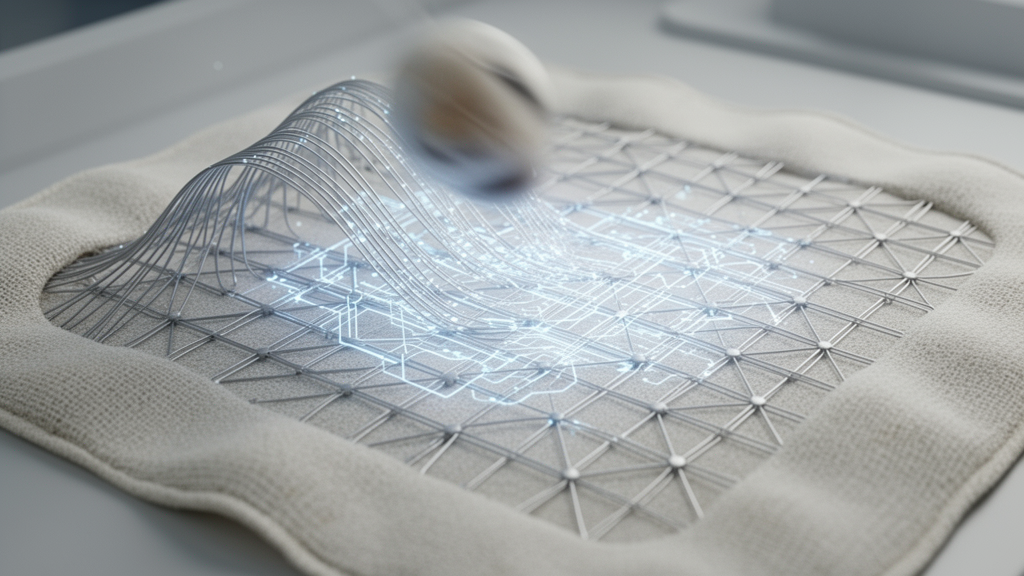
Machine-learning-guided geometric optimization produced stretchable silk fibroin ionic conductors whose resistance responses can map where a bent joint moves. Researchers designed three zigzag-patterned devices with different predicted unfoldability values and experimentally showed that each generated a distinct spatial response fingerprint during repeated flexion. The approach combines fast surrogate modelling with reinforcement-learning search, then translates the selected structures into directly printed sensors with ten-channel resistance readout.
The study targets a central design problem in wearable electronics: flexible ionic conductors must withstand large deformation while retaining measurable electrical changes. The geometry of a zigzag unit cell influences its ability to unfold, but conventional trial-and-error optimization becomes inefficient when topology, manufacturability and deformability are coupled across a high-dimensional parameter space. To make that search more systematic, the researchers parameterized each zigzag unit cell with four control points and generated 3,000 mirror-tiled structural variants.
Each candidate was evaluated by quasi-static simulation to quantify biaxial unfoldability, represented by the mean stretch ratio, λmean. The investigators trained an XGBoost surrogate model using 15 structural descriptors, obtaining a coefficient of determination of R² = 0.97 when predicting the simulated value. They then used the surrogate within a continuous-action A2C reinforcement-learning agent to search for configurations with high unfoldability while satisfying manufacturability constraints. Three optimized designs, with predicted mean stretch ratios of 1.27, 1.77 and 2.04, were selected for fabrication.
Direct-write printing turned the optimized patterns into silk fibroin ionic conductors equipped with ten-channel resistance readout. Under cyclic joint flexion, the λ = 1.27 design produced a symmetric dual-hotspot response, indicating two dominant sensing regions. The intermediate λ = 1.77 design concentrated its response in one channel and reached a peak absolute relative resistance change, |ΔR/R0|, of 0.82. The most unfoldable design, λ = 2.04, generated a broader multi-hotspot pattern and achieved the highest mean response amplitude, 0.27.
These distinct patterns did not collapse when the bending speed changed. Across the tested speeds, their similarity was assessed by Spearman correlation coefficients ranging from 0.75 to 0.84, showing that the spatial fingerprints remained substantially consistent under different deformation rates. The work therefore establishes an experimental pathway from geometric parameterization and simulation, through machine-learning optimization, to printed devices that convert joint motion into position-specific electrical signals. The source reports proof-of-principle device testing rather than a clinical trial or a general-purpose wearable system, so the results are best understood as a demonstration that computational design can tune the spatial behavior of a soft ionic sensor.
Subject of Research: Machine-learning optimization of silk fibroin ionic conductors for spatially resolved wearable motion sensing
Article Title: Machine learning–driven structural optimization of zigzag silk fibroin ionic conductors for spatially resolved wearable motion detection
Article References: Yang, Y., Sun, S., Xu, C., Ren, J., & Ling, S. (2026). Machine learning–driven structural optimization of zigzag silk fibroin ionic conductors for spatially resolved wearable motion detection. npj Flexible Electronics. https://doi.org/10.1038/s41528-026-00656-z
Image Credits: AI Generated
DOI: 10.1038/s41528-026-00656-z
Keywords: machine learning, silk fibroin, ionic conductors, wearable sensors, structural optimization, reinforcement learning, motion detection, XGBoost, flexible electronics, spatial sensing, Machine, learning
News Source: Teresa Odom. (October 22, 2026). Machine learning optimizes silk sensors for spatial motion detection. Scienmag.