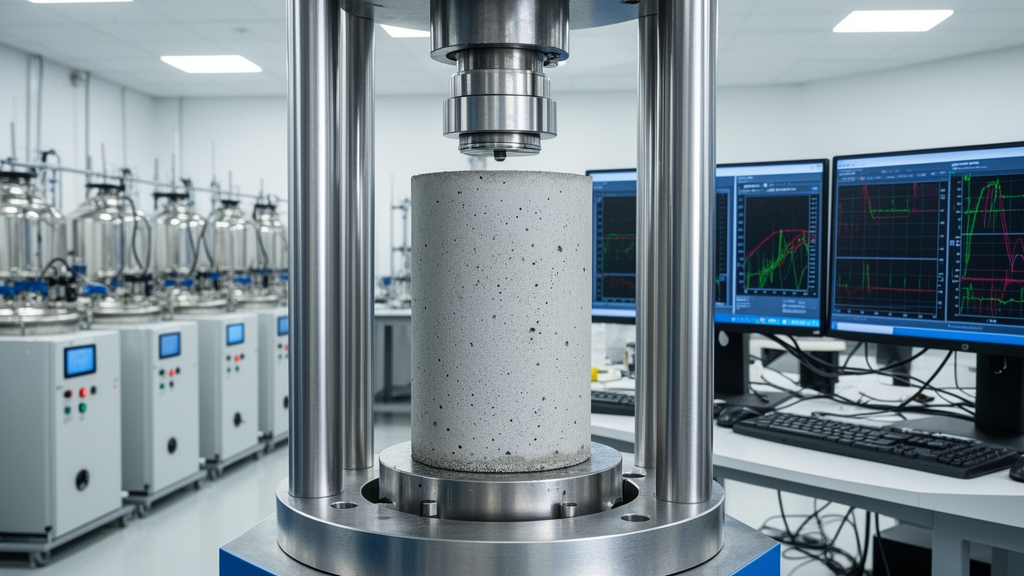
Civil engineering researchers have demonstrated that an XGBoost machine-learning surrogate integrated into the physical framework of the fib Model Code maturity method can accurately predict the compressive strength development of self-compacting concretes containing supplementary cementitious materials across varying curing temperatures. Estimating early-age compressive strength directly in place plays a pivotal operational role on construction sites, where reliable timing is required to safely remove formwork or reopen paved surfaces to heavy traffic without risking structural cracking or catastrophic failure. Conversely, unnecessary delays in formwork removal inflate operational expenditures and disrupt construction schedules. To bridge the gap between empirical maturity models and data-driven methods, the study reformulates the traditional Arrhenius equivalent-age equation, substituting an inflexible empirical regression with a machine-learning model trained to predict the logarithm of the time-scaling factor.
Standard industrial implementations of the maturity method, codified under ASTM C1074, correlate the cumulative temperature history of concrete to its strength development during hydration using an Arrhenius equivalent-age formulation combined with a strength-versus-age equation such as the fib Model Code expression. In conventional formulations, the apparent activation energy represents the critical parameter governing how strongly temperature alters the rate of hydration reactions. While elevated curing temperatures accelerate early chemical reactions and foster rapid initial strength gain, they can also disrupt the uniformity of hydration products, forming larger pores, microcracks, and internal stresses that ultimately reduce long-term mechanical performance. Lower temperatures retard chemical hydration, postponing early strength gain. Although self-compacting concrete offers notable advantages by compacting thoroughly around congested reinforcement without external mechanical vibration, its high cement consumption prompts sustainability concerns. Replacing Portland cement with supplementary cementitious materials like fly ash, ground granulated blast-furnace slag, silica fume, or rice husk ash mitigates environmental impacts, but these binders alter internal temperature profiles and hydration kinetics, making single fixed activation energy values unreliable across different ages and curing temperatures.
To overcome the limitations of classic formulations, earlier investigators developed modified maturity models that treated apparent activation energy as a dynamic variable dependent on concrete age and curing temperature. However, existing modifications typically relied on piecewise empirical regressions calibrated to specific datasets and fixed reference temperatures, preventing them from transferring to different curing regimes or diverse binder families without extensive laboratory recalibration. Other recent research explored purely data-driven machine-learning algorithms to predict concrete properties directly, but many prior predictive models concentrated strictly on mix proportions while ignoring the physical curing-temperature histories that govern early-age hydration. The investigative team addressed these dual shortcomings by preserving the foundational physical backbone—combining the fib Model Code strength equation with the Arrhenius equivalent-age formulation—while assigning an XGBoost regressor to predict the dimensionless logarithmic time-scaling factor rather than attempting to estimate the apparent activation energy directly.
The mathematical motivation for predicting the logarithmic time-scaling factor stems from fundamental numerical properties that emerge during the back-calculation of maturity parameters. In Arrhenius maturity frameworks, the activation-energy factor relates directly to the logarithmic time-scaling factor divided by the signed reciprocal-temperature difference between the curing temperature and the chosen reference temperature. At the reference temperature itself, this reciprocal-temperature difference becomes zero, causing direct back-calculations of the activation-energy factor to divide a bounded numerator by a vanishing denominator. Consequently, any machine-learning model trained directly on the activation-energy factor must discard all reference-temperature experimental data points, which typically constitute a quarter of an entire experimental dataset. By contrast, the logarithmic time-scaling factor remains mathematically well-defined across all tested curing conditions, enabling models to utilize every reference-temperature observation as a natural anchor during model training while preventing minor activation-energy errors from being magnified over large temperature deviations.
The researchers trained and calibrated their hybrid surrogate using an experimental laboratory dataset generated at Cardiff University, encompassing seven distinct self-compacting binder systems all batched at a constant water-to-binder ratio of 0.40 and aimed at a target 28-day compressive strength of 70 megapascals. Standard 100-millimeter cube specimens were cast and cured isothermally in water baths maintained at 10, 20, 35, and 50 degrees Celsius. Compressive strength measurements were taken across seven curing intervals at 1, 3, 7, 14, 28, 56, and 90 days, with three replicate cubes tested for every age and temperature combination, yielding 196 averaged strength readings spanning from 6.4 to 90.4 megapascals across the entire matrix.
Model inputs for the XGBoost surrogate were restricted to ten clear operational features: four binary indicator variables denoting the presence of fly ash, slag, silica fume, or rice husk ash; the replacement percentage of supplementary materials; the curing temperature; the natural logarithm of curing age; the absolute reciprocal-temperature distance; and two mix-specific calibrated kinetic parameters from the fib framework, namely the sensitivity coefficient and the 28-day reference compressive strength. These two calibrated values are obtained naturally from a reference-temperature strength curve and do not require additional testing regimes. Hyperparameter selection was conducted rigorously through a nested cross-validation process, ensuring that the model configurations applied to predict held-out binder mixes were tuned without any data leakage from those unseen mixtures. The resulting architecture favored shallow decision trees, conservative learning rates, and regularisation penalties to ensure robust generalisation across differing binder chemistries.
When assessed under leave-one-mixture-out cross-validation across all 147 off-reference Cardiff observations, the hybrid physics-informed model demonstrated exceptional predictive accuracy, recording a coefficient of determination of 0.943, a root-mean-square error of 4.23 megapascals, and a mean absolute error of 3.24 megapascals. When the team recalibrated the published modified fib empirical model under an identical leave-one-mixture-out validation protocol, its root-mean-square error rose to 5.74 megapascals, while its original published in-sample error stood at 4.97 megapascals. The machine-learning hybrid achieved its highest predictive performances on highly blended pozzolanic mixtures, registering root-mean-square errors of 2.71 megapascals for 40 percent slag, 3.11 megapascals for 40 percent fly ash, and 3.32 megapascals for 10 percent silica fume. The most challenging hold-out fold proved to be the unblended Portland-cement control mix, which yielded a root-mean-square error of 6.47 megapascals because the algorithm had no unblended binder counterparts to learn from when that mixture was withheld from training.
To provide actionable bounds for practical construction decision-making, the team integrated split-conformal prediction intervals, calibrating the prediction half-widths using absolute log-strength residuals derived exclusively from models trained on datasets that excluded the evaluated mix. This strict isolation yielded empirical 95 percent prediction half-widths spanning between 0.170 and 0.218 in log-strength, corresponding to predictive margins roughly 16 to 20 percent below and 18 to 24 percent above expected strength values. Across all seven leave-one-mixture-out validation folds, the empirical coverage attained 94.6 percent against the nominal 95 percent threshold, achieving 100 percent coverage on three blended binders and dipping to 81.0 percent on the isolated Portland-cement control mix. Furthermore, global TreeSHAP model interpretability diagnostics confirmed that the model’s internal feature attributions aligned with physical hydration kinetics: curing temperature served as the strongest positive driver of time scaling, curing age acted as the strongest negative influence as reactions shifted from chemical kinetics to diffusion control, and the calibrated fib parameters carried noticeably more weight than categorical binder flags.
The ultimate generalisation capacity of the hybrid model was scrutinized through external validation on a collated literature dataset of 119 off-reference observations from independent studies, covering vibrated normal-weight concretes with fly ash replacements up to 45 percent and a lightweight self-compacting concrete with 30 percent slag on sintered fly-ash aggregate. Crucially, this external literature dataset established its baseline calibration at a 30-degree Celsius reference temperature rather than the 20-degree Celsius baseline used during training. Applied without any retraining or adjustment, the hybrid model achieved a coefficient of determination of 0.934 and a root-mean-square error of 5.43 megapascals on the external off-reference observations, outperforming the original fib formulation at 6.11 megapascals, the modified fib at 7.07 megapascals, and an identical surrogate trained directly on the activation-energy factor, which degraded to a root-mean-square error of 8.18 megapascals due to temperature scaling sensitivities.
Despite these favorable predictive benchmarks, the authors emphasized several clear boundaries and limitations inherent to their findings. The primary training dataset remains modest in size, encompassing 196 observations drawn from seven laboratory mixes prepared within a single research setting, underscoring the necessity of broader multi-laboratory round-robin validations before universal adoption. Additionally, while the model demonstrated reliable transfer across a shift from 20 to 30 degrees Celsius reference temperatures, larger shifts across broader thermal spectrums remain untested. All experimental validations were conducted under strictly isothermal laboratory curing, meaning the hybrid framework’s precision under fluctuating, non-isothermal curing histories typical of real-world outdoor construction sites has yet to be empirically verified. Nonetheless, by preserving the physical fib backbone and introducing machine learning solely to learn complex kinetic time-scaling behavior, the study offers engineers an interpretable, risk-quantified approach for predicting the strength of sustainable concrete systems.
Subject of Research: Hybrid machine-learning maturity framework for predicting concrete compressive strength
Article Title: From activation energy to equivalent age: An effective machine-learning surrogate for fib-based strength prediction in concretes with supplementary cementitious materials
Article References: Aldawish, A., Kulasegaram, S., Almutlaqah, A., & Alshahrani, A. (2026). From activation energy to equivalent age: An effective machine-learning surrogate for fib-based strength prediction in concretes with supplementary cementitious materials. Case Studies in Construction Materials, 25, Article e06709. https://doi.org/10.1016/j.cscm.2026.e06709
Image Credits: AI Generated
DOI: 10.1016/j.cscm.2026.e06709
Keywords: concrete strength, self-compacting concrete, supplementary cementitious materials, machine learning, maturity method, XGBoost, Arrhenius equation, activation energy, compressive strength, curing temperature, TreeSHAP, conformal prediction, fly ash, silica fume, ground granulated blast-furnace slag, rice husk ash
News Source: Teresa Odom. (November 12, 2026). Machine Learning Model Accurately Predicts Concrete Strength Across Curing Temperatures. Scienmag.