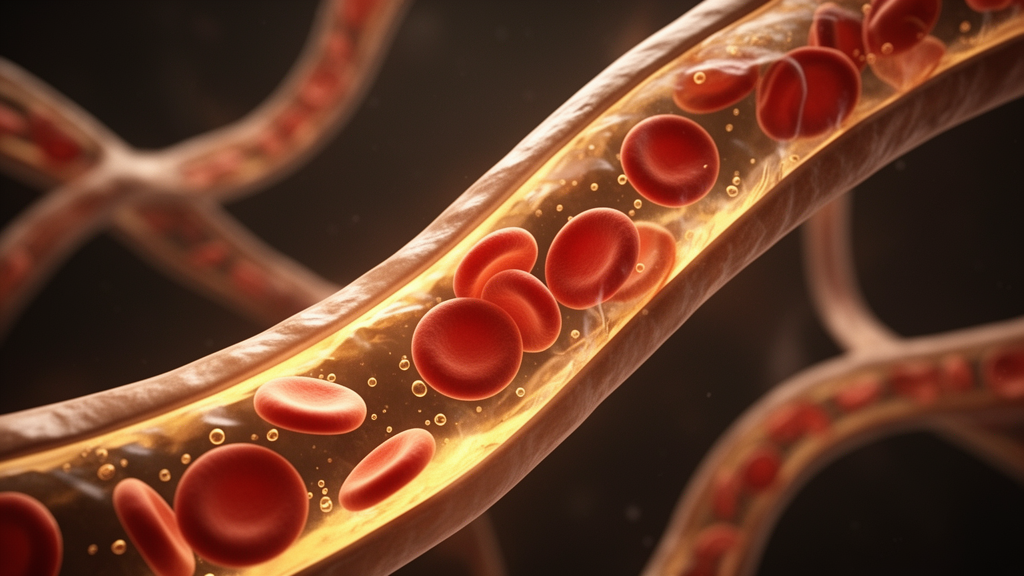
Researchers K. Rajyalakshmi and G. Ravi Kiran have formulated a two-layer analytical model demonstrating that magnetic field strength, viscoelastic fluid properties, and wall slip conditions significantly enhance effective viscosity and hematocrit concentration in stenosed microvascular blood flow. Published in Discover Mechanical Engineering, the investigation evaluates the steady, two-dimensional transport of an electrically conducting Jeffrey fluid representing red blood cells in the central core, surrounded by an outer peripheral layer of Newtonian plasma, through a non-uniform diverging channel containing multiple mild stenotic constrictions embedded in a porous medium. By applying mild-stenosis and lubrication approximations to the governing equations of motion, the authors derived exact closed-form expressions for axial velocity distributions, volumetric flow rates, normalized effective viscosity, normalized core hematocrit, and normalized mean hematocrit. Their analytical solutions indicate that increased Jeffrey parameters, elevated magnetic parameters, and enhanced boundary slip parameters systematically elevate effective viscosity and hematocrit levels, whereas higher porous permeability governed by the Darcy number lowers hydrodynamic resistance.
The physiological motivation for formulating this unified analytical framework stems from the complex hydrodynamics governing blood transport in the smallest vessels of the human circulatory system, specifically arterioles, capillaries, and venules ranging between 20 and 500 micrometers in diameter. In such microcirculatory vessels, physical phenomena diverge substantially from the continuum mechanics observed in large systemic arteries, most notably through the Fåhræus–Lindqvist effect, in which the apparent viscosity of blood decreases markedly as the internal vessel diameter is reduced. Although prior investigations cataloged in the study’s comparative literature table analyzed isolated phenomena—such as single arterial constrictions, uniform cylindrical conduits, idealized non-Newtonian rheologies, or external electromagnetic forces—very few mathematical models integrated multiple mild stenoses alongside non-uniform vessel tapering, porous matrix resistance, wall slip, and multiphase blood rheology simultaneously. Atherosclerotic plaque accumulation creates localized geometric narrowings that alter shear rate distributions, potentially promoting blood clots, stroke, or heart failure, underscoring the necessity of a multifaceted analytical model.
To capture realistic physiological architectures where blood vessels exhibit gradual axial expansion rather than uniform tubular geometries, the researchers structured the channel walls using an exponential diverging profile previously developed by Prasad and Radhakrishnamacharya. The unobstructed channel is defined by a characteristic baseline half-width denoted as h0, varying within the physical range of 20 to 200 micrometers, from which the channel boundaries diverge according to a spatial wall exponent parameter k prime set to 0.1. Embedded along the axial coordinate x are multiple mild stenotic constrictions characterized by maximum protrusion heights delta one and delta two, as well as axial bulge lengths L0 and L1. The mathematical domain is partitioned into two distinct concentric flow regions: an inner core of half-width h1 carrying cellular components, and an outer peripheral cell-free layer of thickness epsilon defined as h0 minus beta times h0, parameterized against cell-free layer thicknesses of 3.12 micrometers for 40 percent hematocrit and 3.60 micrometers for 30 percent hematocrit.
The rheological characterization of microcirculatory blood flow requires distinct constitutive models for the plasma and cellular fractions, reflecting the pronounced shear-thinning and viscoelastic traits of dense red blood cell suspensions. In the proposed model, the central core fluid is governed by the constitutive formulation of an incompressible Jeffrey fluid, which accounts for relaxation and retardation times through the ratio parameter lambda one and retardation parameter lambda two, thereby incorporating fading memory effects and non-Newtonian shear responses. Conversely, the peripheral cell-free layer bordering the vessel wall consists predominantly of plasma and is treated as an incompressible Newtonian fluid with constant dynamic viscosity mu two. Because the physical dimensions of arterioles and microvessels correspond to very low Reynolds numbers, the researchers formally neglected convective inertial accelerations in comparison to viscous forces, Lorentz electromagnetic resistance, and porous medium drag, reducing the equations of motion under mild-stenosis and lubrication approximations to a solvable system of ordinary differential equations.
The analytical formulation specifies governing momentum equations for both the core and peripheral zones under the influence of an applied transverse magnetic field of uniform flux density B0 and a porous medium of constant permeability K0. In the Jeffrey core region, the axial pressure gradient balances non-Newtonian viscous stresses, an electromagnetic Lorentz deceleration force proportional to electrical conductivity sigma and magnetic induction squared, and Darcy resistance inversely proportional to permeability. In the peripheral Newtonian zone, the pressure gradient is countered by standard Newtonian shear gradients alongside identical Lorentz and Darcy resistance terms. Symmetrical flow across the vessel centerline requires a regularity condition where the transverse velocity gradient equals zero at y equals zero. At the fluid-fluid interface located at y equals h1, continuity conditions enforce matching of axial velocities and shear stresses. At the channel wall, the researchers implemented the Saffman slip boundary condition, coupling wall slip velocity directly to the wall shear gradient through slip coefficient alpha and Darcy number Da.
By integrating the governing differential equations subject to centerline symmetry, interface matching, and Saffman wall slip boundary conditions, the authors obtained closed-form mathematical equations for the axial velocity profiles u1 in the core and u2 in the peripheral layer. Integrating these velocity distributions across their respective cross-sectional domains yielded explicit expressions for the core volumetric flow rate Q1 and the peripheral volumetric flow rate Q2, whose sum defines the total volumetric blood flux Q traveling through the constricted conduit. To determine the apparent resistance to blood flow within the microvascular system, the authors evaluated the normalized effective viscosity mu eff. This parameter is extracted analytically by equating the total volumetric flow rate derived from the two-layer Jeffrey formulation to the classical Poiseuille volumetric discharge produced by an equivalent pressure gradient between two parallel plates, coupling the viscosity ratio mu prime, Darcy number Da, magnetic parameter M, Jeffrey parameter lambda one, and slip parameter alpha.
The investigation further established closed-form mathematical relationships governing red blood cell transport by examining the distribution of hematocrit across the channel cross section. Hematocrit represents the volume percentage of red blood cells in whole blood, which under normal human physiological conditions spans between 40 percent and 45 percent. By invoking the conservation of red blood cell flux, the analytical framework dictates that the total red blood cell flux entering the vessel inlet at baseline hematocrit H0 must equal the red blood cell flux transported exclusively through the central core region Q1. Substituting the derived volumetric flow rate expressions into this conservation balance yielded the normalized core hematocrit Hc bar, defined as the ratio of core hematocrit Hc to inlet hematocrit H0. Applying the geometric core-to-channel width proportion beta established the normalized mean hematocrit Hm bar, demonstrating that hematocrit distributions are dynamic variables coupled to the relative discharge rates of the core and periphery.
Computational evaluations and graphical plots generated in MATHEMATICA across physically realistic parameter spaces illustrate how hemodynamic forces dictate effective viscosity variations. Increasing the Jeffrey parameter lambda one causes a direct, monotonic increase in normalized effective viscosity because enhanced viscoelasticity intensifies the core fluid’s resistance to shear deformation, elevating macroscopic flow resistance across the stenosed passage. Similarly, advancing the Hartmann magnetic parameter M magnifies the opposing Lorentz force, which exerts an electromagnetic braking effect on the conducting fluid, dampening velocity profiles and producing an apparent surge in effective viscosity. Conversely, increasing the Darcy number Da markedly attenuates effective viscosity; higher Darcy numbers signify increased porous matrix permeability, which reduces physical drag and facilitates fluid percolation through the channel. Wall slip behavior, governed by slip parameter alpha, also produces an increase in effective viscosity, while increasing stenosis height delta one constricts the available lumen area, amplifying local shear rates and fluid resistance.
The parametric responses of normalized core hematocrit and normalized mean hematocrit demonstrate equally intricate dependencies on rheological, electromagnetic, and geometric variables. The analytical results reveal that normalized core hematocrit Hc bar and normalized mean hematocrit Hm bar increase proportionally with increases in the Jeffrey parameter lambda one, the magnetic parameter M, the slip parameter alpha, and the channel wall exponent k prime. The rise in hematocrit associated with the Jeffrey parameter reflects enhanced elastic retention of erythrocytes within the central core streamline, while Lorentz forces restrict radial particle diffusion. Conversely, core and mean hematocrit decrease as the Darcy number Da rises, because enhanced matrix permeability permits fluid and particle drift into the porous peripheral structure, diluting cellular packing. Enlarging the channel half-width h0 similarly diminishes core hematocrit by expanding the open flow area. In contrast to effective viscosity, increasing stenosis height delta one lowers normalized core hematocrit, as constriction shears redistribute cells away from the core.
To establish mathematical validity, the authors verified that reducing their analytical formulation to a limiting case lacking vessel non-uniformity, multiple stenoses, and wall slip perfectly recovers the established equations and qualitative trends reported by Santosh and Radhakrishnamacharya. The model successfully reproduces the Fåhræus–Lindqvist effect, confirming that apparent blood viscosity diminishes as conduit caliber decreases within the microvascular range, preserving microcirculatory perfusion efficiency. Addressing physiological phenomena often associated with biofluid mechanics, the authors noted that bolus trapping—frequently observed in peristaltic pumping—does not occur in this system due to steady pressure-driven flow without wall motility. While the analytical model provides exact mathematical solutions for the coupled influences of magnetohydrodynamics, viscoelastic rheology, porous drag, wall slip, and multiple arterial narrowings, its physical scope remains bounded by steady-state, laminar, mild-stenosis approximations. Nonetheless, the derived expressions provide valuable mechanical insights into microcirculatory hemodynamics, offering theoretical foundations that may inform the mathematical optimization of biomedical diagnostic devices and targeted magnetic drug delivery.
Subject of Research: Two-layer analytical modeling of magnetohydrodynamic Jeffrey blood flow through porous non-uniform vessels with multiple mild stenoses
Article Title: A two layer analytical study of MHD Jeffrey blood flow in a porous non uniform channel with multiple stenoses
Article References: Rajyalakshmi, K., & Kiran, G. R. (2026). A two layer analytical study of MHD Jeffrey blood flow in a porous non uniform channel with multiple stenoses. Discover Mechanical Engineering, 5(1), Article 218. https://doi.org/10.1007/s44245-026-00389-3
Image Credits: AI Generated
DOI: 10.1007/s44245-026-00389-3
Keywords: Magnetohydrodynamics, Jeffrey fluid model, Microvascular hemodynamics, Blood flow resistance, Multiple mild stenoses, Porous media flow, Wall slip condition, Effective blood viscosity, Core hematocrit, Mean hematocrit, Fahraeus-Lindqvist effect, Non-uniform diverging channel, Two-layer flow model, Saffman slip condition, Darcy number, Lorentz force, Cell-free peripheral layer
News Source: Denise Maddox. (November 12, 2026). Analytical Model Shows Magnetic Fields and Wall Slip Increase Microvascular Blood Viscosity. Scienmag.