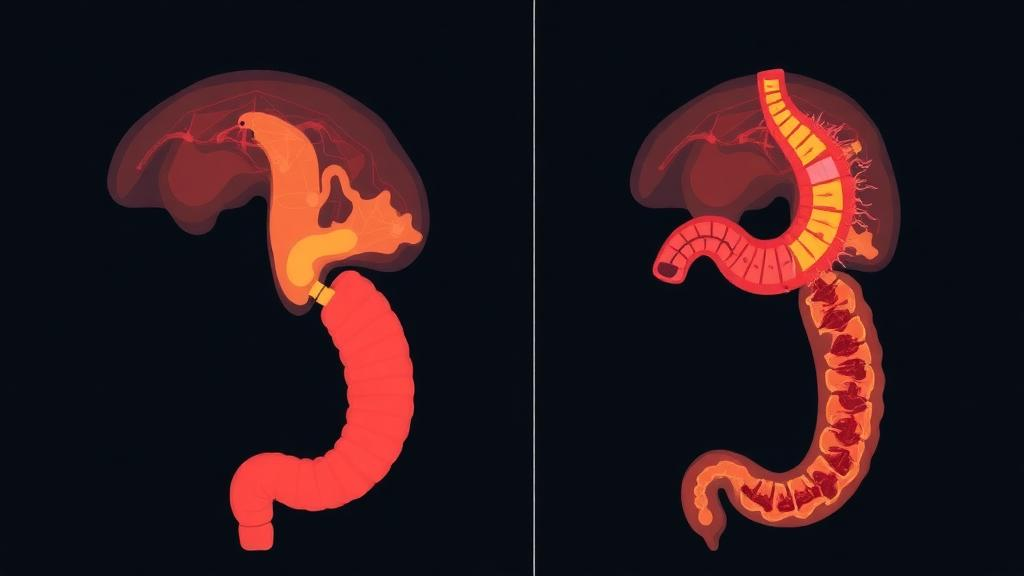
Surviving esophageal or gastric cancer often comes at a hidden cost: a digestive system that never quite works the way it did before. Now, one of the largest longitudinal studies of its kind has mapped exactly how those gut symptoms behave over the crucial first year after surgery, and the results carry a sobering message. For most patients, the severity of their gastrointestinal burden is set early and tends to stay that way, suggesting that the window for identifying who will struggle may open well before a surgeon makes the first incision.
The study, published in the journal Supportive Care in Cancer, drew on data from the Prospective Observational Cohort study of Oesophageal-gastric Cancer Patients, known as POCOP, a nationwide Dutch registry that routinely collects patient-reported outcomes and links them to the Netherlands Cancer Registry. Researchers led by Yipei Lee of the Netherlands Comprehensive Cancer Organization and Amsterdam UMC analyzed 1,896 patients with nonmetastatic esophageal or gastric cancer diagnosed between 2013 and 2024 who underwent either an esophagectomy, the removal of all or part of the esophagus, or a gastrectomy, the removal of all or part of the stomach. Of these, 1,462 patients, or 77.1 percent, had an esophagectomy, while 434, or 22.9 percent, underwent gastrectomy. Because POCOP participants have been shown to broadly resemble the overall Dutch population of patients with these cancers, the findings are likely to generalize beyond a single hospital or region.
The scale of the problem the team set out to quantify is considerable. Globally, roughly 1.49 million new cases of esophageal and gastric cancer were diagnosed in 2022, and for many of these patients, surgical resection combined with chemotherapy or radiotherapy before or after the operation offers the best chance of a cure. But that cure reshapes the gastroesophageal tract in ways the body struggles to compensate for. Previous research has shown that more than one-third of patients experience persistent gastrointestinal symptoms at nine to twelve months after surgery, and around 20 percent of esophagectomy patients and 15 percent of gastrectomy patients report two or more severe symptoms. These symptoms, which include eating restrictions, loss of taste, reflux, diarrhea, and appetite loss, are not merely uncomfortable. Having two or more gastrointestinal symptoms has been linked to clinically meaningful declines in quality of life, physical functioning, and daily activity, with work productivity impairment reported to be 29.3 percent higher among esophagectomy patients with multiple symptoms compared with those who have none.
To capture how these symptoms cluster and evolve, the researchers turned to an unsupervised machine learning technique called k-means clustering. Rather than treating each symptom in isolation, the method groups patients based on the overall pattern and intensity of their reported symptoms. The team extracted gastrointestinal symptom data from two validated quality-of-life instruments: the European Organization for Research and Treatment of Cancer Quality of Life Questionnaire Core 30, or EORTC QLQ-C30, and the EORTC QLQ Oesophageal-Gastric Cancer Module 25, known as QLQ-OG25. Together, these questionnaires covered a broad spectrum of complaints, including dysphagia, or difficulty swallowing; eating restrictions; reflux; odynophagia, or painful swallowing; nausea and vomiting; constipation; diarrhea; appetite loss; dry mouth; trouble with taste; trouble with coughing; trouble swallowing saliva; and trouble talking. Every item is scored on a four-point scale and transformed linearly to a value between 0 and 100, with higher scores indicating worse symptoms.
The clustering was performed separately at five time points: a pre-resection baseline, which for most patients fell before or during neoadjuvant therapy, and then at zero to three, three to six, six to nine, and nine to twelve months after surgery. To decide how many patient groups existed at each point, the researchers used the Elbow method, which calculates the within-cluster sum of squares for candidate solutions ranging from one to ten clusters and identifies where the improvement in fit begins to level off. The answer was consistent: three profiles at every time point, for both surgery types. Crucially, these profiles did not represent distinct symptom patterns, in which one group might suffer mainly from reflux while another struggled primarily with diarrhea. Instead, the groups differed almost entirely in overall severity, forming what the researchers described as mild, moderate, and severe symptom profiles.
The composition of those profiles was revealing. The mild profile was the most common throughout the year, accounting for between 42.5 and 60.5 percent of esophagectomy patients and between 53.9 and 73.5 percent of gastrectomy patients across the assessment periods. Moderate profiles comprised roughly 24 to 42 percent of patients depending on surgery type and timing, while severe profiles, the smallest group, ranged from as few as 2.3 percent to as many as 15.7 percent. For esophagectomy patients, the most frequently reported symptoms across all time periods were eating restrictions, dysphagia, and appetite loss, with dry mouth and coughing problems also rising above baseline levels after surgery. For gastrectomy patients, the picture shifted over time: early on, severe-profile patients reported high scores for dysphagia, eating restrictions, appetite loss, and pain, but by six months after resection, the moderate profile was distinguished by eating restrictions, diarrhea, appetite loss, trouble with taste, and dry mouth, while the severe profile showed broader elevations including nausea, vomiting, and trouble swallowing saliva.
Perhaps the most clinically consequential finding concerns stability. When the researchers tracked how patients moved between profiles from one three-month period to the next, most stayed exactly where they started. Among esophagectomy patients who began in the mild profile, only 0.7 to 2.5 percent ever jumped directly to the severe profile in any postoperative interval. Gastrectomy patients in the mild profile were similarly anchored, with 63.2 to 92.0 percent remaining there between consecutive assessments. There was a general drift toward improvement in the early months: from the first to the second postoperative period, 51.4 percent of esophagectomy patients in the moderate profile moved down to mild, and among gastrectomy patients, roughly half of those in the moderate or severe profiles shifted to mild between baseline and three months. But the dominant pattern was persistence, which means that a patient’s symptom burden shortly after surgery is a strong signal of what the rest of the year will look like.
The statistical models also identified who was most at risk. Using generalized linear mixed models with a random intercept to account for repeated measurements in the same patient, the team found that female sex nearly doubled the odds of landing in a moderate or severe profile after esophagectomy, with an odds ratio of 1.67, and raised the odds by about 54 percent after gastrectomy, at 1.54. Receiving neoadjuvant chemotherapy was an even stronger predictor, with an odds ratio of 1.91 for esophagectomy patients and 2.39 for gastrectomy patients. Other risk factors after esophagectomy included an American Society of Anesthesiologists physical status classification of III or higher, transthoracic rather than transhiatal surgical approach, and a prolonged hospital stay, defined as more than twelve days. After gastrectomy, subtotal removal of the stomach was associated with better outcomes than total removal, with an odds ratio of 0.33 for moderate or severe symptoms. Interestingly, adjuvant chemotherapy or immunotherapy after esophagectomy was linked to a lower likelihood of severe profiles, an association the authors note warrants further investigation.
The researchers are candid about the limits of their approach. The Silhouette scores, a standard measure of how well-separated clusters are, ranged from 0.12 to 0.36, values the authors themselves describe as low and consistent with the exploratory nature of the analysis. Clinical symptom data are notoriously difficult to cluster because most features are highly correlated, and comparable studies of cancer symptom clustering have reported similarly modest scores. The team deliberately avoided principal component analysis, a common dimension-reduction technique, because compressing symptoms into abstract components would obscure direct clinical interpretation. They also acknowledge that the EORTC questionnaires summarize symptoms over the preceding week and may miss day-to-day fluctuations, that lower gastrointestinal symptoms were underrepresented, and that patients who complete questionnaires tend to be younger and healthier, potentially understating the true symptom burden.
Even with those caveats, the study’s implications for survivorship care are hard to ignore. Follow-up care for gastrointestinal symptoms after esophagectomy or gastrectomy is not fully standardized in the Netherlands, and existing approaches largely target single symptoms even though patients experience multiple co-occurring problems. The authors argue that targeting symptom profiles rather than individual complaints could make treatment strategies more effective and improve communication between clinicians and patients, and that patients clustered in higher-severity groups might benefit from earlier multidisciplinary support, including nutritional and rehabilitation care. Because profile membership tends to persist, baseline symptom burden could serve as an early warning system, allowing clinicians to identify high-risk patients before surgery and to set realistic expectations about recovery. The authors emphasize that the findings are exploratory and that future studies using alternative longitudinal modeling approaches are needed before the profiles can be deployed in the clinic. But the core message is already clear: for a substantial minority of patients cured of esophageal or gastric cancer, the hardest part of the journey may begin the moment the operation ends, and the first year is when their trajectory is written.
Subject of Research: Longitudinal gastrointestinal symptom profiles after esophagectomy or gastrectomy for esophageal or gastric cancer
Article Title: Gastrointestinal symptom profiles after resection of esophageal or gastric cancer
Article References: Lee, Y., Katsimpokis, D., van Erning, F. N., Nieuwenhuijzen, G. A. P., van Laarhoven, H. W. M., Gisbertz, S. S., Klarenbeek, B. R., Jeene, P. M., Pouw, R. E., Noteboom, L., Verhoeven, R. H. A., & Vissers, P. A. J. (2026). Gastrointestinal symptom profiles after resection of esophageal or gastric cancer. Supportive Care in Cancer, 34(10), Article 1069. https://doi.org/10.1007/s00520-026-11293-7
Image Credits: AI Generated
DOI: 10.1007/s00520-026-11293-7
Keywords: esophageal cancer, gastric cancer, esophagectomy, gastrectomy, gastrointestinal symptoms, symptom profiles, k-means clustering, patient-reported outcomes, quality of life, supportive care, longitudinal study, survivorship
News Source: Nathaniel Bowman. (October 7, 2026). Machine Learning Maps a Year of Gut Symptoms After Esophageal and Gastric Cancer Surgery. Scienmag.