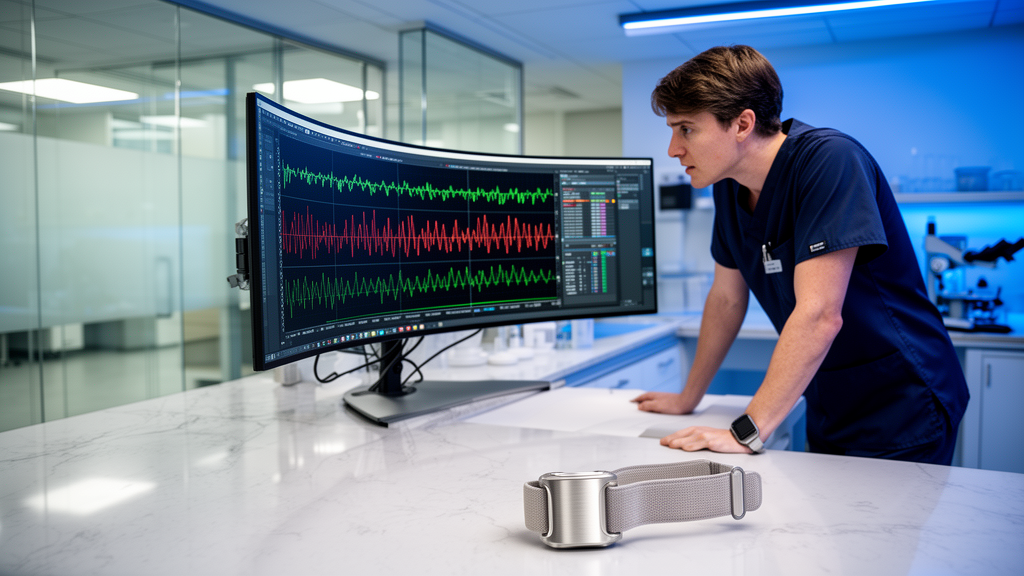
Feature-based machine learning applied to high-resolution tri-axial accelerometry has revealed intervention-specific tremor signal changes that extend beyond conventional amplitude measurements, according to a comparative investigation published in Frontiers in Neurology. While clinical assessments typically quantify tremor reduction through overall amplitude suppression, the research demonstrates that different therapeutic and physiological interventions produce distinct multidimensional signal alterations across diverse tremor conditions.
Machine learning techniques in tremor time-series analysis have historically focused on differentiating distinct tremor disorders from one another rather than monitoring treatment responses. Conventional clinical evaluations primarily track treatment-induced changes in amplitude, an approach that risks overlooking subtle and granular signal alterations. To address this limitation, the investigators evaluated whether advanced feature-based machine learning could capture multidimensional time-series signal changes associated with tremor-modulating interventions and identify shared versus intervention-specific patterns across conditions.
The observational study evaluated a total of sixty-six human participants divided across three tremor conditions and four modulating interventions. The cohort comprised twenty-three individuals with Parkinson’s disease receiving levodopa, twenty participants with enhanced physiological tremor given caffeine, and twenty-three individuals with essential tremor. Within the essential tremor cohort, thirteen participants were assessed under propranolol administration, while ten participants were evaluated under deep brain stimulation.
Each participant was evaluated in therapeutic OFF and ON states using high-resolution tri-axial accelerometry to capture movement dynamics. In addition to measuring established tremor characteristics, the researchers extracted advanced time-series features directly from the raw sensor recordings. The analytical framework implemented machine learning approaches, specifically employing ensemble classification and Principal Component Analysis, to detect and characterize intervention-related signal alterations across the multidimensional feature space.
The analyses demonstrated significant clinical and signal-based intervention effects across all evaluated cohorts. Deep brain stimulation in essential tremor yielded the strongest overall tremor suppression, whereas caffeine administration in enhanced physiological tremor generated the expected tremor enhancement. Across all therapeutic interventions, amplitude-related features decreased consistently; however, dopaminergic therapy with levodopa in Parkinson’s disease was additionally associated with shifts in frequency-related signal characteristics.
The extracted feature profiles revealed that caffeine-induced tremor modulation created a distinct multidimensional signal pattern, whereas therapeutic interventions produced partially overlapping signal modifications. Notably, the researchers determined that no single signal feature consistently characterized successful tremor modulation across all four interventions. The authors concluded that feature-based machine learning uncovers granular, intervention-specific tremor patterns beyond standard metrics, highlighting the utility of data-driven methods for objective tremor assessment.
The collaborative research effort was conducted by Linda Köhler, Soephine Müller, Yi-Shiun Chen, Veronika Selzam, Verena Häring, Jens Volkmann, Robert Lucien Peach, and Sebastian Schreglmann, bringing together investigators from the University Hospital Würzburg in Germany and Imperial College London in the United Kingdom.
Subject of Research: Machine learning time-series analysis of tremor-modulating interventions
Article Title: Multi-dimensional signal exploration on the effect of tremor interventions
Article References: Köhler, L., Müller, J., Chen, Y.-S., Selzam, V., Häring, V., Volkmann, J., Peach, R., & Schreglmann, S. R. (2026). Multi-dimensional signal exploration on the effect of tremor interventions. Frontiers in Neurology, 17, Article 1954245. https://doi.org/10.3389/fneur.2026.1954245
Image Credits: AI Generated
DOI: 10.3389/fneur.2026.1954245
Keywords: Essential Tremor, Parkinson's Disease, Enhanced Physiological Tremor, Deep Brain Stimulation, Propranolol, Levodopa, Caffeine, Tri-Axial Accelerometry, Machine Learning, Time-Series Analysis, Principal Component Analysis, Ensemble Classification, Tremor Modulation, Amplitude Features, Frequency Characteristics, Movement Disorders, Signal Processing, Therapeutic Interventions
News Source: Teresa Odom. (November 14, 2026). Machine Learning Identifies Varied Signal Patterns Across Diverse Tremor Interventions. Scienmag.