• HOME
  • NEWS
  • EXPLORE
    • CAREER
      • Companies
      • Jobs
    • EVENTS
    • iGEM
      • News
      • Team
    • PHOTOS
    • VIDEO
    • WIKI
  • BLOG
  • COMMUNITY
    • FACEBOOK
    • INSTAGRAM
    • TWITTER
Friday, June 26, 2026
BIOENGINEER.ORG
No Result
View All Result
  • Login
  • HOME
  • NEWS
  • EXPLORE
    • CAREER
      • Companies
      • Jobs
        • Lecturer
        • PhD Studentship
        • Postdoc
        • Research Assistant
    • EVENTS
    • iGEM
      • News
      • Team
    • PHOTOS
    • VIDEO
    • WIKI
  • BLOG
  • COMMUNITY
    • FACEBOOK
    • INSTAGRAM
    • TWITTER
  • HOME
  • NEWS
  • EXPLORE
    • CAREER
      • Companies
      • Jobs
        • Lecturer
        • PhD Studentship
        • Postdoc
        • Research Assistant
    • EVENTS
    • iGEM
      • News
      • Team
    • PHOTOS
    • VIDEO
    • WIKI
  • BLOG
  • COMMUNITY
    • FACEBOOK
    • INSTAGRAM
    • TWITTER
No Result
View All Result
Bioengineer.org
No Result
View All Result
Home NEWS Science News Chemistry

Machine learning can identify cancerous cells by their acidity

Bioengineer by Bioengineer
March 16, 2021
in Chemistry
Reading Time: 3 mins read
0
IMAGE
Share on FacebookShare on TwitterShare on LinkedinShare on RedditShare on Telegram

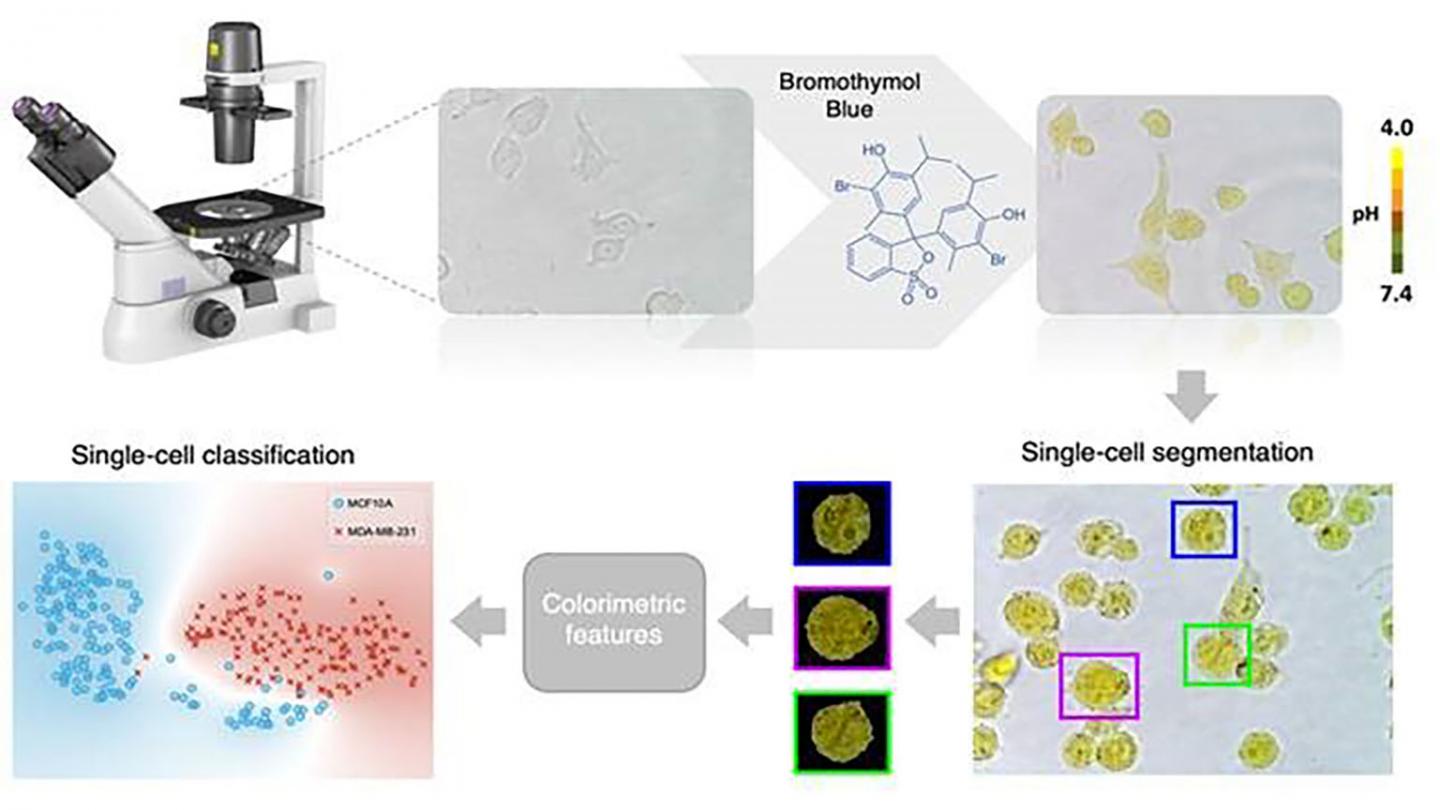
Using a special dye, cells are colored according to their pH, and a machine learning algorithm can detect changes in the color spectrum due to cancer
IMAGE

Credit: Yuri Belotti

WASHINGTON, March 16, 2021 — Cancerous cells exhibit several key differences from healthy cells that help identify them as dangerous. For instance, the pH — the level of acidity — within a cancerous cell is not the same as the pH within a healthy cell.

Researchers from the National University of Singapore developed a method of using machine learning to determine whether a single cell is cancerous by detecting its pH. They describe their work in the journal APL Bioengineering, from AIP Publishing.

“The ability to identify single cells has acquired a paramount importance in the field of precision and personalized medicine,” said Chwee Teck Lim, one of the authors. “This is because it is the only way to account for the inherent heterogeneity associated with any biological specimen.”

Lim explained that other techniques for examining a single cell can induce toxic effects or even kill the cell. Their approach, however, can discriminate cells originating from normal tissues from cells originating from cancerous tissues, as well as among different types of cancer, while keeping the cells alive.

The method relies on treating the cells with bromothymol blue, a pH-sensitive dye that changes color depending on how acidic a solution is. Each type of cell exhibits its own unique fingerprint of red, green, and blue (RGB) based on its intracellular acidity. Because cancerous transformation alters the cell’s pH, an unhealthy cell will respond to bromothymol blue differently, resulting in a characteristic shift of its RGB fingerprint.

By training a machine learning algorithm to map combinations of colors to the disease state of individual cells, the authors can easily recognize an undesired shift. This allows them to determine the health of a cell using only simple, standard equipment: an inverted microscope and a color camera.

“Our method allowed us to classify single cells of various human tissues, both normal and cancerous, by focusing solely on the inherent acidity levels that each cell type tends to exhibit, and using simple and inexpensive equipment,” Lim said.

For practical implementations of this approach, medical professionals will need to noninvasively acquire a sample of the cells in question.

“One potential application of this technique would be in liquid biopsy, where tumor cells that escaped from the primary tumor can be isolated in a minimally invasive fashion from bodily fluids,” Lim said.

The group is looking forward to advancing the concept further to try to detect different stages of malignancies from the cells. They envision a real-time version of the procedure, in which cells suspended in a solution can be automatically recognized and handled.

###

The article “Machine learning based approach to pH imaging and classification of single cancer cells” is authored by Y. Belotti, D.S. Jokhun, J.S. Ponnambalam, V.L M. Valerio, and C.T. Lim. The article will appear in APL Bioengineering on March 16, 2021 (DOI: 10.1063/5.0031615). After that date, it can be accessed at https://aip.scitation.org/doi/10.1063/5.0031615.

ABOUT THE JOURNAL

APL Bioengineering is an open access journal publishing significant discoveries specific to the understanding and advancement of physics and engineering of biological systems. See http://aip.scitation.org/journal/apb.

Media Contact
Larry Frum
[email protected]

Related Journal Article

http://dx.doi.org/10.1063/5.0031615

Tags: BiologyBiomechanics/BiophysicsBiomedical/Environmental/Chemical EngineeringcancerChemistry/Physics/Materials SciencesMedicine/HealthTechnology/Engineering/Computer Science
Share12Tweet8Share2ShareShareShare2

Related Posts

AI and Physics Collaborate to Design Advanced Hydrogen Storage Materials

June 25, 2026

International Team Including Dresden Scientists Develops Novel Designer Proteins for Advanced Study of Living Tissue

June 25, 2026

New Study Uncovers Key Factors Driving Water Chemistry in Nanoscale Environments

June 25, 2026

Plasma Technology Extends Catalyst Lifespan in Hydrogen Production

June 24, 2026
Please login to join discussion

POPULAR NEWS

  • Saying Goodbye to PGY-6: Pediatric Fellowship Realities

    103 shares
    Share 41 Tweet 26
  • Multi-Hospital Study Reveals Long Covid Burden Is Twice as High as Current Estimates

    92 shares
    Share 36 Tweet 23
  • Detection of EDCs in Breast Milk and Infant Urine Up to Six Months Highlights Early Exposure Risks

    77 shares
    Share 31 Tweet 19
  • New Drug Candidate Developed at McMaster Shows Potential for Treating Brain Cancer

    58 shares
    Share 23 Tweet 15

About

We bring you the latest biotechnology news from best research centers and universities around the world. Check our website.

Follow us

Recent News

Tracking Lanthanide-Labeled Microplastics in Plants

POSTECH Researchers Slash Cost of Reconstituted Cell-Free Systems by 95%

AI and Physics Collaborate to Design Advanced Hydrogen Storage Materials

Subscribe to Blog via Email

Success! An email was just sent to confirm your subscription. Please find the email now and click 'Confirm' to start subscribing.

Join 82 other subscribers
  • Contact Us

Bioengineer.org © Copyright 2023 All Rights Reserved.

Welcome Back!

Login to your account below

Forgotten Password?

Retrieve your password

Please enter your username or email address to reset your password.

Log In
No Result
View All Result
  • Homepages
    • Home Page 1
    • Home Page 2
  • News
  • National
  • Business
  • Health
  • Lifestyle
  • Science

Bioengineer.org © Copyright 2023 All Rights Reserved.