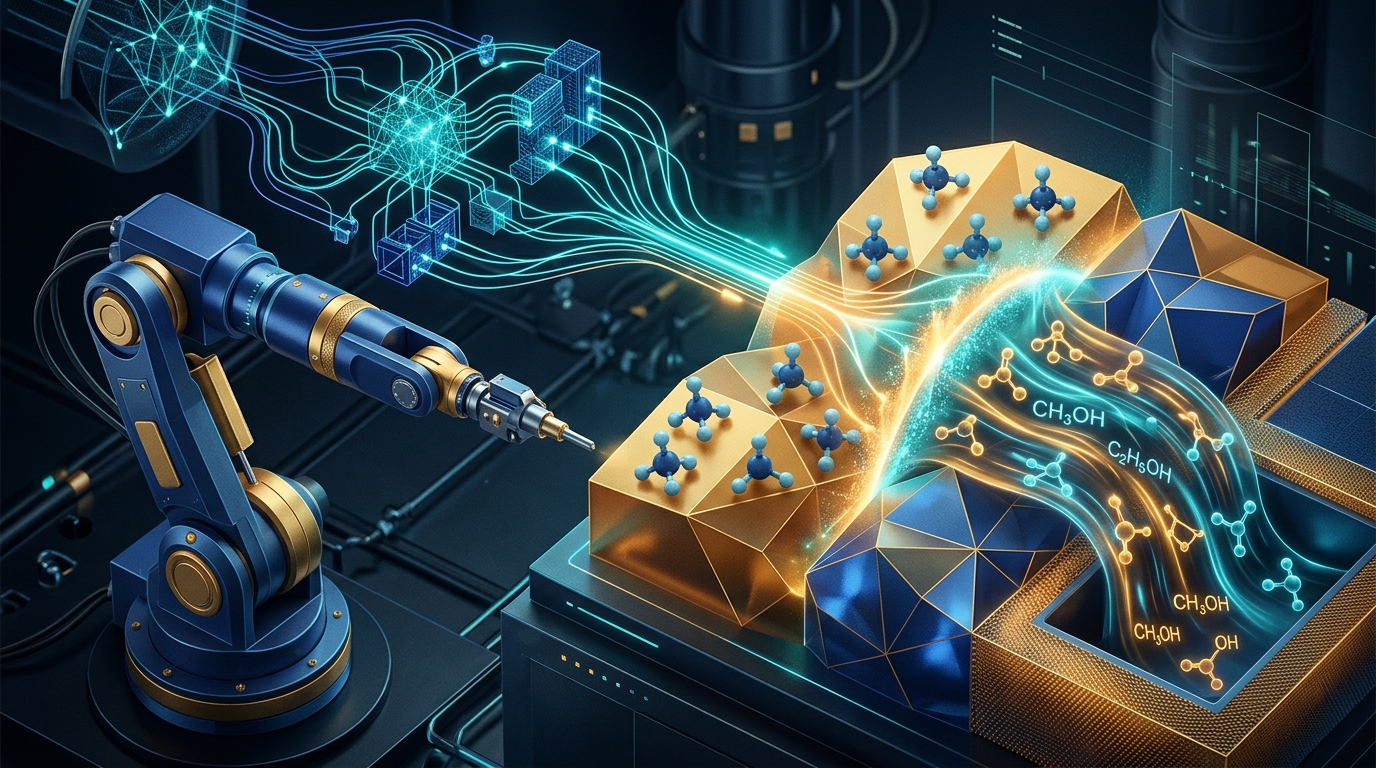
Machine learning and robotic synthesis are reshaping the decades-long hunt for catalysts that can turn methane, the main component of natural gas, directly into ethylene, one of the world’s most important industrial chemicals.
The stakes are considerable. Ethylene is the largest-volume synthetic organic chemical in the world, used mainly to make polyethylene but also serving as a precursor for polyvinyl chloride, polyethylene terephthalate, ethylene glycol, polystyrene and vinyl acetate. Today it comes almost entirely from cracking naphtha or ethane, a process that depends on petroleum, consumes large amounts of energy and carries environmental costs. Converting methane directly into ethylene would open a gas-based chemical route, and oxidative coupling of methane, which offers higher energy efficiency and catalysts that resist coking, has long been seen as the most promising direct pathway.
Yet the reaction has stubbornly resisted industrialization. The problem is thermodynamic: as a selective oxidation reaction, oxidative coupling of methane produces carbon monoxide and carbon dioxide byproducts whose formation releases more free energy than the desired C2 hydrocarbons, so keeping selectivity high while conversion remains high is extraordinarily difficult. The authors’ own statistical analysis of a database covering 622 catalysts reported in the literature found that 98.3 percent fall short of the 30 percent industrial feasibility threshold.
The field’s history shows both progress and persistent limits. Otsuka and colleagues introduced rare earth oxide catalysts such as lanthanum oxide and samarium oxide in 1985, the same year Lunsford’s group introduced the lithium-magnesium oxide system and later proposed the heterogeneous-homogeneous reaction mechanism. In 1988, Labinger calculated that the C2 yield is capped at a maximum of 30 percent under atmospheric pressure because of kinetic constraints in the gas-phase reaction. The classic manganese-sodium tungsten oxide on silica catalyst arrived in 1992, and in 2001 artificial intelligence entered the field for the first time. Siluria Technologies built the world’s first pilot-scale plant in 2015, and in 2018 Takahashi and colleagues applied the random forest algorithm, significantly reducing experimental workload.
Machine learning now contributes across several fronts. The authors compiled a catalyst database with detailed specifications including reaction temperatures, methane conversion rates and C2 yields, categorizing catalysts into four groups: rare earth oxides, alkali and alkaline earth metal catalysts, transition metal complex catalysts such as the manganese-sodium tungsten system, and perovskite-type catalysts. The analysis showed that the manganese-sodium tungsten system performs well at 750 to 800 degrees Celsius, alkali and alkaline earth metal catalysts do better near 700 degrees, and perovskites hold activity across a wide temperature range. Alkali/alkaline earth catalysts and the manganese-tungsten system tend to prioritize C2 selectivity, with data points showing 63.6 percent and 73.8 percent respectively where selectivity reached 50 percent.
Individual studies illustrate the predictive power on offer. Brook Wander and colleagues built a framework that explored 947 binary transition metal catalysts with high precision, predicting adsorption energies of carbon monoxide and hydroxyl species and identifying platinum-titanium, palladium-vanadium, nickel-niobium and titanium-zinc as exceptionally promising combinations.
Other groups have pushed the methodology further. Sora Ishioka combined hierarchical clustering with random forest methods to identify five physical descriptors critical to C2 selectivity: first and second ionization energies, electron affinity, Pauling electronegativity and density. Junya Ohyama applied Gaussian mixture models to 58 experimental catalysts and, through frequent itemset mining, identified 19 low-temperature active catalysts, with predicted aluminum-yttrium oxide and silver-yttrium oxide confirmed as active at low temperature in experiments. Comparisons of algorithms have also matured: Lord Ugwu’s evaluation of extreme gradient boosting, random forest, deep neural networks and support vector regression found the gradient boosting model most accurate, with an average R-squared of 0.91.
Deep learning extends these capabilities to larger and more complex datasets. Shun Nishimura combined 40,330 high-throughput data points with 1802 literature-derived points, using support vector and Bayesian regression to predict 30 new lanthanum oxide-based catalysts that achieved C2 yields above 5 percent at 450 degrees Celsius. Kexin Chen developed a neural network integrated with a simplified four-step reaction network based on 4578 literature data points, successfully predicting the local sensitivity of the manganese-sodium tungsten system and validating the reported 30 percent upper limit for C2 yield while enforcing mass conservation. Input variables matter too: Nishino’s group used catalyst basicity as a model input and synthesized 28 new catalysts, finding that barium-indium-rubidium on lanthanum oxide reached a C2 yield of 26.4 percent at 900 degrees Celsius, outperforming the classical manganese-sodium tungsten catalyst at 17.8 percent.
Machine synthesis addresses the other half of the bottleneck. Selecting any three elements from the 68 elements involved in four decades of catalyst development yields 50,116 possible combinations, and accounting for compositional variations would push the required parallel experiments to 6.3 million, a scale impossible to achieve manually. Where traditional development produced only tens of catalysts per day, machine synthesis now generates thousands daily. Taniike’s high-throughput instrument automatically evaluated 20 catalysts under 216 reaction conditions, generating 12,708 data points and confirming that performance is highly composition-dependent. Ina Hahndorf built a robotic platform translating catalyst data into synthesis parameters, and Janssen introduced high-throughput X-ray diffraction characterization that prepared 24 samples simultaneously on a microtiter plate. Inkjet printing has emerged as a particularly powerful technique: Jie Fan’s group fabricated 2048 formulated lithium-magnesium-manganese oxide catalysts on lanthanum oxide within a week in a four-round synthesis-and-screen process, identifying an optimized formulation through only 32 tests that delivered an external C2 yield of 10.9 percent at 700 degrees Celsius, twice that of pure nano-lanthanum oxide.
Despite these gains, the authors conclude that no new catalyst with a breakthrough C2 yield has emerged from machine learning and machine synthesis alone, because past design has stayed within the traditional framework focused on methyl radical generation. In the accepted heterogeneous-homogeneous mechanism, methane is activated on the catalyst surface to produce methyl radicals that then couple homogeneously in the gas phase, meaning catalyst optimization cannot regulate the coupling step itself. Kinetic simulations by Arutyunova and colleagues predicted a theoretical maximum C2 yield of 25 percent unless the catalyst actively participates in radical coupling. The authors argue that future progress requires shifting gas-phase coupling to a controlled surface-coupling process, as demonstrated in the selective system developed by Jie Fan’s team, whose methyl radical surface coupling catalysts cannot activate oxygen or methane themselves but capture gas-phase radicals and convert them selectively into C2 products, surpassing the traditional 30 percent limit.
Subject of Research: Application of machine learning and machine synthesis to accelerate the discovery of oxidative coupling of methane catalysts for ethylene production
Article Title: Accelerate the discovery of OCM catalysts with machine-learning and machine-synthesis
Article References: Ouyang, J., Ren, Y., Zou, S., Chen, X., & Fan, J. (2025). Accelerate the discovery of OCM catalysts with machine-learning and machine-synthesis. Discover Catalysis, 2(1), Article 24. https://doi.org/10.1007/s44344-025-00029-0
Image Credits: AI Generated
DOI: 10.1007/s44344-025-00029-0
Keywords: oxidative coupling of methane, machine learning, machine synthesis, ethylene, catalyst discovery, high-throughput experimentation, C2 yield, deep learning, inkjet printing, natural gas conversion, methyl radicals, artificial intelligence
News Source: Blake Davidson. (November 3, 2026). Machine learning and robotic synthesis race to break methane conversion barrier. Scienmag.