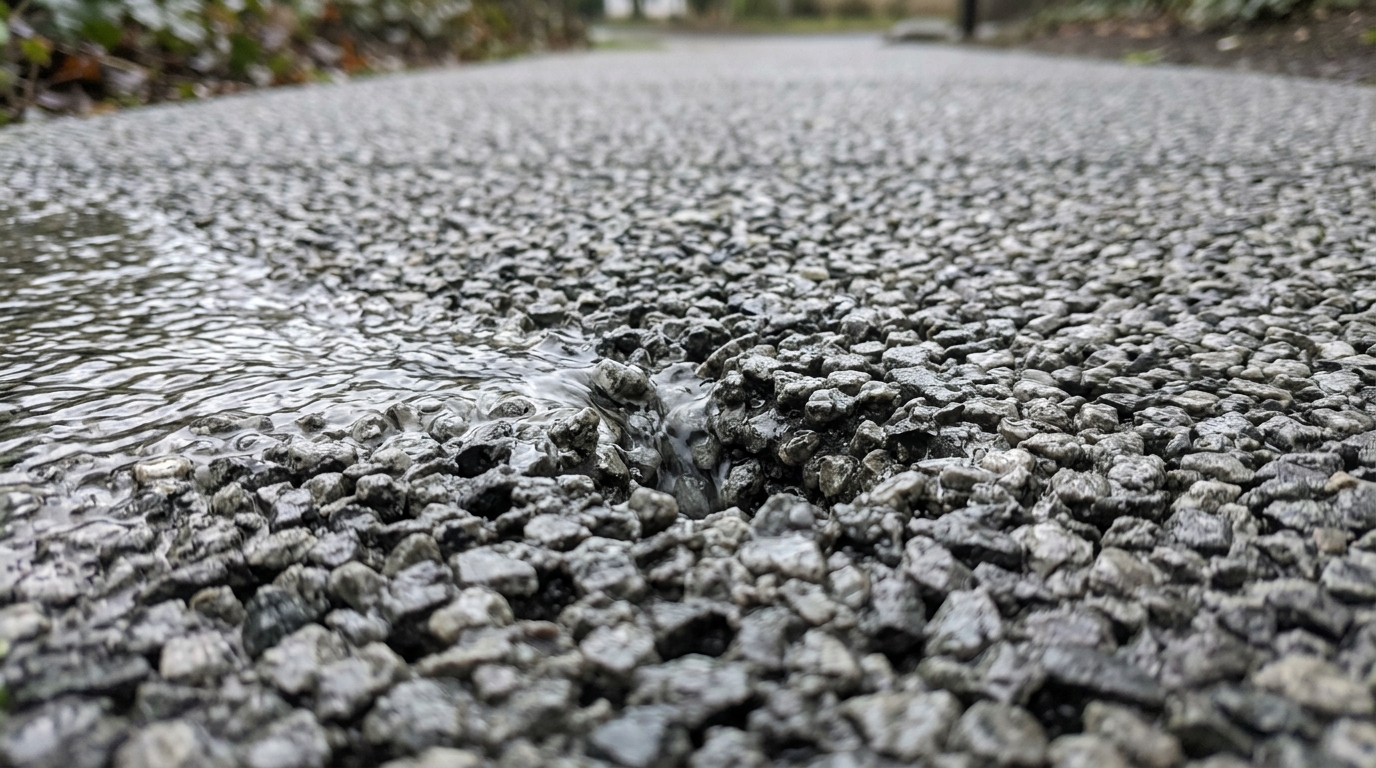
Sustainable pervious concrete has become a critical engineering tool for modern urban stormwater infrastructure, offering an effective method to counteract the hydrological disruptions caused by expanding impervious surfaces. Characterized by an open-graded skeletal architecture with minimal fine aggregates, pervious concrete maintains an interconnected void ratio typically ranging between fifteen percent and thirty percent. This distinct internal geometry allows stormwater to pass directly through pavement surfaces, simultaneously replenishing regional groundwater aquifers, filtering common urban pollutants, and mitigating flash flooding. However, widespread structural deployment has been hindered by reduced mechanical strength compared to conventional dense concrete, restricting its use largely to pedestrian pathways, parking facilities, and low-traffic roadways. To mitigate the significant carbon footprint and high energy consumption associated with ordinary Portland cement production, civil engineers have increasingly turned to supplementary cementitious materials, most prominently fly ash derived from coal-fired power plants. When introduced into the cement paste, fly ash introduces complex, non-linear alterations to fresh paste workability, curing kinetics, pore connectivity, and fluid transport, complicating the balance between mechanical durability and water permeability.
Designing pervious concrete mixtures that maintain rapid water drainage while ensuring adequate structural load capacity has traditionally required extensive, labor-intensive, and material-consuming trial-and-error testing in physical laboratories. While data-driven machine learning models have recently been deployed to predict the compressive strength and hydraulic conductivity of conventional concrete mixtures, computational modeling specifically targeting fly ash-modified pervious concrete has remained remarkably scarce. Previous studies focused predominantly on basic water-to-cement ratios or isolated mechanical strength predictions, neglecting the intricate synergistic interactions between supplementary fly ash content, water-to-binder proportions, and coarse aggregate skeletal structures. Furthermore, classical machine learning tools frequently function as opaque black boxes that hide the governing physical relationships, creating reluctance among structural engineers to adopt algorithmic predictions. To overcome these technological challenges, civil engineering researchers Navaratnarajah Sathiparan and Daniel Niruban Subramaniam constructed an explainable machine learning framework designed to predict pervious concrete hydraulic permeability using standardized experimental data and post-hoc model interpretation.
The study established a protocol-harmonized meta-dataset consisting of one hundred and fifty unique experimental records systematically extracted from peer-reviewed investigations published between 2010 and 2026 across the Scopus and Google Scholar repositories. Beginning with three hundred and twelve initial literature records, the authors applied strict multi-stage screening criteria to eliminate confounding experimental variance and prevent data contamination. Studies were admitted only if they explicitly reported four primary mix constituents: aggregate-to-binder ratio, fly ash-to-binder replacement ratio, water-to-binder ratio, and mean aggregate size, alongside experimentally measured hydraulic permeability in millimeters per second conducted under standardized laboratory water permeameter setups. Conversely, investigations utilizing non-standard mineral or chemical additives such as synthetic polymers, discrete fibers, or ternary cement blends were excluded to isolate the specific influence of fly ash. Because over sixty-five percent of surveyed literature omitted standardized effective porosity or utilized non-comparable planar measurements, the modeling framework focused strictly on raw mix-proportioning parameters available to batch plant operators prior to concrete casting.
To rigorously evaluate the experimental design space, the authors developed a systematic workflow involving data cleaning, standardization, and stratified holdout partitioning. The compiled meta-dataset was split using a stratified seventy-thirty division into a training subset of one hundred and five records and an independent holdout testing subset of forty-five records, preserving proportional distributions of extreme aggregate sizes and high-volume fly ash contents across both groups. Continuous feature values were normalized via Z-score standardization, with mean and standard deviation parameters derived exclusively from the training partition to prevent data leakage into evaluation phases. Four diverse machine learning architectures were implemented to model non-linear material interactions: Artificial Neural Networks utilizing a multi-layer perceptron trained with the Adam optimizer and early stopping, non-parametric K-Nearest Neighbors relying on Euclidean distance metrics, Support Vector Regression employing a non-linear Radial Basis Function kernel, and Extreme Gradient Boosting operating through an ensemble of regularized gradient-boosted decision trees guided by five-fold cross-validation.
The underlying database spanned a broad operational envelope reflecting functional pervious concrete configurations. The aggregate-to-binder ratio extended from 2.50 to 6.56 with a mean value of 3.84, capturing the structural transition from paste-rich matrices to skeleton-dominated networks. The fly ash-to-binder replacement ratio spanned from 0.00 in pure cement control mixtures up to 0.80, with data density concentrated primarily between 0.00 and 0.20 alongside a positive skewness of 1.06 and kurtosis of 1.95. The water-to-binder ratio exhibited a narrow variance strictly bounded between 0.22 and 0.45 with a low standard deviation of 0.04, reflecting practical engineering limits where drier mixtures lose workability while excessively wet mixtures cause paste drainage that clogs basal pores. Mean aggregate size varied from 6.18 millimeters to 20.00 millimeters across an even distribution with a near-neutral kurtosis of negative 0.23, driving hydraulic permeability values across the dataset from dense infiltration thresholds up to an ultra-rapid draining capacity of 23.50 millimeters per second with an overall average of 6.54 millimeters per second.
When evaluated across comprehensive quantitative regression metrics, the Extreme Gradient Boosting model demonstrated superior predictive capability and cross-validation stability over the three alternative architectures. During training, the boosted tree ensemble achieved an exceptional goodness-of-fit with a coefficient of determination of 0.99 and a root mean square error of 1.34 millimeters per second. On the unseen testing dataset, the model maintained high predictive generalization, securing a coefficient of determination of 0.85, a root mean square error of 1.85 millimeters per second, a low scatter index of 0.29, and an engineering reliability a20-index score of 57.78 percent. By contrast, the Artificial Neural Network and Support Vector Regression models achieved identical, moderate testing coefficients of determination of 0.60, with elevated root mean square errors near 3.05 millimeters per second and scatter indices of 0.48. The K-Nearest Neighbors model demonstrated the poorest overall accuracy, generating a weak testing correlation of 0.34, a root mean square error of 3.95 millimeters per second, and a low a20-index of 42.22 percent.
Residual error distribution analyses conducted through beeswarm dispersion mappings provided granular confirmation of model stability and variance control. On the training records, Extreme Gradient Boosting residuals clustered tightly along the zero-error axis within a narrow band extending from negative 2.08 to positive 1.98 millimeters per second, whereas the comparison models produced dispersed error spreads exceeding deviations of plus or minus 7.5 millimeters per second. When exposed to the unseen testing partition, the Extreme Gradient Boosting error range expanded moderately between negative 6.03 and positive 3.69 millimeters per second, preserving an average prediction bias of 0.14 millimeters per second. Conversely, alternative algorithms suffered severe error expansions, with K-Nearest Neighbors displaying widespread residuals spanning from negative 13.57 to positive 10.91 millimeters per second and a substantial positive bias of 0.97 millimeters per second, while Support Vector Regression and Artificial Neural Networks generated severe underestimation extremes reaching negative 11.67 and negative 11.17 millimeters per second, respectively.
To examine shared predictive competence and unique model strengths within a strict plus-or-minus twenty percent error envelope, the researchers constructed four-set Venn diagrams. Across the one hundred and five training samples, a collective core of thirty-one data points fell within the twenty percent accuracy threshold simultaneously for all four algorithms, representing baseline mix designs with minimal predictive variance, while fourteen complex instances remained uncaptured by every model. Extreme Gradient Boosting successfully mapped eight unique training points that all three competing architectures failed to capture, whereas Support Vector Regression captured zero unique points, and the neural network and nearest-neighbor baselines captured three each. In the independent testing evaluation of forty-five records, the universal four-model intersection dropped to eight samples, while fourteen difficult samples remained unmapped across all models. In this testing phase, Extreme Gradient Boosting uniquely resolved seven challenging instances that no other algorithm could predict accurately, while K-Nearest Neighbors resolved zero unique samples, illustrating the superior adaptability of regularized decision tree ensembles over distance-based and dense neural frameworks.
The study further mapped continuous model outputs into five standardized civil engineering drainage tiers based on American Concrete Institute and ASTM international specifications: low permeability below 2 millimeters per second, standard infiltration between 2 and 5 millimeters per second, enhanced drainage between 5 and 8 millimeters per second, high-capacity drainage between 8 and 12 millimeters per second, and ultra-high flow exceeding 12 millimeters per second. Multi-class confusion matrices revealed that Extreme Gradient Boosting successfully classified thirty-four out of forty-five testing instances directly along the major diagonal, representing accurate functional tier assignments. Crucially, all misclassifications produced by the boosted tree ensemble were strictly bounded within immediately adjacent intervals without severe cross-category errors. In contrast, Support Vector Regression correctly aligned thirty testing instances, while K-Nearest Neighbors exhibited widespread interval scattering, misclassifying ten out of fifteen actual standard-tier samples into higher brackets, including erroneous predictions extending all the way into the ultra-high flow category.
To interpret the decision logic of the optimal tree ensemble, the authors conducted post-hoc SHapley Additive exPlanations, translating abstract mathematical operations into mechanistically plausible engineering insights. Global feature importance rankings established that the aggregate-to-binder ratio exerted the greatest predictive influence with a mean absolute attribution value of 1.088, followed by the water-to-binder ratio at 0.964, mean aggregate size at 0.631, and fly ash replacement ratio at 0.223. Summary distributions showed that elevated aggregate-to-binder ratios generated positive attribution values up to plus two by reducing relative paste volume and preserving interconnected macropore channels, whereas lower ratios generated negative attributions down to minus four due to excess paste filling interstitial voids. Higher water-to-binder ratios contributed positive impacts up to plus three by lowering paste viscosity and promoting gravitational consolidation away from upper void structures, while stiffer, low-moisture pastes caused localized throat blockages. Larger aggregate sizes predominantly lowered hydrodynamic resistance, though occasional negative attributions emerged due to packing boundary constraints in laboratory molds. Finally, fly ash replacement exhibited a minor impact constrained between negative 0.5 and positive 0.5, where low substitution preserved voids, intermediate replacement densified packing via micro-filler effects, and high substitution delayed pozzolanic hydration, causing the net hydraulic influence to flatten toward zero.
Subject of Research: Explainable machine learning modeling for predicting the hydraulic permeability of fly ash pervious concrete
Article Title: Explainable machine learning modeling for predicting the hydraulic permeability of fly ash pervious concrete
Article References: Sathiparan, N., & Subramaniam, D. N. (2026). Explainable machine learning modeling for predicting the hydraulic permeability of fly ash pervious concrete. Discover Civil Engineering, 3(1), Article 278. https://doi.org/10.1007/s44290-026-00676-8
Image Credits: AI Generated
DOI: 10.1007/s44290-026-00676-8
Keywords: pervious concrete, fly ash, machine learning, hydraulic permeability, explainable artificial intelligence, civil engineering, stormwater management, concrete technology, Explainable, machine, learning, modeling
News Source: Blake Davidson. (November 7, 2026). Machine Learning Accurately Predicts Fly Ash Pervious Concrete Drainage Performance. Scienmag.