Neuropathic pain, the burning, shooting, or electric-shock-like pain that arises when nerves themselves are damaged or diseased, affects millions of people worldwide and remains one of the most stubborn conditions in clinical medicine. When drugs fail, clinicians often turn to neuromodulation, a family of techniques that use electrical currents, magnetic fields, or precisely targeted heat to alter the way pain signals travel through the nervous system. But with nearly two dozen different neuromodulation approaches now available, ranging from implanted spinal cord stimulators to non-invasive brain stimulation caps, doctors have had surprisingly little rigorous evidence to guide them on which technique works best for which patient. A new systematic review and network meta-analysis published in BMC Medicine offers the most comprehensive answer yet, and its findings are already being discussed as a potential turning point in how nerve-related pain is treated.
The research team, led by Hou-Ming Kan and colleagues working across institutions including Macau University of Science and Technology, the Affiliated Hospital of Xuzhou Medical University, and Peking University, cast an unusually wide net. They systematically searched five major databases, PubMed, Embase, the Cochrane Library, Web of Science, and Scopus, from their inception through July 1, 2025, hunting for randomized controlled trials that tested any neuromodulation technique against any form of neuropathic pain. Two reviewers independently extracted the data, and the team assessed the risk of bias in each trial using the Cochrane Risk of Bias 2 tool, the current gold standard for judging the methodological quality of randomized studies. The final harvest was remarkable: 115 randomized controlled trials evaluating 19 distinct neuromodulation techniques, spanning everything from implanted electrodes along the spinal cord to magnetic pulses aimed at the brain.
To make sense of this enormous body of evidence, the researchers turned to network meta-analysis, a statistical technique that has transformed how comparative medicine is done. Unlike a traditional meta-analysis, which can only pool trials that compare the same two treatments head to head, a network meta-analysis builds a web of comparisons across all trials simultaneously, allowing treatments that were never directly tested against each other to be ranked using both direct and indirect evidence. The team used Bayesian models, implemented in R 4.2.3 and Stata, to estimate the relative effectiveness of each technique. They then ranked the interventions using SUCRA, the surface under the cumulative ranking curve, a metric that assigns each treatment a score between zero and one hundred percent reflecting its probable position among all competitors.
Crucially, the authors did not stop at ranking. They recognized that a league table of treatments is only as trustworthy as the evidence beneath it, so they applied the Confidence in Network Meta-Analysis framework, known as CINeMA, which is built on the widely used GRADE system. This tool grades the certainty of each network estimate by considering factors such as the risk of bias in the contributing trials, the consistency between direct and indirect evidence, the precision of the estimates, and the possibility of publication bias. The conclusions were framed using a partially contextualised approach, meaning the authors weighed both the statistical strength of the findings and their practical importance for patients living with pain.
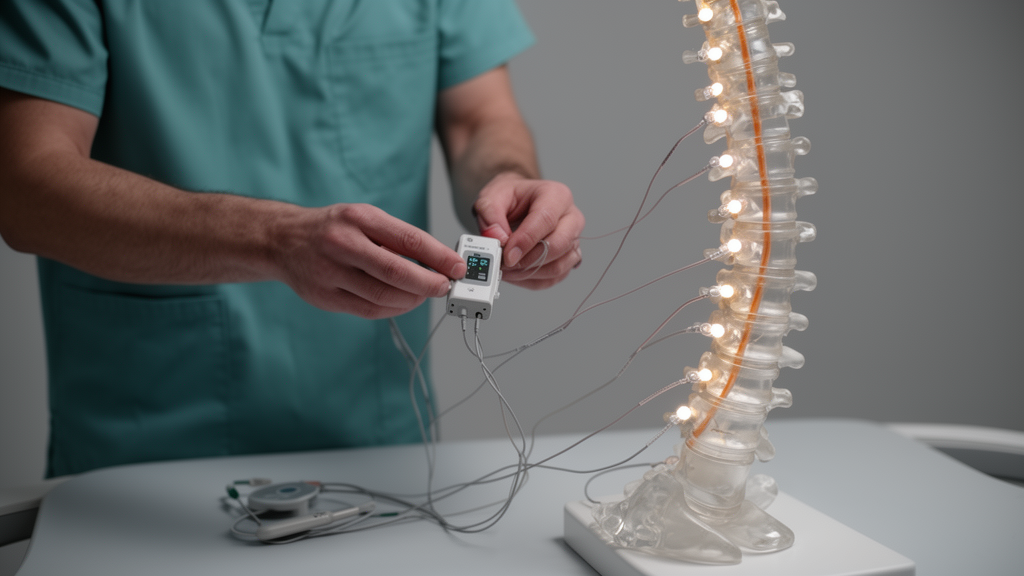
The headline result is that low-frequency spinal cord stimulation, often abbreviated LF-SCS, stood out as the neuromodulation technique with the most substantial supporting evidence for neuropathic pain, and the certainty of that evidence was rated as moderate. Spinal cord stimulation involves surgically implanting thin electrodes in the epidural space near the spinal cord, which deliver electrical pulses that interfere with pain signals ascending to the brain. Low-frequency stimulation, typically operating at rates below about 100 hertz, is the classic configuration that produces a mild tingling sensation known as paresthesia, and it has decades of clinical use behind it. What this new analysis adds is a formal, evidence-graded confirmation that among all the competing techniques, this established approach currently carries the strongest foundation of randomized trial data.
Close behind the leader, the analysis identified several other techniques with favorable analgesic effects, though the certainty of the evidence supporting them was rated as low. These included peripheral nerve stimulation, which targets individual nerves outside the brain and spinal cord; high-frequency spinal cord stimulation, which delivers rapid pulses at around 10 kilohertz and typically produces no tingling sensation at all; radiofrequency thermocoagulation, a technique that uses heat to selectively interrupt pain-carrying nerve fibers; dorsal root ganglion stimulation, which places electrodes on the clustered nerve-cell bodies where sensory fibers converge before entering the spinal cord; and two variants of pulsed radiofrequency, bipolar and high-voltage, which apply brief bursts of electrical energy to nerve tissue without generating destructive heat. The favorable signals for these methods are encouraging, but the authors are careful to note that low-certainty evidence means future research could materially change these conclusions.
Perhaps the most sobering findings concern the non-invasive transcranial techniques, the methods that aim electromagnetic or electrical stimulation at the brain from outside the skull. These include repetitive transcranial magnetic stimulation, which uses powerful magnetic pulses to excite neurons in the primary motor cortex or the dorsolateral prefrontal cortex, as well as transcranial direct current and alternating current stimulation, which pass weak currents through the scalp, and intermittent theta burst stimulation, a rapid patterned form of magnetic stimulation. The analysis found that these brain-directed approaches demonstrated only limited analgesic benefits, and the evidence behind even those modest effects was rated as low certainty. For patients drawn to the idea of pain relief without surgery, this is a reminder that non-invasive does not automatically mean proven, and the authors explicitly call for further studies before these techniques can be confidently recommended.
The significance of this work lies partly in what it exposes about the field itself. The authors point out that high-quality comparative evidence on the analgesic effects of different neuromodulation techniques has been lacking for most neuropathic pain subtypes, with the notable exception of well-defined conditions such as complex regional pain syndrome, a severe chronic pain condition that usually affects a limb after injury. This gap has left clinicians with limited guidance on optimal technique selection in most everyday clinical scenarios, where decisions about whether to implant a spinal cord stimulator, target a dorsal root ganglion, or try a course of transcranial magnetic stimulation have often rested on convention, local expertise, and device marketing rather than on graded comparative evidence. By assembling 115 trials into a single analytical framework, the review converts a fragmented literature into an interpretable map.
The methodological rigor of the study also deserves attention. Bayesian network meta-analyses rely on Markov Chain Monte Carlo sampling to explore the space of possible treatment effects, and the authors monitored convergence using standard diagnostics, including the Brooks-Gelman-Rubin statistic and potential scale reduction factors, to confirm that their models had stabilized. Standardized mean differences served as the effect measure, allowing trials that scored pain on different scales to be pooled on a common metric. The inclusion of credible intervals rather than simple confidence intervals reflects the Bayesian underpinning, expressing the range within which the true effect most plausibly lies. None of this statistical machinery guarantees truth, but combined with the CINeMA certainty grading, it gives readers a transparent account of how much confidence each conclusion deserves.
For patients and clinicians, the practical message is nuanced. The evidence now most strongly supports low-frequency spinal cord stimulation as a neuromodulation option for neuropathic pain, while several invasive alternatives show promise that awaits confirmation through better-designed trials. Non-invasive brain stimulation, despite its appeal, cannot yet be considered a reliably effective stand-alone therapy. The review, which received no specific grant from any funding agency in the public, commercial, or not-for-profit sectors and declared no competing interests, is positioned by its authors as a basis for future research and clinical decision-making. In a field where implanted devices can cost tens of thousands of dollars and failed trials leave patients with scars and disappointment, an evidence-graded ranking of 19 techniques is more than an academic exercise. It is a compass for a specialty that has, until now, been navigating largely by instinct.
Subject of Research: Comparative efficacy of neuromodulation techniques for neuropathic pain
Article Title: Effects of neuromodulation techniques on neuropathic pain: a systematic review and network meta-analysis
Article References: Kan, H.-M., Hong, H.-Y., Hu, Y.-J., Qin, Y.-Y., Zhang, S., Bai, Y.-Y., Wang, C., Wang, R.-Y., Ding, X.-T., Shen, W., & Chen, L.-P. (2026). Effects of neuromodulation techniques on neuropathic pain: a systematic review and network meta-analysis. BMC Medicine. https://doi.org/10.1186/s12916-026-05300-1
Image Credits: AI Generated
DOI: 10.1186/s12916-026-05300-1
Keywords: neuropathic pain, neuromodulation, spinal cord stimulation, network meta-analysis, dorsal root ganglion stimulation, pulsed radiofrequency, transcranial magnetic stimulation, peripheral nerve stimulation, randomized controlled trials, GRADE, pain medicine, BMC Medicine
News Source: Cassandra Pierce. (October 9, 2026). Low-Frequency Spinal Cord Stimulation Emerges as Top Neuromodulation Option for Neuropathic Pain. Scienmag.