LOUISVILLE, Ky. – Researchers from the University of Louisville School of Dentistry and their colleagues have discovered details of how proteins produced by oral epithelial cells protect humans against viruses entering the body through the mouth. They also found that oral bacteria can suppress the activity of these cells, increasing vulnerability to infection.
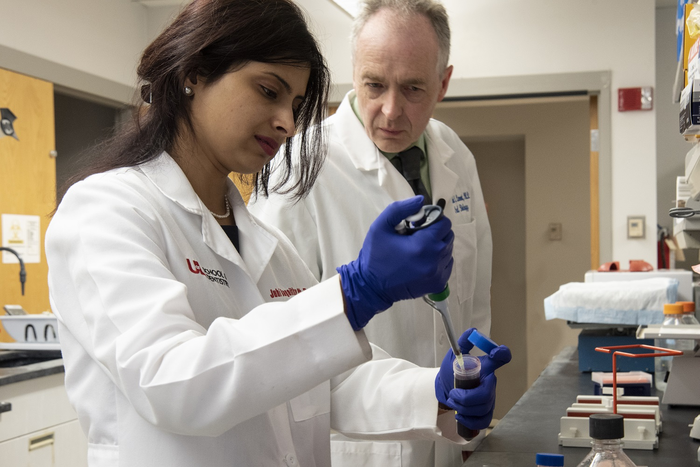
Credit: University of Louisville photo
LOUISVILLE, Ky. – Researchers from the University of Louisville School of Dentistry and their colleagues have discovered details of how proteins produced by oral epithelial cells protect humans against viruses entering the body through the mouth. They also found that oral bacteria can suppress the activity of these cells, increasing vulnerability to infection.
A family of proteins known as interferon lambdas produced by epithelial cells in the mouth serve to protect humans from viral infection, but the oral bacteria Porphyromonas gingivalis reduces the production and effectiveness of those important frontline defenders.
“Our studies identified certain pathogenic bacterial species, P. gingivalis, which cause periodontal disease, can completely suppress interferon production and severely enhance susceptibility to viral infection,” said Juhi Bagaitkar, assistant professor in the UofL Department of Oral Immunology and Infectious Disease. “These resident oral plaque bacteria play a key role in regulating anti-viral responses.”
Bagaitkar and Richard Lamont, professor and chair of the UofL Department of Oral Immunology and Infectious Disease, led the work, with first author Carlos J. Rodriguez-Hernandez and other colleagues at UofL and at Washington University in St. Louis. The findings were published in December in PNAS.
The mouth often is a gateway into the body for viruses that infect the gastrointestinal tract and lungs such as SARS-CoV-2, human immunodeficiency virus (HIV), herpes simplex and cancer-causing viruses such as human papillomavirus (HPV).
P. gingivalis, a common oral bacterium that causes periodontal disease, has been linked to numerous other diseases, including Alzheimer’s disease and rheumatoid arthritis. Recent clinical studies have shown that immune suppression in patients with periodontitis can enhance susceptibility to HIV, herpes simplex and HPV.
Improved understanding of how interferons provide broad antiviral protection and activate antiviral genes to protect people from viruses, as well as how P. gingivalis compromises their protection, may lead researchers to clinical approaches to increase that protection.
Research at UofL has revealed connections between P. gingivalis and multiple other diseases and conditions, including rheumatoid arthritis, Alzheimer’s disease and esophageal cancer.
Bagaitkar was one of the first junior faculty members whose research was supported by the Center of Biomedical Research Excellence (CoBRE) for research in microorganism disease research funded by the National Institute of General Medical Sciences.
###
Journal
Proceedings of the National Academy of Sciences
DOI
10.1073/pnas.2105170118
Method of Research
Experimental study
Subject of Research
Cells
Article Title
Microbiome-mediated incapacitation of interferon lambda production in the oral mucosa
Article Publication Date
21-Dec-2021
COI Statement
The authors declare no competing interest.