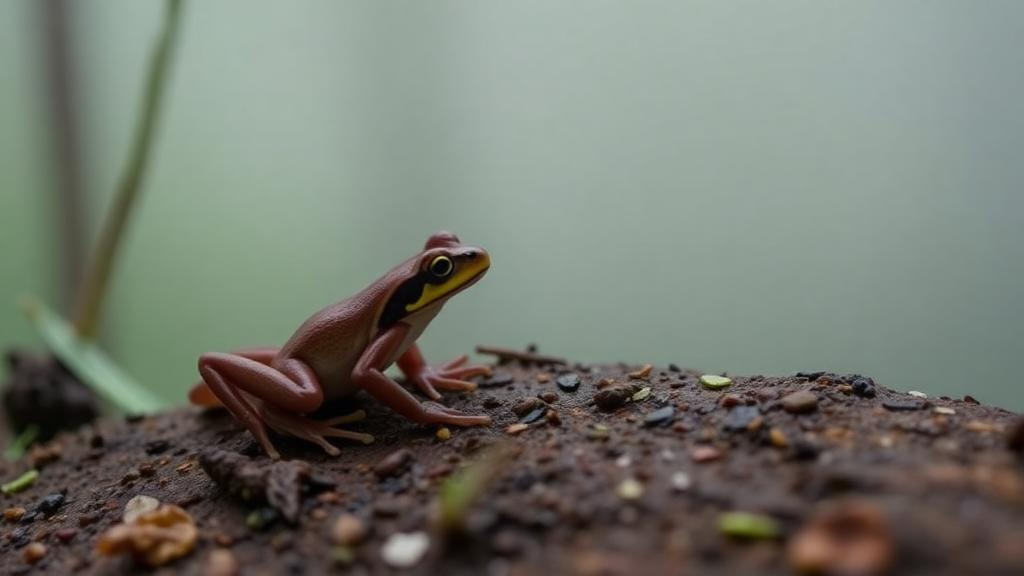
Deep in the misty Garo Hills of Meghalaya, in northeastern India, researchers have resurrected two frog species that science had all but forgotten. Described in 1919 by the legendary British herpetologist George Albert Boulenger, the tiny bush frogs known as Ixalus garo and Ixalus kempiae were based on single, sub-adult specimens collected near Tura more than a century ago. Since then, no one had reliably documented either species, and even the genus to which they belonged remained unresolved. A new study published in the journal Herpetozoa now confirms their identities, formally relocates them within the diverse bush frog genus Raorchestes, and, in a striking twist of taxonomic housekeeping, reveals that a species described as recently as 2019 is actually the same animal as Boulenger’s century-old Ixalus kempiae.
The research, led by scientists at the Sálim Ali Centre for Ornithology and Natural History (SACON), combined painstaking field surveys across 13 sites in the Garo and Khasi Hills with modern molecular and morphological analysis. Between October 2020 and January 2022, the team conducted nocturnal visual encounter surveys, homing in on the high-pitched calls of bush frogs after dusk. Once located, calling individuals were photographed, sampled for liver tissue, and preserved as voucher specimens, providing the genetic material and life-color documentation that Boulenger, working from a handful of pickled specimens shipped from colonial-era Assam, never had the chance to record.
Bush frogs of the genus Raorchestes are among the most spectacular vertebrate radiations on the Indian subcontinent, with the overwhelming majority of known species concentrated in the Western Ghats biodiversity hotspot of peninsular India. A smaller number of species ranges eastward through Northeast India and into Southeast Asia and China, most belonging to the so-called R. parvulus group. For over a hundred years, however, the two Garo Hills names sat in a taxonomic limbo. Ahl moved them to Rhacophorus in 1931, Bourret shifted them to Philautus in 1942, and after Philautus was later split apart, their generic home became anyone’s guess. The original descriptions, based on single sub-adult holotypes without genetic data, photographs in life, or details of many diagnostic characters, made field identification nearly impossible.
The team’s mitochondrial DNA analysis of the 16S rRNA gene, amplified through the polymerase chain reaction and analyzed alongside sequences from seventeen other Raorchestes species plus outgroup taxa, produced a decisive answer. Maximum likelihood phylogenetics showed that both rediscovered species nest firmly within Raorchestes, and the authors formally transferred them as Raorchestes garo comb. nov. and Raorchestes kempiae comb. nov. The fieldwork also yielded topotypical specimens, collected near the original type locality, that matched Boulenger’s holotypes in the key characters he described: in R. garo, a truncated snout, a small but visible ovoid tympanum, and dark orange coloring on the underside of the hind limbs; in R. kempiae, a rounded snout, an indistinct tympanum hidden beneath skin, and a yellow groin spotted with black and brown.
The molecular work produced a genuine surprise. Specimens matching Ixalus kempiae were genetically nearly identical to Raorchestes cangyuanensis, a species described in 2019 from Yunnan Province, China, showing only 0.46 percent divergence on the 16S gene, well within the range typical of variation within a single species. With no meaningful genetic separation and strong morphological overlap, the team concluded that R. cangyuanensis is a junior synonym of R. kempiae, meaning the Chinese name, published just five years ago, disappears into a name coined in 1919. The authors attribute the confusion to the simple fact that no one had seen or studied kempiae since Boulenger’s day, so the 2019 description could not be checked against the long-lost senior name. Complicating matters further, a 2023 study had already suggested that cangyuanensis might be synonymous with another name, R. manipurensis, and the authors note that resolving that tangle will require examination of manipurensis type specimens and new genetic material.
The surveys did more than confirm old names. At a low-elevation site within the Eman Asakgre Community Reserve, the team encountered a third, clearly distinct form of bush frog, which molecular and morphological evidence confirmed as new to science. Named Raorchestes asakgrensis, in honor of the Asakgre community whose residents supported the fieldwork, the species is a small, roughly 20-millimeter frog with an obtusely pointed snout, a faintly visible tympanum, supernumerary tubercles on the palm, and a uniformly creamy white underside to its hind limbs, a combination that separates it from all regional congeners. Genetically it differs from its closest relative, R. shillongensis, by 5.8 percent, and it forms a well-supported clade with sequences from Nongkhyllem in the Khasi Hills foothills some 150 kilometers away, suggesting a wider but still restricted distribution.
The two rediscovered species could hardly be more different in their apparent conservation outlook. Raorchestes garo, a medium-sized bush frog with a bold hourglass marking on its back, was recorded only infrequently and only above 800 meters elevation, at three localities in the West and East Garo Hills: Sakalgre, Daribokgre, and Mandalgre. Its estimated extent of occurrence is a precarious 11.46 square kilometers, and males call from shrubs more than 2.5 meters above the ground between April and September. Raorchestes kempiae, by contrast, proved relatively abundant across an elevational gradient stretching from 100 to 1,200 meters, with records from Mikadogre, Bollonggre, and Nengmandalgre, and an enormous estimated extent of occurrence of over 242,000 square kilometers when combined with the Chinese locality data. The authors accordingly recommend downgrading the species from Critically Endangered to Least Concern on the IUCN Red List.
For R. asakgrensis, the picture is intermediate. The species was heard calling at dusk from bushes, and a single amplecting pair was observed perched 1.5 meters above the ground at around half past seven in the evening during the pre-monsoon rains of May. Its estimated extent of occurrence is 1,625 square kilometers across elevations of 150 to 950 meters, with records spanning the Garo Hills from Sasatgre to Oragitok and Dangkipara and reaching into the low Khasi Hills at Umling and Nongpoh. The authors caution that all three range estimates remain preliminary, and that further surveys will be needed to map the true distributions of these cryptic, canopy-dwelling amphibians.
What makes the study remarkable is how much biodiversity lay hidden in plain sight within a few tens of kilometers of Boulenger’s original collecting grounds. The newly confirmed fauna of the Garo and Khasi Hills now includes four species of Raorchestes: the rediscovered R. garo and R. kempiae, the Khasi Hills endemic R. shillongensis, and the newly described R. asakgrensis. A fifth species, R. annandalii, was reported from Meghalaya in 2010, but its confirmed presence remains doubtful, since the Brahmaputra River separates Meghalaya from the species’ Darjeeling type locality and acts as a barrier to many regional lineages.
Beyond the Garo Hills, the paper carries a broader message about the pace and pattern of amphibian discovery. Species described from single, juvenile type specimens, without calls, genetics, or images of the living animal, can remain effectively invisible for generations, confusing conservation assessments and leading taxonomists to inadvertently describe the same animal twice under different names. Integrative taxonomy, which weaves together DNA barcoding, detailed morphometrics measured to the hundredth of a millimeter, ecological observations, and distribution modeling, offers a way out of this tangle. As Northeast India’s forests face mounting pressure, systematic surveys of the kind conducted here are proving essential not only for cataloging what lives in these hills, but for making sure the names science uses actually match the frogs calling in the dark.
Subject of Research: Taxonomic revision and rediscovery of Garo Hills bush frogs (Raorchestes) in Meghalaya, India
Article Title: Rediscovery and redescription of Ixalus garo Boulenger, 1919, and Ixalus kempiae Boulenger, 1919, with a reassessment of the taxonomic status of Raorchestes cangyuanensis Wu, Suwannapoom, Xu, Murphy & Che, 2019 and the description of a new species from the Garo Hills of Meghalaya
Article References: Naveen, R. S., Chandramouli, S. R., Babu, S., Ryndongsngi, A. M., Karunakaran, P. V., & Kumara, H. N. (2024). Rediscovery and redescription of Ixalus garo Boulenger, 1919, and Ixalus kempiae Boulenger, 1919, with a reassessment of the taxonomic status of Raorchestes cangyuanensis Wu, Suwannapoom, Xu, Murphy & Che, 2019 and the description of a new species from the Garo Hills of Meghalaya. Herpetozoa, 37, 359-372. https://doi.org/10.3897/herpetozoa.37.e122825
Image Credits: AI Generated
DOI: 10.3897/herpetozoa.37.e122825
Keywords: Raorchestes, bush frogs, Garo Hills, Meghalaya, taxonomic rediscovery, Herpetozoa, 16S rRNA, new species, synonymy, amphibian diversity, Boulenger, integrative taxonomy
News Source: Margaret Porter. (October 19, 2026). Lost for a Century, Two Tiny Indian Bush Frogs Emerge from the Mist of Meghalaya. Scienmag.