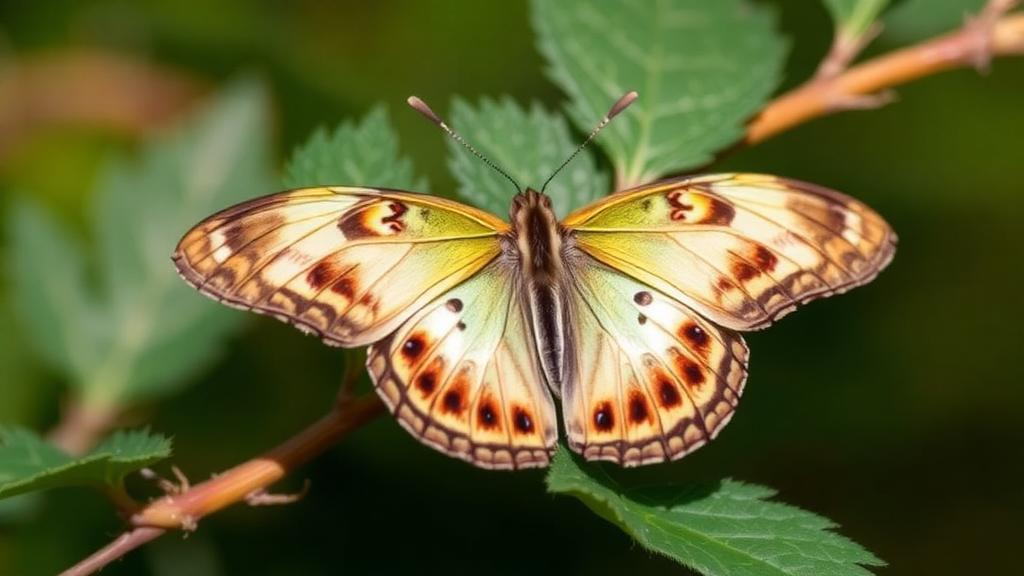
Deep in the mountains of northern Albania, on dark soils formed from ancient oceanic crust, lives a butterfly that scientists have just formally recognized as new to science. An international team of researchers has described Polyommatus lurae, a previously undetected species of the so-called anomalous blue butterflies, using an unusual combination of evidence: mitochondrial DNA barcodes, chromosome counts, and standardized measurements of wing colour reflectance. The discovery, published in the journal Comparative Cytogenetics, shows that even well-studied groups of European insects can still hide cryptic species in underexplored corners of the continent.
The anomalous blues belong to the subgenus Agrodiaetus within the large genus Polyommatus, a lineage of more than 120 species that spread explosively across the Western Palaearctic and Central Asia in the last three million years. Males of this group often display striking dorsal wing colours, from blue and silver to violet and brown, while females are usually brown. The species studied here are part of the brown complex, in which males are coffee-brown rather than blue, and they are notoriously difficult to tell apart by appearance alone. The state of a white streak on the underside of the hindwing, long used as an identification trait, turned out to be unreliable, as shown by past misidentifications of the Greek species Polyommatus aroaniensis in Croatia, where specimens lacking the streak were initially assigned to the wrong species until mitochondrial COI barcoding corrected the record.
Until now, the Polyommatus aroaniensis species complex was thought to contain three closely related allopatric species distributed across the southern Balkan Peninsula. Polyommatus aroaniensis sensu stricto lives in southern Greece and the Peloponnese and carries 47 to 48 chromosomes per haploid set, together with mitochondrial haplogroup aroa1. Polyommatus timfristos, described in 2016 from the mountains of central Greece, has only 38 chromosomes and haplogroup aroa2. Polyommatus orphicus, found in north-eastern Greece, southern Bulgaria and North Macedonia, has 41 to 42 chromosomes and haplogroup orph1. Each species is differentiated primarily by its chromosome number and mitochondrial DNA, because external morphology varies so much geographically and individually that it rarely provides unambiguous separation.
Suspicion that a fourth taxon existed arose when the first author collected butterflies across 94 sites in Albania, from the southern province of Korçë to the north-eastern province of Kukës. Only seven sites yielded members of the aroaniensis complex, and one region stood out dramatically: the Lurë region in Dibër province, where many individuals showed a remarkably dark habitus and mostly lacked the white hindwing streak entirely. Even more striking was their habitat. These butterflies lived on dark-coloured ophiolitic soils, substrates derived from fragments of former oceanic crust pushed up during mountain building, while related populations in the nearby Valikardhë region occupied visibly paler karst, or chalky limestone, substrates. In the ophiolitic habitats, plants of Onobrychis alba, a known foodplant for various Agrodiaetus species, were found growing.
To resolve the identity of these butterflies, the team analysed DNA from 41 Albanian specimens and mined 19 additional COI sequences from GenBank for comparison. The full 658-base-pair DNA barcode fragment was amplified with the primers LepF1 and LepR1, and a 411 to 440-base-pair fragment of the nuclear ITS2 region was also sequenced to strengthen the phylogenetic signal. Phylogenies were reconstructed with Bayesian inference, maximum likelihood and maximum parsimony methods on both the COI alignment and a concatenated COI plus ITS2 matrix of 1039 base pairs. In every analysis, the Albanian specimens carrying the mitochondrial haplogroup aroa3 formed a monophyletic, well-differentiated clade with strong support. The haplotype network, built from 54 specimens collapsed into 28 haplotypes, confirmed that aroa3 is the most differentiated mitochondrial lineage within the entire aroaniensis species complex, clearly separated from aroa1, aroa2 and orph1 by multiple nucleotide substitutions.
Karyotyping provided the second decisive line of evidence. Testes were removed from freshly collected males within an hour of capture, stored in fixative, and stained with acetic orcein for chromosome analysis under high-magnification light microscopy. The Albanian populations of Polyommatus orphicus showed a haploid chromosome number of n=42, fitting the previously described variability of the species. The dark Lurë butterflies, however, carried n=42 to 43, with variation caused by polymorphism for a single chromosome fusion or fission. Crucially, the difference between the two taxa lies in a different chromosome pair, meaning they differ by at least one fixed chromosome fission. Chromosome rearrangements have been shown to be important drivers of speciation in Polyommatus butterflies, and even a slight reduction in fertility of heterozygotes for such rearrangements can create a genetic boundary between chromosomally diverged populations.
The third line of evidence came from an innovative morphometric technique based on wing colour. The researchers photographed set male specimens under a standardized triangular arrangement of light sources in a darkened room, positioning the wings at a 20-degree angle to measure maximum light reflectance from the wing scale structures. Reflectance measurements were taken from the intervein space of the inner postdiscal zone, and exact RGB and hue values were extracted for statistical analysis. Non-metric multidimensional scaling plots of 27 specimens showed that wing reflectance matched the phylogenetic clades significantly. Polyommatus orphicus generally showed a measurable greenish reflectance on the postdiscal band of the forewing, a trait completely absent in the new species. Statistical analysis also revealed a significant link between each species and its typical soil substrate, dark ophiolitic versus light karst soils.
At the contact zone between the two species, where mixed ophiolite and karst substrates occur, the team detected specimens with unusual combinations of mitochondrial haplogroup and karyotype, including individuals with the orph2 haplogroup and n=43 chromosomes, together with intermediate morphology and intermediate wing reflectance. The researchers interpret these as hybrids between the new species and Polyommatus orphicus. Notably, the karyotypes expected for first-generation hybrids, which should all show 41 visible elements in the first meiotic metaphase, were not observed, suggesting that there is no complete reproductive isolation between the two species and that the observed patterns result from repeated hybridization and backcrosses. Alternatively, the Albanian orphicus lineage may itself carry n=42 to 43, though the restriction of these specimens to the contact zone and their intermediate morphology favour the hybridization hypothesis.
Based on this consensus of molecular, cytogenetic and morphometric evidence, the team formally described the Albanian taxon as Polyommatus lurae sp. nov., named after the Lurë region where the type locality lies. The species name also alludes to a local legend in which the Lura tribe, during the Ottoman wars, sent armed men disguised in bridal veils to surprise the enemy camp, a fitting reference for a species that has survived periods of close contact with more widely distributed congeners without complete admixture. The new species is distinguished by its dark chocolate-brown upperside, the absence of a white postdiscal streak on the forewing underside, a minimal or invisible hindwing streak, lack of wing reflectance, and its karyotype. Worn individuals may be externally indistinguishable from related taxa, but can still be identified by chromosome number and COI barcode.
The discovery carries an urgent conservation message. The Lurë region has been a National Park since 1966, yet illegal logging and forest fires are estimated to have destroyed as much as half of the original park, and overgrazing by sheep threatens the Onobrychis foodplants on which the butterfly depends. Because Polyommatus lurae occupies a very restricted area linked to a unique ophiolitic biotope found mostly in Albania, the researchers argue it should be considered a candidate for protected species lists in Albania and Europe. As Albania moves toward European Union membership, adequate protection legislation for its biodiversity heritage, including control of illegal logging, burning and uncontrolled grazing, will be essential to secure the future of this newly recognized species and the unique ecosystems that harbour it.
Subject of Research: Cryptic butterfly speciation in Albania
Article Title: Integrative analysis reveals cryptic speciation linked to habitat differentiation within Albanian populations of the anomalous blues ( Lepidoptera , Lycaenidae , Polyommatus Latreille, 1804)
Article References: Parmentier, L., Vila, R., & Lukhtanov, V. (2022). Integrative analysis reveals cryptic speciation linked to habitat differentiation within Albanian populations of the anomalous blues (Lepidoptera, Lycaenidae, Polyommatus Latreille, 1804). Comparative Cytogenetics, 16(4), 211-242. https://doi.org/10.3897/compcytogen.v16.i4.90558
Image Credits: AI Generated
DOI: 10.3897/CompCytogen.v16.i4.90558
Keywords: butterflies, Albania, cryptic species, Agrodiaetus, karyotype, DNA barcoding, speciation, biodiversity, Integrative, analysis, reveals, cryptic
News Source: Drew Townsend. (October 19, 2026). Hidden Butterfly Species Discovered in Albania Through DNA, Chromosomes and Wing Colour. Scienmag.