So how can the speed of dark matter be measured? The prerequisite is to find a galaxy in the universe that moves relative to dark matter. Since everything in the universe is in motion and there is a great deal of dark matter, it is not difficult to find such galaxies.
Heavy objects, like galaxies, attract all types of matter, whether it is dark matter or visible matter that we encounter on a daily basis. As dark matter moves past a galaxy, the galaxy begins to pull the dark matter particles towards it. However, the change of speed direction of the particles takes time. Before their trajectory curves towards the galaxy, they already manage to pass the galaxy.
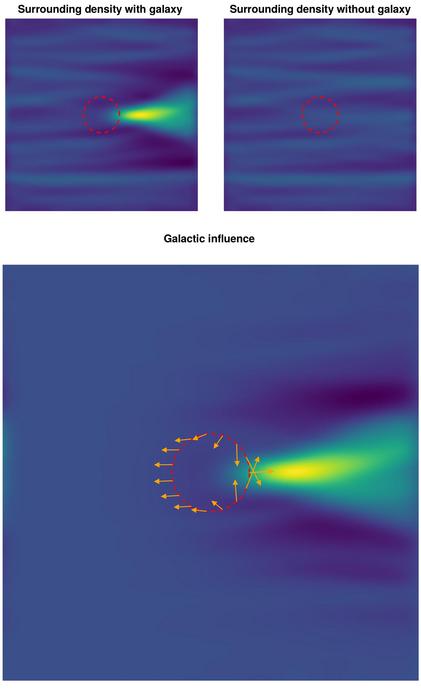
Thus, dark matter particles do not enter the galaxy, but instead move behind the galaxy (see video). Behind the galaxy, therefore, the density of matter increases, and this leads to a slowdown of the galaxy – a phenomenon called dynamical friction. The strength of dynamical friction, in turn, depends on how quickly dark matter particles pass the galaxy, that is, how long the galaxy has time to change the trajectory of the dark matter particles. When particles pass slowly, the density of matter increases closer to the galaxy, causing it to slow down more.
The green dot represents a galaxy, and the upper panels show the movement of dark matter particles past the galaxy (if a galaxy exists in the corresponding panel). The lower panels show the shape of all the trajectories, demonstrating that the gravity field of a galaxy affects the particles of matter, creating an overdensity behind the galaxy. Overdensity again slows down the galaxy and distorts its shape.
Let us assume that the galaxy causing the dynamical friction is not tiny, but large. In this case, the overdensity behind it generates friction of different strengths at different points in the galaxy, as seen in Figure 1. The difference in friction makes the shape of the galaxy more lopsided. We experience a similar change in shape on Earth as tidal cycles – high tides and low tides caused by the gravity of the moon.
It is irrelevant how big the dark matter particles eventually turn out to be – their orbit still curves behind the galaxy. The method might not produce accurate results if the particles were comparable in size to the galaxies themselves. However, these dark matter models are already excluded.
Finding the lopsided galaxies themselves is not difficult, because they make up about 30 percent of all galaxies in outer space. Of course, a lot depends on how far to look in the outer parts of a galaxy and what level of lopsidedness deems a galaxy lopsided.
Also, the lopsided shape of a galaxy may not be caused only by dynamical friction. There are a number of other reasons for that. For example, galaxies that were formed after the collision of several galaxies may be asymmetric. In this case, however, we should be able to detect somewhere inside the galaxy the nucleus of another galaxy or a larger stellar halo. Galactic lopsidedness can also be caused by a constant inflow of gas. In such situations, the shape of the galaxy will take a few billion years to recover.
Thus, to measure the velocities of dark matter, we need a lopsided galaxy that is as isolated from other galaxies as possible. In this case, it is more certain that nothing has happened to it other than the passage of dark matter.
In this research, we have figured out how to precisely calculate the forces that affect galaxies in tidal cycles. The next stage is to find galaxies sufficiently lopsided in the universe to study the velocity of dark matter relative to the galaxies.
Cosmology is an important test polygon of theoretical physics. Calculating the speed of dark matter can be important for testing new dark matter models and lifting the veil of secrecy over the nature of dark matter.
Credit: Rain Kipper
So how can the speed of dark matter be measured? The prerequisite is to find a galaxy in the universe that moves relative to dark matter. Since everything in the universe is in motion and there is a great deal of dark matter, it is not difficult to find such galaxies.
Heavy objects, like galaxies, attract all types of matter, whether it is dark matter or visible matter that we encounter on a daily basis. As dark matter moves past a galaxy, the galaxy begins to pull the dark matter particles towards it. However, the change of speed direction of the particles takes time. Before their trajectory curves towards the galaxy, they already manage to pass the galaxy.
Thus, dark matter particles do not enter the galaxy, but instead move behind the galaxy (see video). Behind the galaxy, therefore, the density of matter increases, and this leads to a slowdown of the galaxy – a phenomenon called dynamical friction. The strength of dynamical friction, in turn, depends on how quickly dark matter particles pass the galaxy, that is, how long the galaxy has time to change the trajectory of the dark matter particles. When particles pass slowly, the density of matter increases closer to the galaxy, causing it to slow down more.
The green dot represents a galaxy, and the upper panels show the movement of dark matter particles past the galaxy (if a galaxy exists in the corresponding panel). The lower panels show the shape of all the trajectories, demonstrating that the gravity field of a galaxy affects the particles of matter, creating an overdensity behind the galaxy. Overdensity again slows down the galaxy and distorts its shape.
Let us assume that the galaxy causing the dynamical friction is not tiny, but large. In this case, the overdensity behind it generates friction of different strengths at different points in the galaxy, as seen in Figure 1. The difference in friction makes the shape of the galaxy more lopsided. We experience a similar change in shape on Earth as tidal cycles – high tides and low tides caused by the gravity of the moon.
It is irrelevant how big the dark matter particles eventually turn out to be – their orbit still curves behind the galaxy. The method might not produce accurate results if the particles were comparable in size to the galaxies themselves. However, these dark matter models are already excluded.
Finding the lopsided galaxies themselves is not difficult, because they make up about 30 percent of all galaxies in outer space. Of course, a lot depends on how far to look in the outer parts of a galaxy and what level of lopsidedness deems a galaxy lopsided.
Also, the lopsided shape of a galaxy may not be caused only by dynamical friction. There are a number of other reasons for that. For example, galaxies that were formed after the collision of several galaxies may be asymmetric. In this case, however, we should be able to detect somewhere inside the galaxy the nucleus of another galaxy or a larger stellar halo. Galactic lopsidedness can also be caused by a constant inflow of gas. In such situations, the shape of the galaxy will take a few billion years to recover.
Thus, to measure the velocities of dark matter, we need a lopsided galaxy that is as isolated from other galaxies as possible. In this case, it is more certain that nothing has happened to it other than the passage of dark matter.
In this research, we have figured out how to precisely calculate the forces that affect galaxies in tidal cycles. The next stage is to find galaxies sufficiently lopsided in the universe to study the velocity of dark matter relative to the galaxies.
Cosmology is an important test polygon of theoretical physics. Calculating the speed of dark matter can be important for testing new dark matter models and lifting the veil of secrecy over the nature of dark matter.
DOI
10.1051/0004-6361/202347235
Method of Research
Data/statistical analysis
Subject of Research
Not applicable
Article Title
Back to the present: A general treatment for the tidal field from the wake of dynamical friction
Article Publication Date
15-Dec-2023