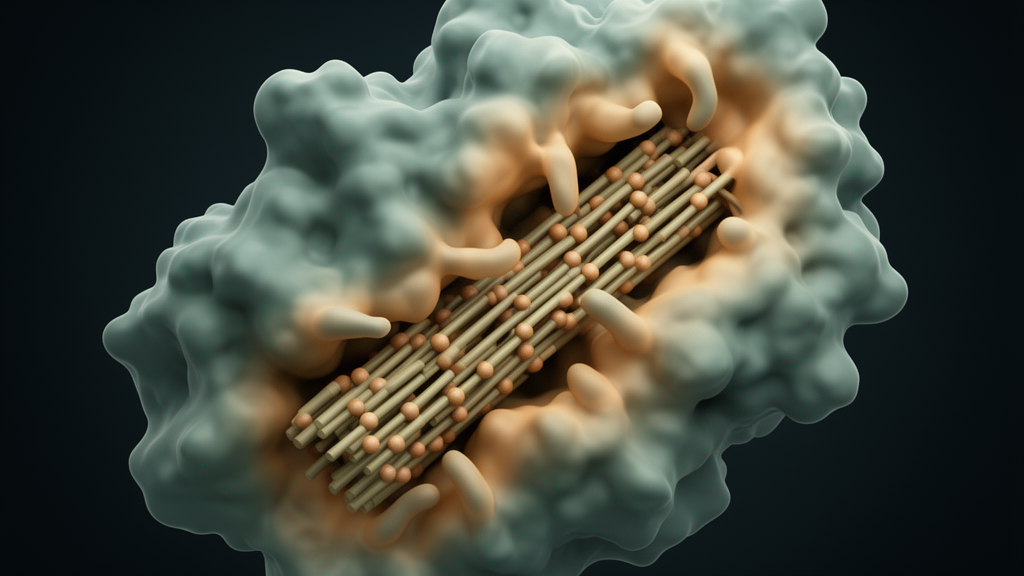
Enzymes that chop up cellulose sit at the heart of any plan to turn wood, straw, and other plant waste into fuels and chemicals, and their speed often decides whether a biorefinery makes economic sense. A team working across Nanjing University, China Tobacco Jiangsu Industrial Co., Ltd., and Jilin University now reports that the fastest route to a better cellulase did not run through the enzyme’s catalytic center at all. Instead, by deliberately loosening the flexible, solvent-exposed rim of the catalytic cavity in a family 5 glycoside hydrolase called CelB, the researchers built a double mutant that cuts cellulose markedly faster than the natural enzyme. The work, published in Frontiers in Bioengineering and Biotechnology, offers a template for engineering enzymes by tuning their periphery rather than their conserved core.
CelB comes from Bacillus sp. strain N-4 and belongs to glycoside hydrolase family 5, or GH5, the largest and most diverse family of endoglucanases. GH5 members crop up in bacteria, archaea, eukaryotes, and even some viruses, and many do far more than classic cellulose cutting; some act as mannanases or xylanases, and one enzyme from the porcine gut microbiota processively converts cellulose into cellobiose and cellotriose. This versatility makes GH5 enzymes attractive industrial catalysts, particularly for breaking down lignocellulose. What made CelB especially interesting to the team is its architecture. Most GH5 endoglucanases studied to date are single-domain enzymes, but CelB is bi-modular: a canonical catalytic domain spanning residues 1 to 309, a proline-rich linker, and a chitin-binding domain of the ChtBD3 type. Among three phylogenetically selected candidates, CelB also expressed well in soluble form, with roughly 40 percent of the total expressed protein found in the soluble fraction, and showed a specific activity of 2.813 units per milligram against carboxymethylcellulose.
The engineering strategy started with molecular docking. The researchers placed a cellohexaose ligand, a six-unit glucose chain, into an AlphaFold model of CelB and flagged every residue within 5 angstroms of the bound sugar. That screen produced more than twenty candidate hotspots, but an evolutionary conservation analysis using the ConSurf server eliminated most of them, because their conservation scores exceeded 8, signaling that they are likely structurally or functionally indispensable. The catalytic glutamates themselves, Glu139 and Glu228, fell into this protected zone. Five residues survived the filter: Trp39, Tyr40, Thr177, Leu210, and Thr265. All sit near the edge of the catalytic cavity where it meets the solvent, positioned to influence how glycan chains enter and leave rather than to perform chemistry directly. Trp39, Tyr40, and Thr265 cluster near the minus-3 subsite of the binding track, while Thr177 and Leu210 face the plus-2 subsite.
Solvent-accessibility calculations shaped the first round of mutations. Trp39 and Thr177 are fully exposed, with relative solvent-accessible surface areas above 50 percent; Tyr40 and Leu210 are partially exposed; and Thr265 is completely buried beneath the bulky aromatic side chains of Trp39, Tyr40, and Phe43. Guided by evolutionary profiles, the team introduced volume-reducing substitutions such as W39F, Y40G, Y40I, L210V, and T265S, plus hydration-oriented changes W39T and T177N. One substitution never made it to testing: the W39T mutant failed to express solubly, a consequence of the native tryptophan forming a Pi-Pi T-shaped interaction with the highly conserved Tyr66 that appears to hold local structure together. Among the variants that did express, Y40G reached 4.622 units per milligram, a 1.64-fold gain over wild type, and T177N reached 4.357 units per milligram, a 1.55-fold gain.
Molecular dynamics simulations explained where those gains came from. Root mean square fluctuation analysis showed that Y40G increased fluctuations in the Ser33-Gly41 segment, consistent with glycine’s lack of a C-beta atom and minimal steric bulk, while T177N raised fluctuations in the Ile172-Asp181 region, plausibly because asparagine’s greater hydrophilicity promotes side-chain hydration and mobility in water. Both effects pointed the same direction: substitutions that loosen the peripheral backbone can raise catalytic activity. That observation set up the second phase, a focused saturation mutagenesis campaign at Tyr40 and then Thr177, restricted to small residues and to hydrophilic ones with polar or charged side chains.
The library design was deliberately lean. Small-residue substitutions were installed with site-specific primers, while a degenerate codon encoded six hydrophilic residues, Lys, Asn, Gln, His, Glu, and Asp, each appearing only once to keep the library small and the hit rate high. Arginine was excluded on three grounds: its bulky guanidinium group tends to form nonspecific cation-Pi and electrostatic contacts, it stays fully protonated and positively charged up to about pH 10, and adding its codons would have doubled the screening workload. The bet paid off. Y40K, a lysine substitution, reached 6.896 units per milligram, 2.58 times the wild-type value, beating Y40G and every smaller-residue variant, with Y40Q close behind at 2.02-fold. Hydrophilicity, not merely shrinkage, proved to be the winning property at this solvent-exposed site.
Iterating the same focused strategy at Thr177 on the Y40K backbone produced the final construct, Y40K/T177K, at 9.107 units per milligram, 3.2 times wild-type activity. Simulation analysis showed that the double mutant carries elevated flexibility not only in the regions already loosened by Y40K, including His35-Asn45, Ala64-Val78, and Ser263-Ser290, but also in Gly174-Asp181 around the second mutation. The mechanism appears to propagate through a network of noncovalent contacts: the native Tyr40 packs hydrophobically against His35 and Lys267, and replacing it with lysine disrupts that packing, sending ripples through coupled structural units of the TIM-barrel fold. A parallel attempt to tune the proline-rich linker connecting the catalytic domain to the chitin-binding domain backfired; substituting four prolines with serine reduced activity, with one triple mutant losing 80 percent, indicating that the native linker architecture matters for coordinating the two modules.
Kinetic measurements quantified the payoff and revealed a clear pattern. Against soluble carboxymethylcellulose, Y40K/T177K achieved a kcat of 45.840 per second and a Km of 3.896 milligrams per milliliter, giving a catalytic efficiency of 11.766 milliliters per milligram per second, 2.73 times the wild-type figure of 4.307. Against phosphoric acid-swollen cellulose, an insoluble substrate that is harder for enzymes to access, the double mutant reached 2.719 milliliters per milligram per second, a 1.78-fold improvement driven almost entirely by a higher turnover number of 18.021 per second. In both cases the gains came mainly from kcat rather than substrate affinity, and the modest Km changes likely reflect the mutations’ side effects on neighboring binding residues such as His35, Lys267, Trp178, and Gln180, which contact the glycan directly.
The simulations added a mechanistic story for the faster turnover. The solvent-accessible surface area of the catalytic cavity, computed over 100-nanosecond trajectories, rose from 4.082 to 5.497 square nanometers in the double mutant, signaling a more open, dynamic pocket. Meanwhile, the distance between the center of mass of the two catalytic glutamates and that of the bound cellohexaose increased from 0.988 to 1.243 nanometers, meaning the ligand preferentially samples positions farther from the catalytic center. Together these observations are consistent with an increased tendency for the glycan chain to dissociate from the catalytic cleft, freeing the active site for the next catalytic cycle. That interpretation echoes earlier findings in the cellobiohydrolase TrCel7A, where flexible substrate-enclosing loops aid ligand release, and in TrCel5A, where faster dissociation from cellulose correlates with higher turnover.
Flexibility, however, came with a thermal price. The wild-type enzyme works optimally at 65 degrees Celsius, but the optima of Y40K and Y40K/T177K slid to 50 and 45 degrees respectively, and the mutants lost their advantage at 70 and 80 degrees, where simulations show the His35-Asn45 segment becoming hyper-flexible and perturbing neighboring structure. Differential scanning fluorimetry traced the same trade-off in melting temperature, which fell from 65.2 degrees for wild type to 54.5 and then 52.4 degrees for the single and double mutants. At 60 degrees Celsius all three enzymes were fully inactivated within 12 hours, with the variants retaining slightly less residual activity than wild type at the six-hour mark. pH profiles and metal-ion sensitivities were largely preserved, with peak activity near pH 6.0 to 6.5 for all three enzymes and strong inhibition by zinc and copper. The authors position these results as evidence that non-conserved, solvent-exposed peripheral regions are dynamic determinants of catalysis rather than passive scaffolding, and as a rational route to high-performance GH5 endoglucanases, provided the flexibility gains are balanced against the structural rigidity that industrial operating temperatures may demand.
Subject of Research: Protein engineering of the peripheral regions of a GH5 endoglucanase to enhance catalytic efficiency
Article Title: Enhancing the flexibility of the peripheral regions within the catalytic cavity of a family 5 glycoside hydrolase CelB for improving catalytic efficiency
Article References: Huang, Z., Ding, S., Xu, L., Li, J., Wang, L., Gao, R., Zhou, J., & Shi, H. (2026). Enhancing the flexibility of the peripheral regions within the catalytic cavity of a family 5 glycoside hydrolase CelB for improving catalytic efficiency. Frontiers in Bioengineering and Biotechnology, 14, Article 1931754. https://doi.org/10.3389/fbioe.2026.1931754
Image Credits: AI Generated
DOI: 10.3389/fbioe.2026.1931754
Keywords: GH5 endoglucanase, CelB, protein engineering, saturation mutagenesis, molecular dynamics, catalytic efficiency, cellulase, flexibility, lignocellulose, biorefinery, Bacillus, site-directed mutagenesis
News Source: Bethany Barker. (October 27, 2026). Loosening the Rim: Peripheral Flexibility Boosts a Cellulase’s Catalytic Power. Scienmag.