• HOME
  • NEWS
  • EXPLORE
    • CAREER
      • Companies
      • Jobs
    • EVENTS
    • iGEM
      • News
      • Team
    • PHOTOS
    • VIDEO
    • WIKI
  • BLOG
  • COMMUNITY
    • FACEBOOK
    • INSTAGRAM
    • TWITTER
Monday, July 6, 2026
BIOENGINEER.ORG
No Result
View All Result
  • Login
  • HOME
  • NEWS
  • EXPLORE
    • CAREER
      • Companies
      • Jobs
        • Lecturer
        • PhD Studentship
        • Postdoc
        • Research Assistant
    • EVENTS
    • iGEM
      • News
      • Team
    • PHOTOS
    • VIDEO
    • WIKI
  • BLOG
  • COMMUNITY
    • FACEBOOK
    • INSTAGRAM
    • TWITTER
  • HOME
  • NEWS
  • EXPLORE
    • CAREER
      • Companies
      • Jobs
        • Lecturer
        • PhD Studentship
        • Postdoc
        • Research Assistant
    • EVENTS
    • iGEM
      • News
      • Team
    • PHOTOS
    • VIDEO
    • WIKI
  • BLOG
  • COMMUNITY
    • FACEBOOK
    • INSTAGRAM
    • TWITTER
No Result
View All Result
Bioengineer.org
No Result
View All Result
Home NEWS Science News Chemistry

Looking at linkers helps to join the dots

Bioengineer by Bioengineer
July 9, 2020
in Chemistry
Reading Time: 2 mins read
0
IMAGE
Share on FacebookShare on TwitterShare on LinkedinShare on RedditShare on Telegram

IMAGE

Credit: © 2020 Ahmad R. Kirmani

Better understanding the science that underpins well-known techniques for developing quantum dots–tiny semiconducting nanocrystals–can help reduce the guesswork of current practices as material scientists use them to make better solar panels and digital displays.

Just billionths of a meter across, quantum dots are routinely prepared in solution and coated or sprayed as an ink to create a thin electrically conducting film that is used to make devices. “But finding the best way to do this has been a matter of trial and error,” says material scientist Ahmad R. Kirmani. Now, with colleagues at KAUST and the University of Toronto, Canada, he has revealed why certain well-known techniques can dramatically improve the film’s performance.

Quantum dots absorb and emit different wavelengths of light depending on their size. This means they can be tuned to be highly efficient absorbers in solar panels, or to emit different colors for a display, just by making the crystals bigger or smaller.

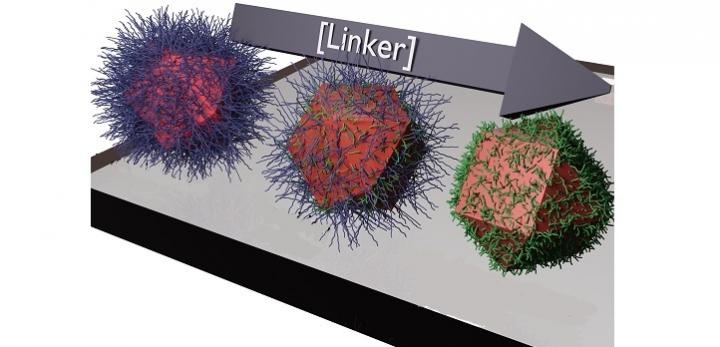
The dots are commonly grown from lead and sulfur in solution. Because the dots’ properties depend on their size, their growth must be halted at the right point, which is done by adding special molecules to cap their growth. Engineers often use molecules of oleic acid, each with 18 carbon atoms, which attach to the crystal’s surface, like hairs, blocking growth.

This creates a solution of dots suitable for coating to create a film. Yet, this film is not good at conducting electricity because the long acid molecules hamper the flow of electrons between nanocrystals. So engineers add shorter molecules. These “linkers” only have around two carbon atoms per molecule. The linkers replace the long capping molecules, increasing conductance. “The method has been used for a couple of decades, but nobody had investigated exactly what happens,” says Kirmani.

To find out, Kirmani’s team used a microbalance to monitor the exchange of oleic acid for linkers during the transition. They measured the spacing between the dots by scattering X-rays from them, and they also recorded the film’s changing thickness, density and optical absorption characteristics.

Rather than seeing a smooth change in the film’s properties, they saw a sudden jump–marking a phase transition. When roughly all the acid molecules have been displaced by linkers, the dots abruptly come close together, and the conductivity shoots up.

Kirmani hopes other teams will be inspired to investigate further, possibly by arresting the transition process somewhere midway and introducing various molecules to the dot surface to see what novel features emerge. “There is a lot of potential in taking this understanding to new paradigms for new technologies,” he says.

###

Media Contact
Carolyn Unck
[email protected]

Original Source

https://discovery.kaust.edu.sa/en/article/985/looking-at-linkers-helps-to-join-the-dots

Related Journal Article

http://dx.doi.org/10.1021/acsaem.0c00389

Tags: Chemistry/Physics/Materials SciencesMaterialsNanotechnology/Micromachines
Share12Tweet8Share2ShareShareShare2

Related Posts

Salt adaptation linked to higher disease risk, Mizzou study finds

Salt adaptation linked to higher disease risk, Mizzou study finds

July 6, 2026
Intelligent Microgrid Management Promises Lower Household Energy Bills and Reduced Diesel Emissions — Chemistry

Intelligent Microgrid Management Promises Lower Household Energy Bills and Reduced Diesel Emissions

July 4, 2026

Graz University of Technology Deciphers the Structural Secrets of MOF Thin Films

July 2, 2026

Breaking Thermodynamic Limits: Wavelength-Driven Catalysis Advances Ammonia Synthesis

July 2, 2026
Please login to join discussion

POPULAR NEWS

  • Detection of EDCs in Breast Milk and Infant Urine Up to Six Months Highlights Early Exposure Risks

    77 shares
    Share 31 Tweet 19
  • New Drug Candidate Developed at McMaster Shows Potential for Treating Brain Cancer

    58 shares
    Share 23 Tweet 15
  • Saying Goodbye to PGY-6: Pediatric Fellowship Realities

    103 shares
    Share 41 Tweet 26
  • KTU Researchers Explore Ultrasound’s Role in Enhancing Blood Flow Beyond Diagnostics

    53 shares
    Share 21 Tweet 13

About

We bring you the latest biotechnology news from best research centers and universities around the world. Check our website.

Follow us

Recent News

Flame retardant BDE-209 targets molecularly linked to ulcerative colitis

Ultra-high frequency particle impacts mimic rockbursts to shatter hard rock

Kidney transplant outcomes in older adults studied by German researchers

Subscribe to Blog via Email

Enter your email address to subscribe to this blog and receive notifications of new posts by email.

Join 83 other subscribers
  • Contact Us

Bioengineer.org © Copyright 2023 All Rights Reserved.

Welcome Back!

Login to your account below

Forgotten Password?

Retrieve your password

Please enter your username or email address to reset your password.

Log In
No Result
View All Result
  • Homepages
    • Home Page 1
    • Home Page 2
  • News
  • National
  • Business
  • Health
  • Lifestyle
  • Science

Bioengineer.org © Copyright 2023 All Rights Reserved.