• HOME
  • NEWS
  • EXPLORE
    • CAREER
      • Companies
      • Jobs
    • EVENTS
    • iGEM
      • News
      • Team
    • PHOTOS
    • VIDEO
    • WIKI
  • BLOG
  • COMMUNITY
    • FACEBOOK
    • INSTAGRAM
    • TWITTER
Sunday, May 17, 2026
BIOENGINEER.ORG
No Result
View All Result
  • Login
  • HOME
  • NEWS
  • EXPLORE
    • CAREER
      • Companies
      • Jobs
        • Lecturer
        • PhD Studentship
        • Postdoc
        • Research Assistant
    • EVENTS
    • iGEM
      • News
      • Team
    • PHOTOS
    • VIDEO
    • WIKI
  • BLOG
  • COMMUNITY
    • FACEBOOK
    • INSTAGRAM
    • TWITTER
  • HOME
  • NEWS
  • EXPLORE
    • CAREER
      • Companies
      • Jobs
        • Lecturer
        • PhD Studentship
        • Postdoc
        • Research Assistant
    • EVENTS
    • iGEM
      • News
      • Team
    • PHOTOS
    • VIDEO
    • WIKI
  • BLOG
  • COMMUNITY
    • FACEBOOK
    • INSTAGRAM
    • TWITTER
No Result
View All Result
Bioengineer.org
No Result
View All Result
Home NEWS Science News

Looking at complex light wave forms

Bioengineer by Bioengineer
May 31, 2017
in Science News
Reading Time: 2 mins read
0
Share on FacebookShare on TwitterShare on LinkedinShare on RedditShare on Telegram
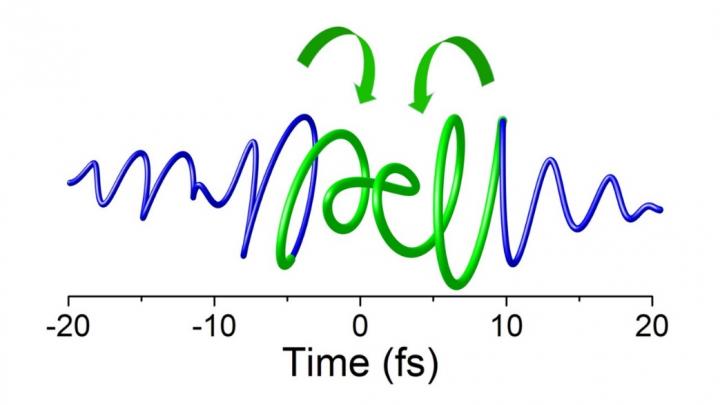
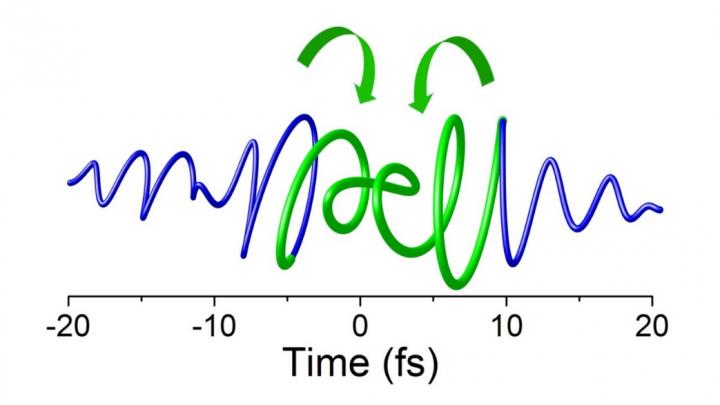
IMAGE

Credit: Graphics: Giuseppe Sansone

For the first time an international research team under the direction of Prof. Dr. Giuseppe Sansone at the Institute of Physics at the University of Freiburg has been able to completely characterize the complex evolution of weak electric fields. The team just published its research findings in the scientific journal Nature Photonics.

Light pulses are electromagnetic waves. Their characteristics such as the direction of oscillation, duration and intensity depend on the spatiotemporal evolution of their electric and magnetic fields. Both of these vectors can run in complex trajectories as a light pulse propagates – for instance, they can move along a circle, an elliptical or describe any variation thereof. The movement occurs on a timescale of several hundred attoseconds, which is much faster than any ordinary electronic or optoelectronic device can measure: an attosecond is a billionth of a billionth of a second.

In order to observe how the electric field moves anyway, the team developed a method using a so-called attosecond laser. "Using this new tool we were able to produce electrons in the form of wave packets that only last a few hundred attoseconds," explains Sansone. During their dynamics, electrons are very sensitive to any kind of external disturbance. The researchers leveraged this characteristic to modify the electrons' trajectories with weak visible light pulses. They were then able to measure how the trajectories had been altered, thereby deducing the intensity and direction of the electric field. "Our method will enable researchers in the future to have a complete characterization of electronic dynamics in solids by measuring the visible light reflected on its surface," says Sansone.

Researchers at the University of Jena, Max Planck Institute for Nuclear Physics in Heidelberg, the National Metrology Institute of Germany (PTB) in Braunschweig and the Politecnico in Milan and the Istituto di Fotonica e Nanotecnologie (Institute for Photonics and Nanotechnology) in Padua, Italy, contributed significantly to these findings.

###

Original publication:

P. A. Carpeggiani et al. (2017): Vectorial optical field reconstruction by attosecond spatial interferometry.

In: Nature Photonics. DOI 10.1038/nphoton.2017.73

Media Contact

Giuseppe Sansone
[email protected]
49-761-203-5738

Startseite

############

Story Source: Materials provided by Scienmag
Share12Tweet8Share2ShareShareShare2

Related Posts

Noncanonical Sulfur Metabolism, Immunity Altered in Down Syndrome — Technology and Engineering

Noncanonical Sulfur Metabolism, Immunity Altered in Down Syndrome

May 17, 2026

Physical Resilience Linked to Aging Views in Chinese Elders

May 17, 2026

Tau T205 Phosphorylation Controls Memory and Engrams

May 17, 2026

Phocaeicola dorei Eases Liver Fibrosis via Efferocytosis

May 17, 2026
Please login to join discussion

POPULAR NEWS

  • Research Indicates Potential Connection Between Prenatal Medication Exposure and Elevated Autism Risk

    844 shares
    Share 338 Tweet 211
  • New Study Reveals Plants Can Detect the Sound of Rain

    730 shares
    Share 291 Tweet 182
  • Salmonella Haem Blocks Macrophages, Boosts Infection

    62 shares
    Share 25 Tweet 16
  • Breastmilk Balances E. coli and Beneficial Bacteria in Infant Gut Microbiomes

    58 shares
    Share 23 Tweet 15

About

We bring you the latest biotechnology news from best research centers and universities around the world. Check our website.

Follow us

Recent News

Noncanonical Sulfur Metabolism, Immunity Altered in Down Syndrome

Physical Resilience Linked to Aging Views in Chinese Elders

Tau T205 Phosphorylation Controls Memory and Engrams

Subscribe to Blog via Email

Enter your email address to subscribe to this blog and receive notifications of new posts by email.

Join 82 other subscribers
  • Contact Us

Bioengineer.org © Copyright 2023 All Rights Reserved.

Welcome Back!

Login to your account below

Forgotten Password?

Retrieve your password

Please enter your username or email address to reset your password.

Log In
No Result
View All Result
  • Homepages
    • Home Page 1
    • Home Page 2
  • News
  • National
  • Business
  • Health
  • Lifestyle
  • Science

Bioengineer.org © Copyright 2023 All Rights Reserved.