• HOME
  • NEWS
  • EXPLORE
    • CAREER
      • Companies
      • Jobs
    • EVENTS
    • iGEM
      • News
      • Team
    • PHOTOS
    • VIDEO
    • WIKI
  • BLOG
  • COMMUNITY
    • FACEBOOK
    • INSTAGRAM
    • TWITTER
Thursday, May 14, 2026
BIOENGINEER.ORG
No Result
View All Result
  • Login
  • HOME
  • NEWS
  • EXPLORE
    • CAREER
      • Companies
      • Jobs
        • Lecturer
        • PhD Studentship
        • Postdoc
        • Research Assistant
    • EVENTS
    • iGEM
      • News
      • Team
    • PHOTOS
    • VIDEO
    • WIKI
  • BLOG
  • COMMUNITY
    • FACEBOOK
    • INSTAGRAM
    • TWITTER
  • HOME
  • NEWS
  • EXPLORE
    • CAREER
      • Companies
      • Jobs
        • Lecturer
        • PhD Studentship
        • Postdoc
        • Research Assistant
    • EVENTS
    • iGEM
      • News
      • Team
    • PHOTOS
    • VIDEO
    • WIKI
  • BLOG
  • COMMUNITY
    • FACEBOOK
    • INSTAGRAM
    • TWITTER
No Result
View All Result
Bioengineer.org
No Result
View All Result
Home NEWS Science News Biology

Long-term consequences of CO2 emissions

Bioengineer by Bioengineer
April 16, 2021
in Biology
Reading Time: 2 mins read
0
IMAGE
Share on FacebookShare on TwitterShare on LinkedinShare on RedditShare on Telegram

Oxygen in the ocean will continue to decrease for many centuries
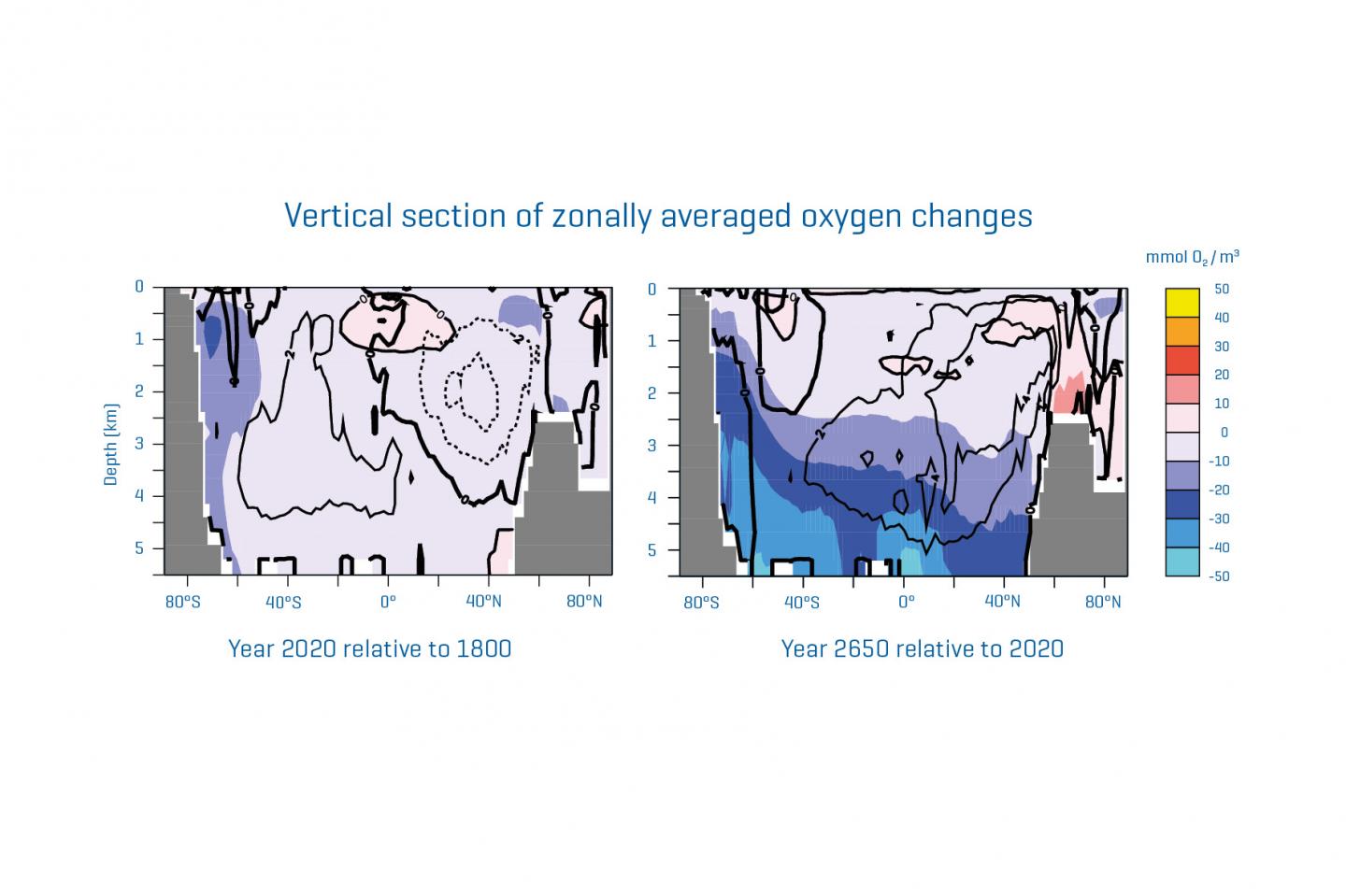
IMAGE

Credit: C. Kersten, modified from A. Oschlies, 2021, GEOMAR.

The life of almost all animals in the ocean depends on the availability of oxygen, which is dissolved as a gas in seawater. However, the ocean has been continuously losing oxygen for several decades. In the last 50 years, the loss of oxygen accumulates globally to about 2% of the total inventory (regionally sometimes significantly more). The main reason for this is global warming, which leads to a decrease in the solubility of gases and thus also of oxygen, as well as to a slowdown in the ocean circulation and vertical mixing. A new study published today in the scientific journal Nature Communications shows that this process will continue for centuries, even if all CO2 emissions and thus warming at the Earth’s surface would be stopped immediately.

“In the study, a model of the Earth system was used to assess what would happen in the ocean in the long term if all CO2 emissions would be stopped immediately”, explains the author, Professor Andreas Oschlies from GEOMAR Helmholtz Centre for Ocean Research Kiel. “The results show that even in this extreme scenario, the oxygen depletion will continue for centuries, more than quadrupling the oxygen loss we have seen to date in the ocean “, Oschlies continues.

The long-term decrease in oxygen takes place primarily in deeper layers. According to Prof. Oschlies, this also has an impact on marine ecosystems. A so-called ‘metabolic index’, which measures the maximum possible activity of oxygen-breathing organisms, shows a widespread decline by up to 25%, especially in the deep sea (below 2000 metres). This is likely to lead to major shifts in this habitat, which was previously considered to be very stable, explains the oceanographer. These changes have already been initiated by our historical CO2 emissions and are now on their way to the deep ocean. He recommends that a comprehensive investigation of the deep ocean habitat, which has only been studied randomly so far, should take place before this environment, that is deemed as having been stable for many millennia, is likely to change significantly due to the now expected decrease in oxygen.

In the upper layers of the ocean, the model shows a much faster response to climate action. There, a further expansion of the relatively near-surface oxygen minimum zones can be stopped within a few years if the emissions were stopped. An ambitious climate policy can therefore help to prevent at least the near-surface ecosystems from being put under further pressure by a progressive decrease in oxygen.

###

The study was inspired by discussions with members of the Collaborative Research Centre “Climate-Biogeochemical Interactions in the Tropical Ocean” (SFB 754) completed just over a year ago, and the Global Ocean Oxygen Network (GO2NE), and will be followed by more detailed investigations within the framework of the UN Decade of Ocean Sciences for Sustainable Development 2021-2030.

Contact:
Dr. Andreas Villwock (GEOMAR, Communication and Media), Tel.:+49 0431 600-2802, [email protected]

Media Contact
Andreas Oschlies
[email protected]

Related Journal Article

http://dx.doi.org/10.1038/s41467-021-22584-4

Tags: Climate ChangeEarth ScienceOceanography
Share12Tweet8Share2ShareShareShare2

Related Posts

Parasite Spread Enhanced by Host Wing-Raising Behavior — Biology

Parasite Spread Enhanced by Host Wing-Raising Behavior

May 14, 2026
Hoverflies’ Sexy Eyes Reveal Secrets of Their Aerodynamic Abilities — Biology

Hoverflies’ Sexy Eyes Reveal Secrets of Their Aerodynamic Abilities

May 14, 2026

Why Emus Can’t Fly: Unlocking the Mystery Hidden in Bird Embryos

May 14, 2026

Stanford Medicine Researchers Connect Human Molecular and Microbial Diversity to Geography and Ethnicity

May 14, 2026
Please login to join discussion

POPULAR NEWS

  • Research Indicates Potential Connection Between Prenatal Medication Exposure and Elevated Autism Risk

    842 shares
    Share 337 Tweet 211
  • New Study Reveals Plants Can Detect the Sound of Rain

    729 shares
    Share 291 Tweet 182
  • Salmonella Haem Blocks Macrophages, Boosts Infection

    62 shares
    Share 25 Tweet 16
  • Breastmilk Balances E. coli and Beneficial Bacteria in Infant Gut Microbiomes

    57 shares
    Share 23 Tweet 14

About

We bring you the latest biotechnology news from best research centers and universities around the world. Check our website.

Follow us

Recent News

Knowledge Graphs Revolutionize Chemical Process Digital Twins

Smart City Policies Boost Aging Household Consumption Inequality

Genetically Targeted mTORC1 Inhibitor Uncovers Nuclear Control

Subscribe to Blog via Email

Enter your email address to subscribe to this blog and receive notifications of new posts by email.

Join 82 other subscribers
  • Contact Us

Bioengineer.org © Copyright 2023 All Rights Reserved.

Welcome Back!

Login to your account below

Forgotten Password?

Retrieve your password

Please enter your username or email address to reset your password.

Log In
No Result
View All Result
  • Homepages
    • Home Page 1
    • Home Page 2
  • News
  • National
  • Business
  • Health
  • Lifestyle
  • Science

Bioengineer.org © Copyright 2023 All Rights Reserved.