


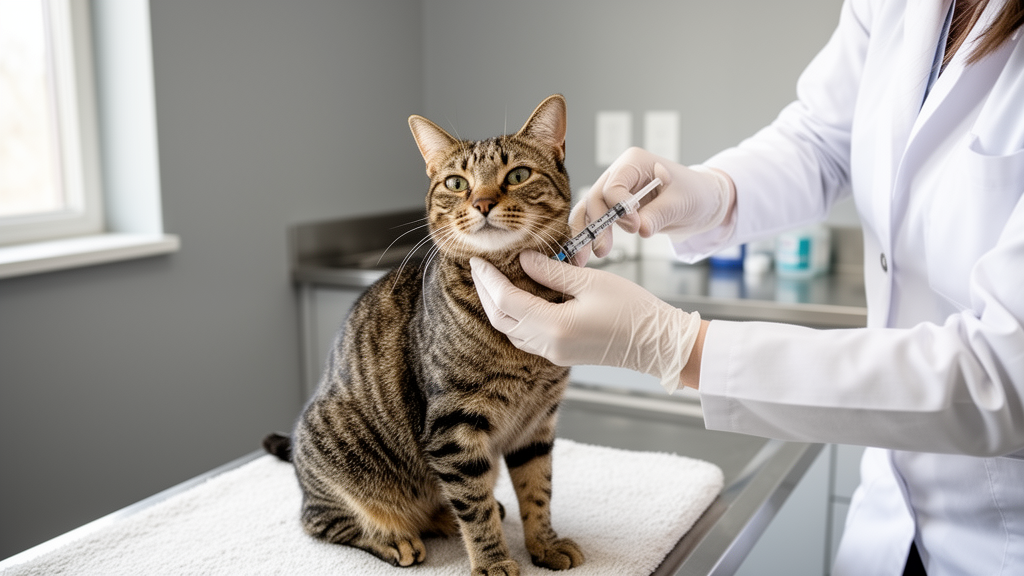
A weekly injectable weight-management drug for cats has moved a step closer to the veterinary clinic, with a new pharmacokinetic study reporting that the experimental GLP-1/GIP dual agonist HDM7006 circulates in feline blood for roughly two days after a single dose and can be given once weekly without building up in the body.
HDM7006, which carries the human-medicine code name HDM1005, is a 46-amino-acid peptide that activates both the GLP-1 receptor and the glucose-dependent insulinotropic polypeptide receptor. In laboratory cell assays, the drug showed markedly higher potency at the feline GLP-1 receptor than tirzepatide, with EC50 values of 7.95 picomolar in cats and 2.67 picomolar in humans, compared with 379.10 picomolar and 12.04 picomolar respectively for tirzepatide. At the GIP receptor, HDM7006’s potency was comparable to tirzepatide’s. The developers at Huadong Medicine argue that this balanced dual activity, combined with the high homology between feline and human GLP-1 and GIP receptors, makes the molecule a promising candidate for cats.
After the 1.0 milligram per kilogram injection, the initial concentration averaged 26,632 nanograms per milliliter and the elimination half-life was 43.7 hours. Clearance was low at 1.62 milliliters per hour per kilogram, which the authors note is well below 30 percent of feline hepatic blood flow, and the volume of distribution was 99.2 milliliters per kilogram, only slightly above the total blood volume of a cat.
Subcutaneous dosing produced the numbers most relevant to a practical weekly regimen. Median time to peak concentration ranged from 18.0 to 24.0 hours across the four dose levels, and elimination half-lives ranged from 39.8 to 47.1 hours. Absolute bioavailability, calculated against the intravenous data, was 42.23 percent at 0.1 milligrams per kilogram, 65.37 percent at 0.5, 78.38 percent at 1.0 and 49.25 percent at 2.0. A power-model analysis of the relationship between dose and exposure found that the 90 percent confidence intervals for the slopes of both peak concentration and area under the curve fell within the pre-defined interval of 0.77 to 1.23, indicating dose-proportional, linear pharmacokinetics across the full 0.1 to 2.0 milligram per kilogram range with no evidence of saturable absorption or clearance.
After five weekly subcutaneous doses of 0.5 milligrams per kilogram, steady state was reached after roughly three doses, faster than the four to six half-lives classical theory would predict. Trough concentrations before the third, fourth and fifth doses were tightly clustered between 547 and 608 nanograms per milliliter. The accumulation index was 1.12, essentially indicating no meaningful drug build-up, and peak concentrations at steady state, averaging 2,199 nanograms per milliliter, were nearly identical to the 2,116 nanograms per milliliter observed after the first dose. Half-life after the last dose was 52.1 hours, closely matching the single-dose values.
Sex had no detectable influence on drug exposure. Statistical comparison of peak concentrations and drug exposure between males and females in every dosing group produced p-values above 0.05, and the female-to-male ratios of the main parameters all fell between 0.5 and 2.0. The same held true in the repeated-dose arm, allowing the researchers to pool the sexes for all primary analyses. Immunogenicity, a key regulatory concern for peptide therapeutics highlighted in a 2023 US Food and Drug Administration guideline, was also low. Using a validated bridging ELISA with screening, confirmatory and titer stages, only two of 152 single-dose samples tested positive for anti-drug antibodies, a rate of 1.33 percent, and both came from a single male cat in the highest dose group at 336 hours post-dose with low titers of 20. All 35 samples from the repeated-dose study were negative.
The study was not without attrition. Of the 40 cats in the single-dose phase, 39 completed the protocol; one female in the 1.0 milligram per kilogram group developed a significant stress reaction on day eight and was excluded by veterinary decision. In the multiple-dose group, seven of eight cats finished, with one female withdrawn after five days for the same reason. The main clinical observation in the remaining animals was anorexia, which the authors attribute to the drug’s intended appetite-suppressing pharmacology rather than to unexpected toxicity, and no other adverse reactions were reported. They caution that cats are unusually sensitive to handling and sampling procedures, which may have compounded the stress responses seen in the two excluded animals.
The pharmacokinetic data build on earlier pharmacodynamic work by the same group. In obese cats given weekly subcutaneous HDM7006 in escalating titration schedules, food intake fell and body condition improved in a dose-dependent manner, with weight reductions of 8.42 percent, 13.71 percent and 19.45 percent in the low-, medium- and high-dose groups at the study endpoint compared with vehicle controls.
The clinical context is significant because no weight-loss drug has yet been approved for pet cats. The World Small Animal Veterinary Association officially classifies obesity as a disease, linking it to diabetes, cardiovascular conditions and arthritis, and surveys cited by the authors suggest a substantial and apparently growing prevalence of overweight pets in the United States, China and elsewhere. A compound with a roughly 44-hour half-life, dose-proportional exposure and minimal antibody formation, the authors conclude, supports once-weekly subcutaneous dosing and warrants further investigation in diabetic and overweight cats. As with any pharmacokinetic study, the findings come from a small number of healthy, young, purebred laboratory cats, so how the drug performs in older, obese, client-owned animals with concurrent disease remains to be demonstrated in the clinical trials now planned.
Subject of Research: Pharmacokinetics of the GLP-1/GIP dual agonist HDM7006 in healthy domestic cats
Article Title: Pharmacokinetics of HDM7006, a high-potency balanced GLP-1/GIP dual agonist, in healthy domestic cats
Article References: Zhang, Z., Cui, S., Jiang, C., Teng, L., Pan, H., Dong, Z., Peng, L., Wang, B., & Liu, D. (2026). Pharmacokinetics of HDM7006, a high-potency balanced GLP-1/GIP dual agonist, in healthy domestic cats. Frontiers in Veterinary Science, 13, Article 1988580. https://doi.org/10.3389/fvets.2026.1988580
Image Credits: AI Generated
DOI: 10.3389/fvets.2026.1988580
Keywords: HDM7006, GLP-1 receptor, GIP receptor, dual agonist, pharmacokinetics, cats, feline obesity, subcutaneous dosing, bioavailability, anti-drug antibodies, veterinary pharmacology, once-weekly dosing
News Source: Drew Townsend. (October 30, 2026). Long-Acting GLP-1/GIP Dual Agonist Shows Weekly Dosing Potential in Healthy Cats. Scienmag.



