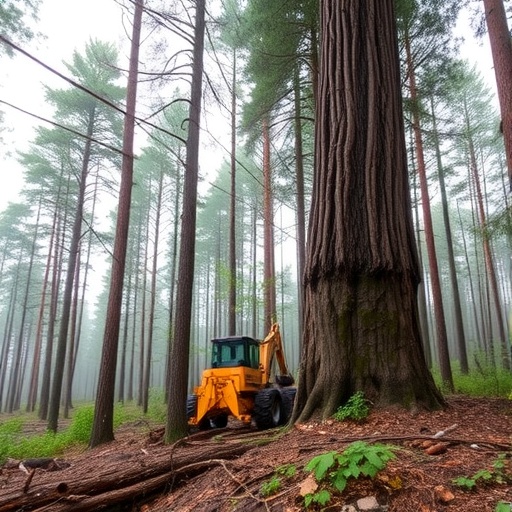
In Nepal’s Sal forests, the most dangerous moment for young trees may not be the fall of a harvested tree itself, but what happens afterward. A new study has revealed that felling and timber extraction leave distinct injury patterns across the forest floor, with dragged logs and machinery causing the greatest share of seedling damage, while falling trees more frequently injure mature trees left standing. The findings offer a detailed look at how routine harvesting can quietly reshape forest regeneration long after timber has been removed.
Sal, or Shorea robusta, is one of South Asia’s most important forest trees. Its forests support biodiversity, store carbon, provide timber and fuelwood, and sustain rural livelihoods. Yet harvesting operations can expose the plants that remain to a chain of physical impacts. Falling crowns may break neighboring branches, logs can strike or crush vegetation, and heavy machinery may bend, uproot, or split seedlings as it travels along extraction routes. Repeated traffic can also compact soil and create conditions that make recovery more difficult.
The study, published on 20 May 2026 in Agricultural Ecology and Environment, examined damage in Saraswati Community Forest and Belakatari National Forest in Udayapur District, Nepal. Rajeev Joshi and colleagues investigated whether different harvesting activities produced recognizable forms of injury and whether seedlings and residual trees faced the same risks. Their results show that the answer is no: the operation responsible for the damage often determines both which plants are harmed and how they are harmed.
To assess the effects of felling, the researchers established 30 circular plots around trees selected for harvest. Each plot had a radius corresponding to the height of the tree, creating an observation area that approximated the likely zone affected by its fall. Ten plots were located in the community forest and 20 in the national forest. Before harvesting began, the team inspected vegetation in the anticipated direction of fall, allowing newly inflicted injuries to be distinguished from damage that had occurred earlier.
The researchers assessed extraction-related impacts separately by placing 30 transects along skid trails linking tree stumps with nearby forest roads. Each transect extended for up to about 60 meters and covered a corridor 12 meters wide. Every residual plant inside these corridors was recorded and classified according to its condition. Injuries were grouped as bending, crown damage, stem damage, uprooting, or butt-end damage, while severity was rated as low, medium, or high using predefined criteria. The team standardized its assessments among field workers and calculated percentages with 95% confidence intervals using the Wilson score method.
The pattern among seedlings was especially striking. Timber extraction accounted for 45.41% of recorded seedling damage, compared with 43.35% attributed to felling and 11.24% associated with other human activities. During felling, 44.4% of damaged seedlings were bent, 38.4% suffered stem injuries, and 17.2% were uprooted. Extraction produced a similar but slightly different pattern: bending accounted for 47.1% of damaged seedlings, stem damage for 29.6%, and uprooting for 23.3%.
Although bending may appear less serious than a broken stem or a plant pulled from the ground, it can have long-term consequences. A bent seedling may lose access to sunlight, develop an unstable form, or become more vulnerable to disease and future mechanical damage. Stem injuries can interrupt water and nutrient transport, while uprooting directly removes the plant from the soil. The study found that 53.4% of seedling injuries caused during extraction were medium or high severity, emphasizing how skid trails, machinery, and dragged logs can threaten the next generation of forest trees.
Residual trees displayed a different vulnerability. Felling was responsible for 58.06% of recorded damage to standing trees, compared with 22.58% caused by extraction. During felling, crown injuries dominated, representing 61.1% of damaged residual trees. This pattern is consistent with the movement of branches and crowns as a harvested tree falls through the surrounding canopy. During extraction, by contrast, butt-end injuries represented 71.4% of damage to residual trees, likely reflecting direct contact with log ends, turning logs, or machinery operating in confined corridors.
Most injuries to trees were classified as low severity, but even minor wounds can accumulate across repeated harvests. Damage to crowns can reduce photosynthetic capacity, while injuries to lower stems and buttresses may create entry points for fungi and insects or reduce future timber value. If the same areas are harvested repeatedly, a series of individually modest impacts could alter stand structure, slow growth, and reduce the resilience of the forest. For seedlings, the consequences may be even more significant because regeneration depends on large numbers of young plants surviving the period immediately after disturbance.
The researchers say the results support practical steps associated with reduced-impact logging. Pre-harvest inventories can identify valuable seedlings and vulnerable residual trees before operations begin. Directional felling can guide falling trees away from regeneration patches, while carefully planned skid trails can reduce the area exposed to machinery and limit unnecessary passes. Operator training, post-harvest inspections, and long-term ecological monitoring could help forest managers determine whether damaged plants recover or disappear. The study does not measure damage across entire forest stands, so broader before-and-after inventories will be needed to estimate total ecological effects. Even so, its operation-specific evidence gives Nepal’s forest offices and community groups a clearer way to protect regeneration while continuing to meet timber and livelihood needs.
Subject of Research: Not applicable
Article Title: Damage to residual plants during felling and timber extraction on Sal (Shorea robusta Gaertn. f.) dominant forest in Nepal
News Publication Date: 20 May 2026
Web References: Agricultural Ecology and Environment: https://www.maxapress.com/aee ; DOI: https://doi.org/10.48130/aee-0026-0012
References: Joshi et al., “Damage to residual plants during felling and timber extraction on Sal (Shorea robusta Gaertn. f.) dominant forest in Nepal,” Agricultural Ecology and Environment, DOI: 10.48130/aee-0026-0012
Image Credits: Agricultural Ecology and Environment
Keywords: Sal forests, Shorea robusta, Nepal, timber harvesting, felling damage, timber extraction, seedlings, residual trees, reduced-impact logging, forest regeneration, forestry management, ecological monitoring
Tags: biodiversity loss due to loggingcarbon storage disruption in Sal forestsforest management and sustainable harvesting practicesforest soil compaction from logging trucksimpact of felling on mature treeslong-term effects of timber harvestingNepal forest regenerationphysical injury patterns in South Asian forestspost-logging forest recovery challengesSal forest logging impactsseedling damage from logging machinerytimber extraction environmental effects