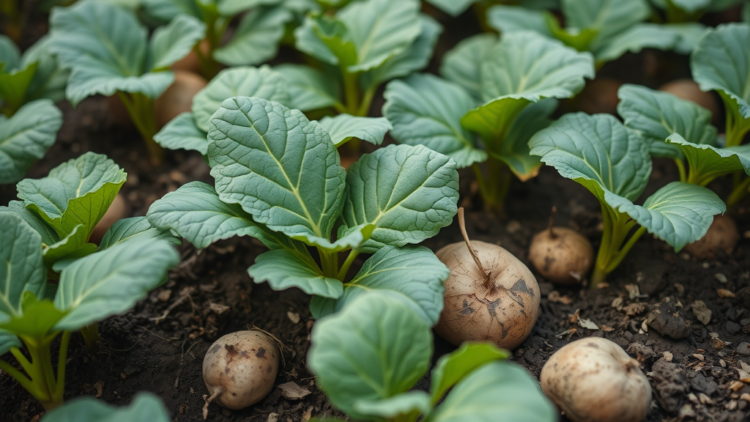
Potato is the fourth most important food crop on Earth, and knowing exactly how a potato canopy is growing has long depended on a deceptively simple number: the leaf area index, or LAI, the one-sided green leaf area per unit of ground surface. Measuring it in the field means cutting plants, punching disks from leaves, and drying samples to a constant weight, which is laborious, destructive, and impossible to scale across a farm. A new study published in the journal Artificial Intelligence in Agriculture shows that a hybrid deep learning model, taught first by physics simulations and then corrected by a handful of real field measurements, can estimate potato LAI from light reflected off the crop with an accuracy that outperforms traditional spectral methods, especially in the dense, closed canopies where conventional approaches break down.
The research team, led by scientists working at the National Precision Agriculture Research Center in Xiaotangshan, Beijing, ran field experiments across three consecutive growing seasons from 2017 to 2019. They varied potato cultivars, planting densities, nitrogen rates, and, in some years, irrigation and potassium treatments across randomized plots. Using a handheld spectrometer positioned one meter above the canopy under clear-sky conditions, they recorded hyperspectral reflectance from 400 to 1000 nanometers at five growth stages per season, capturing everything from sparse early vegetation to full canopy closure. In total they assembled 690 field spectra paired with equally many destructive LAI measurements, spanning values from 0.15 to 6.52 square meters of leaf per square meter of ground, a range broad enough to stress-test any estimation model.
The physical principle behind the approach is well understood. In the visible part of the spectrum, between 400 and 700 nanometers, chlorophyll and other leaf pigments absorb incoming sunlight to drive photosynthesis, producing characteristic dips in reflectance. In the near-infrared band, from roughly 760 to 1000 nanometers, the spongy internal structure of leaves scatters photons, creating a high reflectance plateau. As a canopy thickens and LAI rises, this contrast sharpens. The trouble is that classic vegetation indices such as NDVI compress this rich information into a handful of bands, and their correlation with LAI, which peaked at only about 0.54 in this study for the simple ratio index, saturates once LAI climbs above 2. Beyond that threshold, additional leaves are effectively invisible to the index, causing systematic underestimation precisely when vigorous growth matters most for yield forecasting and nitrogen management.
To build a smarter estimator, the researchers first turned to the PROSAIL radiative transfer model, which couples a leaf-level optical model called PROSPECT-5 with the SAIL canopy reflectance model. By sweeping combinations of chlorophyll content, leaf structure, leaf angle, solar geometry, and LAI itself, they generated an enormous synthetic dataset of 78,780 simulated spectral curves spanning 400 to 2500 nanometers. A comparison showed that the simulated spectral envelope fully enclosed the variability of the actual field measurements, confirming that the simulations captured the real-world heterogeneity induced by different cultivars, growth stages, and management practices. Crucially, the inputs were resampled to an 8-nanometer interval between 450 and 962 nanometers to strip redundancy and keep computation manageable.
The centerpiece of the study is a hybrid neural network that pairs a convolutional neural network, or CNN, with a long short-term memory network, or LSTM. The CNN side uses three stacked one-dimensional convolutional blocks with 16, 32, and 64 filters, each followed by batch normalization, ReLU activation, and max pooling, to pull out local morphological features in the spectrum, such as absorption valleys and reflectance peaks. The LSTM side, given the funnelled output of the CNN, treats the spectrum as a continuous sequence ordered by wavelength and uses its internal memory gates to model long-range dependencies, effectively connecting how pigment absorption in the visible region relates to scattering in the near-infrared plateau. The authors argue this architecture fits the physics better than attention mechanisms, which are data-hungry, or plain multilayer perceptrons, which treat each wavelength as an isolated node and discard spectral continuity.
The deep features that emerged were demonstrably more sensitive to LAI than anything the raw spectrum could offer. When the researchers correlated activation values from each network’s fully connected layer against measured LAI, LSTM-only features topped out at a correlation of 0.49, CNN features reached 0.78, but CNN-LSTM features repeatedly exceeded 0.80, peaking at 0.82. Even more striking, gradient-based activation maps revealed that the hybrid network concentrated its attention precisely on the red-edge transition region between 700 and 750 nanometers and on segments of the near-infrared plateau, the exact wavelength zones that plant physiology predicts should carry the strongest canopy-structure signal. In other words, the network autonomously rediscovered the biophysics it was never explicitly taught.
Raw deep learning, however, still stumbled on a chronic agricultural problem: too few ground-truth samples, unevenly distributed toward medium LAI values. Deep networks trained from scratch on field data beat traditional machine learning benchmarks, with the CNN-LSTM reaching a validation coefficient of determination of 0.74 and a root mean square error of 0.55 square meters per square meter, but random forest and XGBoost models tuned to spectral features collapsed from training accuracies near 0.88 to validation values of just 0.38 and 0.44, a textbook overfitting pattern. The decisive move was transfer learning. The researchers first pre-trained the CNN-LSTM network on the 78,780 PROSAIL simulations, where it achieved near-perfect internalization of radiative transfer physics, with validation R-squared of 0.995. Then they froze the convolutional feature-extraction layers and fine-tuned only the fully connected layers using the limited field measurements, transplanting physical knowledge from simulation into the messy reality of the field.
The payoff was substantial. Applied directly to field data without fine-tuning, the pre-trained model managed only a validation R-squared of 0.53 and badly underestimated dense canopies. With transfer learning, validation accuracy rose to 0.80 with RMSE of 0.50, a 41 percent accuracy improvement over the non-transfer model in the high-LAI range, where mean absolute error fell to 0.53 compared with 0.90 for the direct-transfer version and 0.79 for the traditional partial least squares regression baseline. The systematic bias that plagued simpler methods, overestimating sparse plots and underestimating closed canopies, largely vanished, with predictions converging tightly around the one-to-one line. Across individual years the framework held R-squared values of 0.77 in 2017 and 0.81 in 2018, dipping to 0.56 in 2019, a decline the authors traced to extreme nitrogen treatments that pushed canopies beyond the simulated parameter space, such as chlorophyll accumulation exceeding the pre-training limits.
The study is candid about its constraints. The PROSAIL parameter space was fixed by local measurements, so applying the framework elsewhere demands recalibration and at least a small set of in-situ samples for fine-tuning. Training on a single NVIDIA RTX 5070 GPU with 64 gigabytes of memory took about 65 minutes per pre-training session, a manageable cost but not a trivial one, and validation remains limited to a single site over three years. Still, the implications reach beyond potatoes. The work demonstrates a practical recipe for fusing physical simulation with deep learning: let a radiative transfer model teach a hybrid CNN-LSTM the general laws of how light interacts with leaves, then let a few dozen field measurements adapt those laws to one farm, one season, one cultivar. For agronomists, that points toward rapid, non-destructive canopy maps that can guide variable-rate fertilization and irrigation with a fraction of the fieldwork, and for the broader field of quantitative remote sensing, it offers a template for bringing physically grounded AI to any crop whose light signature tells the story of its growth.
Subject of Research: Estimating potato leaf area index from canopy hyperspectral data using a hybrid CNN-LSTM deep learning model with simulation-to-reality transfer learning
Article Title: Estimation of potato leaf area index using a hybrid CNN-LSTM architecture with transfer learning
Article References: Liu, Y., Yue, J., Fan, Y., Feng, Z., Zhang, H., Guo, W., Qiao, H., Yang, F., Liu, H., Zhou, W., & Feng, H. (2026). Estimation of potato leaf area index using a hybrid CNN-LSTM architecture with transfer learning. Artificial Intelligence in Agriculture. https://doi.org/10.1016/j.aiia.2026.09.003
Image Credits: AI Generated
DOI: 10.1016/j.aiia.2026.09.003
Keywords: potato, leaf area index, hyperspectral remote sensing, CNN-LSTM, transfer learning, PROSAIL, radiative transfer model, precision agriculture, deep learning, vegetation indices, crop monitoring, spectral saturation
Cite Scienmag News
APA
MLA
Chicago
Alan Morgan. (September 21, 2026). AI Learns to Read Potato Leaves to Transform Crop Monitoring. Scienmag. https://scienmag.com/ai-learns-to-read-potato-leaves-to-transform-crop-monitoring/
Alan Morgan. “AI Learns to Read Potato Leaves to Transform Crop Monitoring.” Scienmag, 21 September 2026, https://scienmag.com/ai-learns-to-read-potato-leaves-to-transform-crop-monitoring/. Accessed 21 September 2026.
Alan Morgan. “AI Learns to Read Potato Leaves to Transform Crop Monitoring.” Scienmag. September 21, 2026. https://scienmag.com/ai-learns-to-read-potato-leaves-to-transform-crop-monitoring/
Copy citation
Download RIS
Tags: CNN-LSTMcrop monitoringdeep learninghyperspectral remote sensingleaf area indexpotatoprecision agriculturePROSAILradiative transfer modelspectral saturationtransfer learningvegetation indices