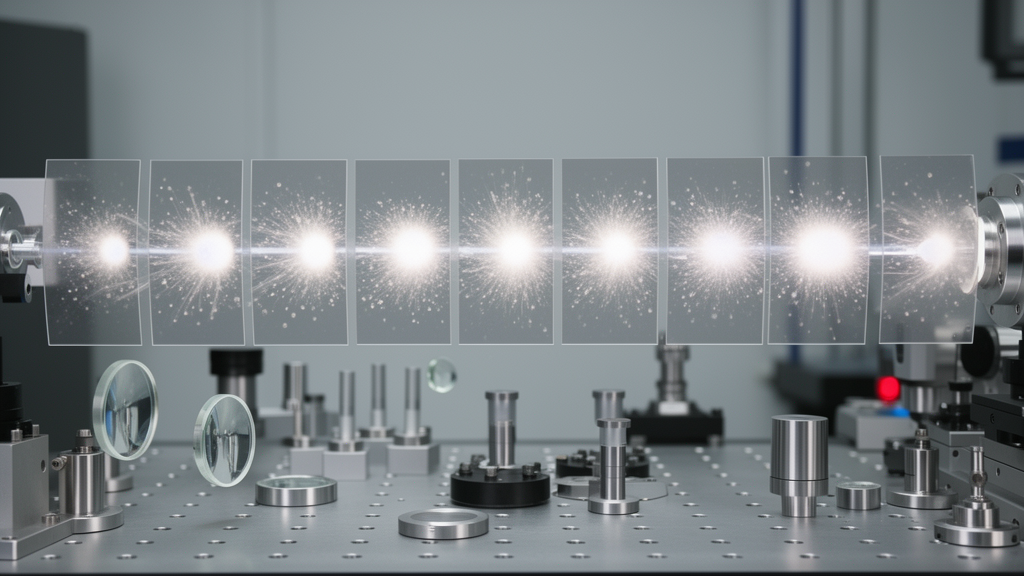
Ultrafast photography can record the beginning and aftermath of rapid events with just 11 frames if the captures are spaced according to when important changes occur rather than at uniform intervals. A University of Tokyo team demonstrated the approach, known as logarithmic ultrafast photography, by combining sequentially timed all-optical mapping photography, or STAMP, with band-resolved individual delay generation, or BRIDGE. Their arrangement placed frames more closely together at early times and farther apart later, covering a sequence from femtoseconds to nanoseconds—five orders of magnitude in a single measurement.
The timing strategy addresses a central limitation of conventional ultrafast imaging. Cameras commonly acquire single-shot frames at fixed or mostly fixed intervals within a selected exposure window. That schedule can document a characteristic moment of an event, but it may miss transient behavior between samples, especially when the event develops across markedly different timescales. The researchers’ method instead concentrates a limited number of captures on periods in which the target is expected to change substantially. In effect, the sequence gives greater temporal attention to the onset of a process while still preserving later stages that may be missed if the camera captures only a narrowly chosen instant.
BRIDGE provides the fine control required for this logarithmic schedule. It extracts wavelength bands sequentially and permits those bands to be adjusted independently while translating the optical information to a selected point in the event’s evolution. Integrated with STAMP, which is designed for high-image-quality ultrafast operation, the system allows a finite set of frames to be positioned across femtosecond-to-nanosecond timescales. The reported 11-frame sequence had an exposure equivalent to approximately 260 frames per second, while its nonuniform spacing connected the earliest observations with those occurring later in the same event.
Lead author Keitaro Shimada said the objective was to connect very different timescales within one measurement rather than choose between observing the first instance of an event and following what came afterward. The design is especially relevant to phenomena that cannot be reproduced exactly. Recording early and later stages of the same occurrence can expose relationships that disappear when researchers reconstruct a sequence from separate experiments, according to Shimada and principal investigator Keiichi Nakagawa. Their approach therefore treats timing as part of the observation strategy: instead of applying one interval throughout, investigators can adapt the placement of each frame to the dynamics they seek to resolve.
The method was presented in the peer-reviewed journal Optica as a general imaging technique rather than as a demonstrated advance in a single biomedical or industrial application. The researchers identify potential uses in laser processing, material dynamics, plasma and shock-wave research, and biomedical science, but the supplied report does not establish performance in those specific fields or clinical benefit. Its demonstrated contribution is the ability to connect multiple timescales with a sparse set of single-shot ultrafast images. By making the intervals themselves a customizable feature of the measurement, logarithmic ultrafast photography offers a practical way to preserve more of an event’s progression without relying on dense, uniformly spaced sampling.
Subject of Research: Logarithmic timing of ultrafast images across femtosecond-to-nanosecond timescales
Article Title: Quality over quantity in ultrafast photography
Article References: Quality over quantity in ultrafast photography. Original publication (Bibliographic details unavailable.)
Image Credits: AI Generated
DOI: Not provided
Keywords: ultrafast photography, STAMP, BRIDGE, femtosecond imaging, nanosecond dynamics, temporal sampling, laser imaging, shock waves, material dynamics, Quality, over, quantity
News Source: Denise Maddox. (October 20, 2026). Logarithmic timing captures ultrafast events in 11 frames. Scienmag.