• HOME
  • NEWS
  • EXPLORE
    • CAREER
      • Companies
      • Jobs
    • EVENTS
    • iGEM
      • News
      • Team
    • PHOTOS
    • VIDEO
    • WIKI
  • BLOG
  • COMMUNITY
    • FACEBOOK
    • INSTAGRAM
    • TWITTER
Thursday, June 25, 2026
BIOENGINEER.ORG
No Result
View All Result
  • Login
  • HOME
  • NEWS
  • EXPLORE
    • CAREER
      • Companies
      • Jobs
        • Lecturer
        • PhD Studentship
        • Postdoc
        • Research Assistant
    • EVENTS
    • iGEM
      • News
      • Team
    • PHOTOS
    • VIDEO
    • WIKI
  • BLOG
  • COMMUNITY
    • FACEBOOK
    • INSTAGRAM
    • TWITTER
  • HOME
  • NEWS
  • EXPLORE
    • CAREER
      • Companies
      • Jobs
        • Lecturer
        • PhD Studentship
        • Postdoc
        • Research Assistant
    • EVENTS
    • iGEM
      • News
      • Team
    • PHOTOS
    • VIDEO
    • WIKI
  • BLOG
  • COMMUNITY
    • FACEBOOK
    • INSTAGRAM
    • TWITTER
No Result
View All Result
Bioengineer.org
No Result
View All Result
Home NEWS Science News Biology

Location and extent of coral reefs mapped worldwide using advanced AI

Bioengineer by Bioengineer
October 28, 2020
in Biology
Reading Time: 3 mins read
0
IMAGE
Share on FacebookShare on TwitterShare on LinkedinShare on RedditShare on Telegram

IMAGE

Credit: Center for Global Discovery and Conservation Science at Arizona State University

Nearly 75% of the world’s coral reefs are under threat from global stressors such as climate change and local stressors such as overfishing and coastal development. Those working to understand and protect coral reefs are building the know-how to mitigate the damage but doing so requires first knowing where reefs are located.

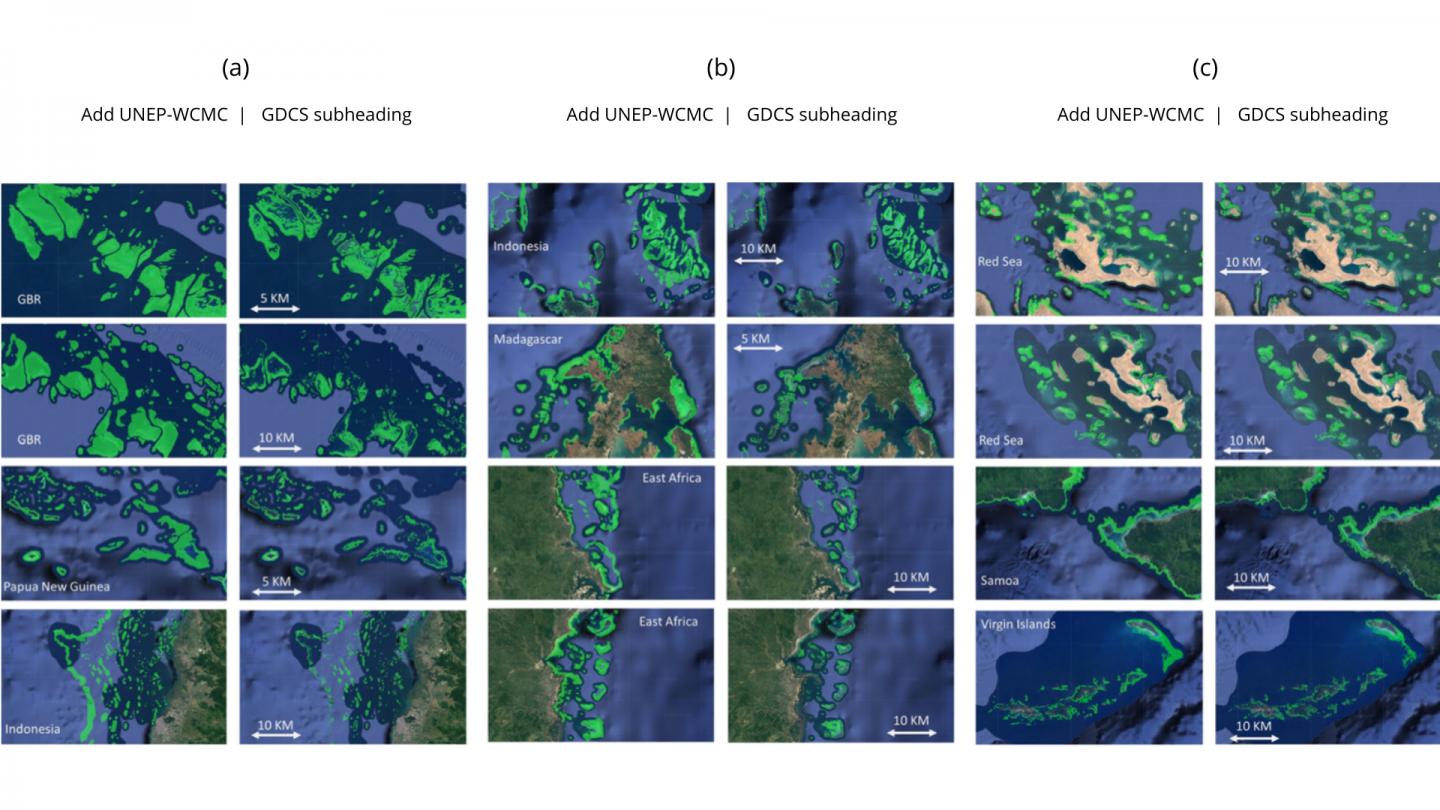
Many approaches, such as diver-based observation and satellite imagery, have been used to estimate the distribution of coral reefs around the world, but past approaches have led to inconsistent accuracy because the underlying data are derived from disparate sources and varying methodologies. Now, researchers from the Arizona State University Center for Global Discovery and Conservation Science (GDCS) have generated a global coral reef extent map using a single methodology capable of predicting the location of shallow coral reefs with nearly 90% accuracy.

The GDCS team used convolutional neural networks (CNNs), an advanced artificial intelligence approach, along with thousands of satellite images from Planet Inc. to create the new global map. Planet’s satellites obtain daily coverage of the Earth’s landmass and its coral reefs at a 3.7-meter resolution. Many of these satellites are as small as a loaf of bread but, operating together, they collect over 11 terabytes of data every day. This continuous stream of imagery yields a massive amount of data–too much for even a large team of scientists to manually sort through. Using convolutional neural networks and ASU’s supercomputer, the GDCS team was able to analyze the data and extract the locations of shallow reefs less than 20 meters (70 feet) of water depth worldwide.

The maps are openly available through the Allen Coral Atlas, a collaborative partnership between ASU, Vulcan Inc., Planet Inc., University of Queensland, and National Geographic Society to map and monitor the world’s coral reefs in unprecedented detail.

“The new map represents our best estimate of the location of shallow coral reefs on the planet, and it guides next steps including our ongoing collaboration to map the composition of these reefs and their changing health over time”, said first author, Jiwei Li, of GDCS.

The researchers indicated that these new maps can be used with other global maps or datasets to create derived data or analytic products. Some immediate uses of the map at the Allen Coral Atlas include determining where to monitor for coral bleaching, a global phenomenon driven by ocean warming.

Greg Asner, co-author of the study and ASU’s Allen Coral Atlas lead explained, “This first-ever A.I.-driven map of the world’s coral reefs is just a drop in the bucket compared to what we have coming out over the next year and beyond. The partnership is already rolling out much more detailed reef composition maps on a region by region basis, and we are preparing to launch a global reef monitoring system that detects bleaching. These and other large-scale marine technology innovations are already helping conservation, management and resource policy specialists make decisions. That’s our big picture goal.”

###

Media Contact
Heather D’Angelo
[email protected]

Original Source

https://link.springer.com/article/10.1007/s00338-020-02005-6

Related Journal Article

http://dx.doi.org/10.1007/s00338-020-02005-6

Tags: Algorithms/ModelsBiologyEcology/EnvironmentGeography
Share13Tweet8Share2ShareShareShare2

Related Posts

Natural Hallucinogens: Evolution’s Ecological Tools, Not Mere Chemical Byproducts

June 25, 2026

This Famous Butterfly Revealed: Three Distinct Species Hidden in One

June 25, 2026

Scientists Attack Soybean Cyst Nematode by Starving Its Food Source

June 25, 2026

Decoding the Secret Code of a Crucial Immune Sensor

June 24, 2026
Please login to join discussion

POPULAR NEWS

  • Saying Goodbye to PGY-6: Pediatric Fellowship Realities

    103 shares
    Share 41 Tweet 26
  • Multi-Hospital Study Reveals Long Covid Burden Is Twice as High as Current Estimates

    92 shares
    Share 36 Tweet 23
  • Detection of EDCs in Breast Milk and Infant Urine Up to Six Months Highlights Early Exposure Risks

    77 shares
    Share 31 Tweet 19
  • New Drug Candidate Developed at McMaster Shows Potential for Treating Brain Cancer

    58 shares
    Share 23 Tweet 15

About

We bring you the latest biotechnology news from best research centers and universities around the world. Check our website.

Follow us

Recent News

Tracking Lanthanide-Labeled Microplastics in Plants

POSTECH Researchers Slash Cost of Reconstituted Cell-Free Systems by 95%

AI and Physics Collaborate to Design Advanced Hydrogen Storage Materials

Subscribe to Blog via Email

Enter your email address to subscribe to this blog and receive notifications of new posts by email.

Join 82 other subscribers
  • Contact Us

Bioengineer.org © Copyright 2023 All Rights Reserved.

Welcome Back!

Login to your account below

Forgotten Password?

Retrieve your password

Please enter your username or email address to reset your password.

Log In
No Result
View All Result
  • Homepages
    • Home Page 1
    • Home Page 2
  • News
  • National
  • Business
  • Health
  • Lifestyle
  • Science

Bioengineer.org © Copyright 2023 All Rights Reserved.