• HOME
  • NEWS
  • EXPLORE
    • CAREER
      • Companies
      • Jobs
    • EVENTS
    • iGEM
      • News
      • Team
    • PHOTOS
    • VIDEO
    • WIKI
  • BLOG
  • COMMUNITY
    • FACEBOOK
    • INSTAGRAM
    • TWITTER
Sunday, August 16, 2026
BIOENGINEER.ORG
No Result
View All Result
  • Login
  • HOME
  • NEWS
  • EXPLORE
    • CAREER
      • Companies
      • Jobs
        • Lecturer
        • PhD Studentship
        • Postdoc
        • Research Assistant
    • EVENTS
    • iGEM
      • News
      • Team
    • PHOTOS
    • VIDEO
    • WIKI
  • BLOG
  • COMMUNITY
    • FACEBOOK
    • INSTAGRAM
    • TWITTER
  • HOME
  • NEWS
  • EXPLORE
    • CAREER
      • Companies
      • Jobs
        • Lecturer
        • PhD Studentship
        • Postdoc
        • Research Assistant
    • EVENTS
    • iGEM
      • News
      • Team
    • PHOTOS
    • VIDEO
    • WIKI
  • BLOG
  • COMMUNITY
    • FACEBOOK
    • INSTAGRAM
    • TWITTER
No Result
View All Result
Bioengineer.org
No Result
View All Result
Home NEWS Science News Biology

Living together: How legume roots accommodate two distinct microbial partners

Bioengineer by Bioengineer
February 28, 2019
in Biology
Reading Time: 2 mins read
0
IMAGE
Share on FacebookShare on TwitterShare on LinkedinShare on RedditShare on Telegram

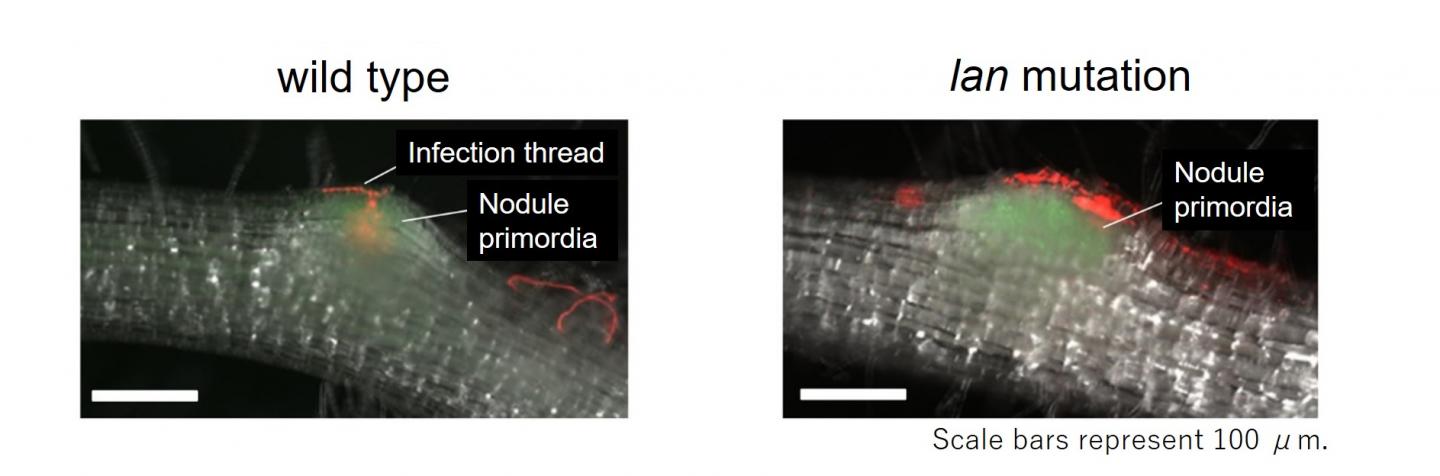
A research team including University of Tsukuba identifies a gene that controls how legume roots form biological partnerships with two completely different types of microbe — bacteria and fungi — that both help supply nutrients
IMAGE

Credit: University of Tsukuba

Tsukuba, Japan – Legumes such as peas and beans form intimate and mutually beneficial partnerships (symbioses) with nitrogen-fixing bacteria, rhizobia. The plant benefits from an enhanced supply of nitrogen, ‘fixed’ from the air by the rhizobia, while the bacteria benefit from protective accommodation inside special structures, called root nodules, that supply nutrients from the host plant. A different type of symbiosis is formed between the roots of many plant species and soil fungi, called mycorrhizal fungi. Both types of complex plant-microbe interactions are crucial for supplying plants with nutrients, but many details of how these symbioses develop remain unclear.

University of Tsukuba researchers, collaborating with two other Japanese universities, have revealed a key piece in the jigsaw puzzle of mechanisms that control the developmental processes behind the symbioses of roots with microbes. The team identified a gene that is pivotal in controlling how legume roots establish cellular accommodation for rhizobia bacteria, described in a recent publication in PLOS Genetics.

When the gene is inactivated in a mutant plant, the roots produce dramatically fewer nitrogen-fixing nodules because the usual (intracellular) route of entry for the bacteria, called an infection thread, does not develop properly in the root cells. However, small numbers of nodules do develop, some weeks later than normal, when the bacteria enter by a different (intercellular) route between the root cells.

The team named the gene lack of symbiont accommodation (lan). They showed it is inactivated in the mutant, and found it is closely related to a gene in other plant species. It is thought to encode a protein that acts in a complex of other regulatory proteins (called Mediator) to control the expression of numerous genes and processes. This is the first report of the gene’s involvement in controlling plant-microbe interactions.

“We used the model legume Lotus japonicus, which grows and reproduces rapidly and has a smaller, simpler genome than most crop plants,” says corresponding author Takuya Suzaki. “Our research methods included genetic modification, studying the plant’s anatomy by microscopy using fluorescent dyes, genome sequencing, and producing mutant plants using the latest gene editing technologies.”

The lan gene is important not only for symbiosis with rhizobia: the team showed that the gene is also required for establishing symbioses with mycorrhizal fungi.

“This study shows that a single control system operates in establishing two completely different symbioses that are important for plant nutrition,” says Suzaki. “Our results have wider implications for understanding how plant developmental processes are coordinated.”

###

Media Contact
Masataka Watanabe
[email protected]

Related Journal Article

http://dx.doi.org/10.1371/journal.pgen.1007865

Tags: BiochemistryBiologyCell BiologyGenesPlant Sciences
Share12Tweet8Share2ShareShareShare2

Related Posts

Strubbelig–NHL3 Receptor Complex Helps Arabidopsis Respond to Cellulose Deficiency

Strubbelig–NHL3 Receptor Complex Helps Arabidopsis Respond to Cellulose Deficiency

August 15, 2026
Bombyx mori Satellitome Analysis Reveals Evolutionary Stability, Dispersed Chromosomal Organization, Transposon Origins

Bombyx mori Satellitome Analysis Reveals Evolutionary Stability, Dispersed Chromosomal Organization, Transposon Origins

August 15, 2026

Synthetic pyrenoid reconstruction reveals EPYC1-driven carbon concentration mechanisms and evolution

August 15, 2026

Endophytic Flavobacterium boosts root hairs and drought tolerance through ERF–CEP5 signaling

August 15, 2026
Please login to join discussion

POPULAR NEWS

  • KAIST develops semiconductor neuron that harnesses noise to selectively process signals

    29 shares
    Share 12 Tweet 7
  • Imagining natural and extra robotic thumbs together strengthens kinesthetic sensorimotor networks

    29 shares
    Share 12 Tweet 7
  • PARP1 Drives Neuropathic Pain Through GPX4-Dependent Ferroptosis in Injured Mice’s Sensory Neurons

    29 shares
    Share 12 Tweet 7
  • Strubbelig–NHL3 Receptor Complex Helps Arabidopsis Respond to Cellulose Deficiency

    29 shares
    Share 12 Tweet 7

About

We bring you the latest biotechnology news from best research centers and universities around the world. Check our website.

Follow us

Recent News

KAIST develops semiconductor neuron that harnesses noise to selectively process signals

Imagining natural and extra robotic thumbs together strengthens kinesthetic sensorimotor networks

PARP1 Drives Neuropathic Pain Through GPX4-Dependent Ferroptosis in Injured Mice’s Sensory Neurons

Subscribe to Blog via Email

Success! An email was just sent to confirm your subscription. Please find the email now and click 'Confirm' to start subscribing.

Join 85 other subscribers
  • Contact Us

Bioengineer.org © Copyright 2023 All Rights Reserved.

Welcome Back!

Login to your account below

Forgotten Password?

Retrieve your password

Please enter your username or email address to reset your password.

Log In
No Result
View All Result
  • Homepages
    • Home Page 1
    • Home Page 2
  • News
  • National
  • Business
  • Health
  • Lifestyle
  • Science

Bioengineer.org © Copyright 2023 All Rights Reserved.