• HOME
  • NEWS
  • EXPLORE
    • CAREER
      • Companies
      • Jobs
    • EVENTS
    • iGEM
      • News
      • Team
    • PHOTOS
    • VIDEO
    • WIKI
  • BLOG
  • COMMUNITY
    • FACEBOOK
    • INSTAGRAM
    • TWITTER
Saturday, June 27, 2026
BIOENGINEER.ORG
No Result
View All Result
  • Login
  • HOME
  • NEWS
  • EXPLORE
    • CAREER
      • Companies
      • Jobs
        • Lecturer
        • PhD Studentship
        • Postdoc
        • Research Assistant
    • EVENTS
    • iGEM
      • News
      • Team
    • PHOTOS
    • VIDEO
    • WIKI
  • BLOG
  • COMMUNITY
    • FACEBOOK
    • INSTAGRAM
    • TWITTER
  • HOME
  • NEWS
  • EXPLORE
    • CAREER
      • Companies
      • Jobs
        • Lecturer
        • PhD Studentship
        • Postdoc
        • Research Assistant
    • EVENTS
    • iGEM
      • News
      • Team
    • PHOTOS
    • VIDEO
    • WIKI
  • BLOG
  • COMMUNITY
    • FACEBOOK
    • INSTAGRAM
    • TWITTER
No Result
View All Result
Bioengineer.org
No Result
View All Result
Home NEWS Science News Chemistry

Livestock and poultry farming should be the future focus of agricultural ammonia emissions control

Bioengineer by Bioengineer
April 13, 2020
in Chemistry
Reading Time: 2 mins read
0
IMAGE
Share on FacebookShare on TwitterShare on LinkedinShare on RedditShare on Telegram

IMAGE

Credit: Jiayu Huang

As the only alkaline gas in the atmosphere, ammonia can react with sulfur dioxide and nitrogen oxides to form secondary fine particles, accelerating the generation of atmospheric haze. Ammonia is therefore considered as a catalyst and accelerator for the widespread haze pollution problem in China. In the past decade, China has made great progress in the prevention and control of atmospheric sulfur dioxide and nitrogen oxide pollution, but little has been done in terms of ammonia emissions control.

Compiling an emissions inventory is an important basis for ammonia control. Although there are some existing global or national emission inventories, they are not very applicable to regional-scale ammonia emission reduction policies due to the lack of specific regional information. Professor Weishou Shen’s research group at Nanjing University of Information Science and Technology (NUIST) investigated ammonia emissions from agriculture in Jiangsu Province from 2000 to 2017 based on the emissions factor method, and the findings have been published in Atmospheric and Oceanic Science Letters.

“Jiangsu is where our research team is based, and it happens that this province ranks first in ammonia emissions from agriculture in key areas of national air pollution control in China,” explains Shen. “We therefore feel it’s our duty to investigate the characteristics and trend of change of ammonia emissions from agriculture here.”

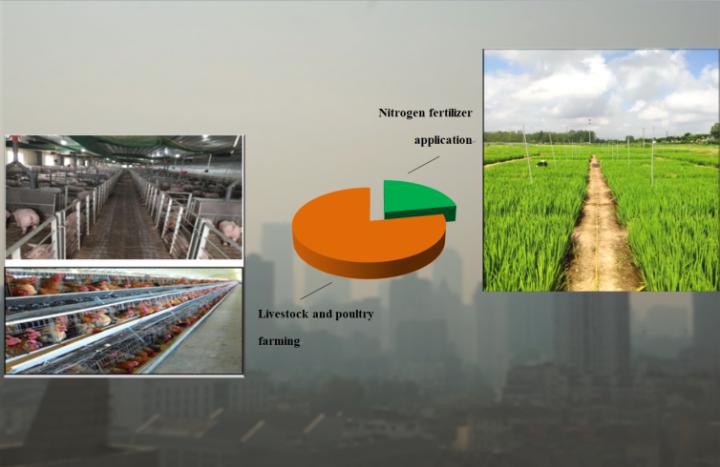
The team selected five regional representative nitrogen fertilizers and four typical livestock types and calculated their corresponding emission factors to investigate the characteristics and trends of agricultural ammonia emissions in Jiangsu from 2000 to 2017. They found that ammonia emissions from agriculture were mainly contributed by livestock and poultry farming (78.08%) and nitrogen fertilizer application (21.92%), and presented a fluctuating interannual trend during the study period.

“We suggest that ammonia emissions control from livestock and poultry farming should be a future focus of agricultural ammonia control,” concludes Shen.

###

Media Contact
Ms. Zheng Lin
[email protected]

Original Source

http://159.226.119.58/aosl/EN/news/news39.shtml

Related Journal Article

http://dx.doi.org/10.1080/16742834.2020.1736499

Tags: AgricultureAtmospheric ChemistryAtmospheric ScienceChemistry/Physics/Materials SciencesEarth SciencePolicy/Ethics
Share12Tweet8Share2ShareShareShare2

Related Posts

AI and Physics Collaborate to Design Advanced Hydrogen Storage Materials

June 25, 2026

International Team Including Dresden Scientists Develops Novel Designer Proteins for Advanced Study of Living Tissue

June 25, 2026

New Study Uncovers Key Factors Driving Water Chemistry in Nanoscale Environments

June 25, 2026

Plasma Technology Extends Catalyst Lifespan in Hydrogen Production

June 24, 2026
Please login to join discussion

POPULAR NEWS

  • Saying Goodbye to PGY-6: Pediatric Fellowship Realities

    103 shares
    Share 41 Tweet 26
  • Multi-Hospital Study Reveals Long Covid Burden Is Twice as High as Current Estimates

    92 shares
    Share 36 Tweet 23
  • Detection of EDCs in Breast Milk and Infant Urine Up to Six Months Highlights Early Exposure Risks

    77 shares
    Share 31 Tweet 19
  • New Drug Candidate Developed at McMaster Shows Potential for Treating Brain Cancer

    58 shares
    Share 23 Tweet 15

About

We bring you the latest biotechnology news from best research centers and universities around the world. Check our website.

Follow us

Recent News

Tracking Lanthanide-Labeled Microplastics in Plants

POSTECH Researchers Slash Cost of Reconstituted Cell-Free Systems by 95%

AI and Physics Collaborate to Design Advanced Hydrogen Storage Materials

Subscribe to Blog via Email

Success! An email was just sent to confirm your subscription. Please find the email now and click 'Confirm' to start subscribing.

Join 82 other subscribers
  • Contact Us

Bioengineer.org © Copyright 2023 All Rights Reserved.

Welcome Back!

Login to your account below

Forgotten Password?

Retrieve your password

Please enter your username or email address to reset your password.

Log In
No Result
View All Result
  • Homepages
    • Home Page 1
    • Home Page 2
  • News
  • National
  • Business
  • Health
  • Lifestyle
  • Science

Bioengineer.org © Copyright 2023 All Rights Reserved.