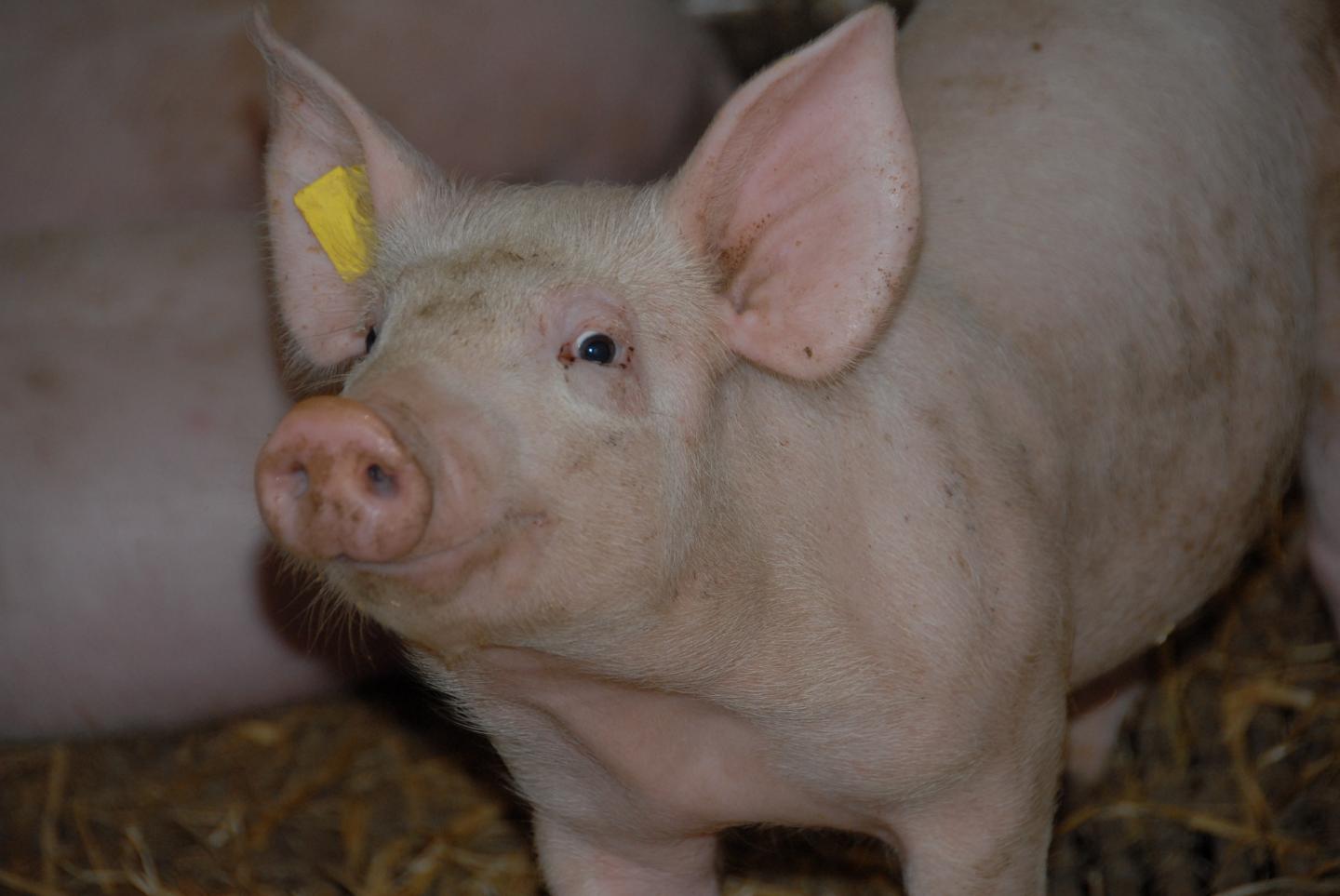
Credit: ©Vetmeduni Vienna
The present case investigated at Vetmeduni Vienna is the first clinical report on this form of listeriosis in fattening pigs. In their study, researchers from the Institute of Microbiology, the Institute of Pathology and the Institute of Milk Hygiene, under coordination by Lukas Schwartz from the University Clinic for Swine, showed that the bacterium Listeria monocytogenes, as the causative agent of listeriosis, should – contrary to current practice – form part of the list of differential diagnoses when fattening pigs suffer from bloody diarrhoea and septicaemia.
Fatal listeriosis in Lower Austria
The study was motivated by an episode of fatal listeriosis in fattening pigs in a pig farm in Lower Austria with an integrated fattening unit with space for 450 pigs. Clinical symptoms such as anorexia, bloody diarrhoea and an increased body temperature up to 40°C were observed in about 10% of the fattening pigs, mostly in well-fed animals with a bodyweight of 40-100 kg. In total, 35 fattening pigs died in a period of about 3 weeks.
A real crime thriller: evidence from DNA fingerprinting
Two fattening pigs with clinical symptoms as well as fed maize silage samples were investigated for further diagnostics. Molecular biological characterization isolated identical L. monocytogenes strains from samples taken from the pigs and in the maize silage. Additionally, a high content of deoxynivalenol was found in the maize silage. Deoxynivalenol is a mycotoxin found above all as a metabolic product in affected grains with potentially negative effects for the immune system. “The feeding of maize silage contaminated by listeria, which survive under poor ensilaging conditions, was the most likely source of infection of the fattening pigs,” says first author Heiko Stein.
Ensilaging under anaerobic conditions provides reliable protection
The researchers were able to show with their study that L. monocytogenes can cause clinical disease in fattening pigs that may be the result of immunosuppression due to high deoxynivalenol exposure. Stein therefore formulates the following appeal: “When feeding silage, it is important that all ensilaging procedures occur under appropriate anaerobic conditions to guarantee suppression of listerial growth.”
Important new insights for food safety
Listeria are rod-shaped bacteria that naturally occur in many different places. Most are harmless for people. The species L. monocytogenes, however, is anything but harmless for humans and animals. An infection caused by these bacteria can result in serious diarrhoea and encephalitis in humans and may even be fatal.
It is known from cattle and sheep that feeding silage of poor quality can lead to L. monocytogenes transmission causing encephalitis or bloody diarrhoea. In the scientific literature, however, only a few older case reports have dealt with L. monocytogenes transmission in pig herds despite the fact that L. monocytogenes contamination of pork products is of great concern for public health.
“Whenever bloody diarrhoea combined with increased mortality occurs in fattening pigs, L. monocytogenes should be part of the list of differential diagnoses, especially if silage is part of feeding. Since in our case therapeutic and prophylactic measures led to a fast recovery of diseased animals, antimicrobial therapy is indicated as soon as possible to avoid further shedding of L. monocytogenes via faeces and to prevent additional fatal cases,” says Stein in conclusion.
###
Media Contact
Lukas Schwarz
[email protected]
43-125-077-5228
Original Source
https:/