


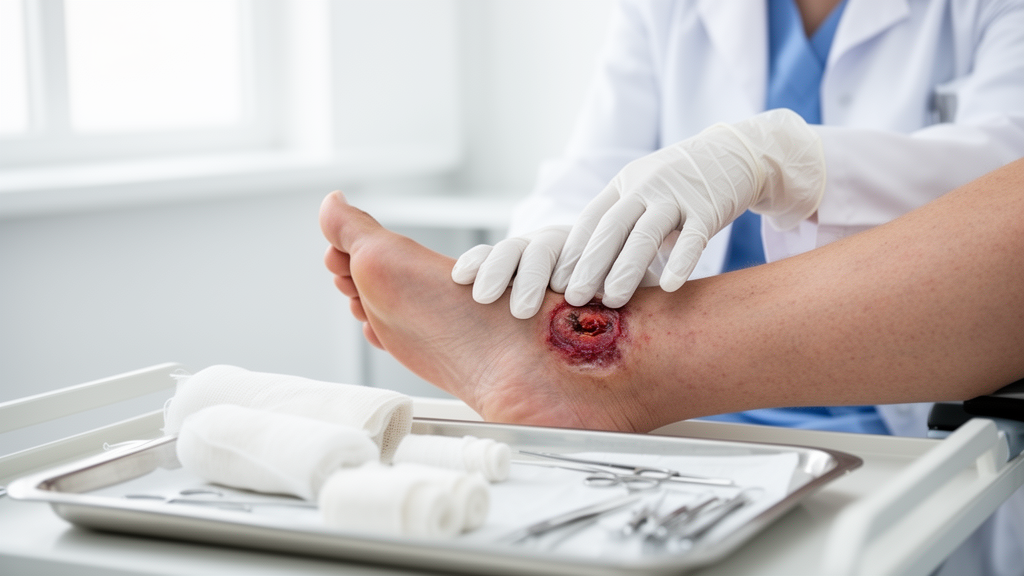
Older adults with diabetic foot ulcers healed faster when they were treated with the GLP-1 receptor agonist liraglutide, according to a randomized, placebo-controlled clinical trial published in Diabetology & Metabolic Syndrome. The trial also found that one month of liraglutide therapy lowered circulating levels of senescence-associated secretory phenotype factors, a set of inflammatory molecules linked to cellular aging.
Diabetic foot ulcers are strongly correlated with aging, yet the effects of anti-senescent treatments on wound repair in these patients have been poorly characterized. The research team set out to test whether GLP-1 receptor agonists, a class of agents described as geroprotective, could promote wound healing in patients with diabetic foot ulcers.
The study was a prospective, randomized, placebo-controlled clinical trial. The investigators enrolled 105 eligible participants and randomly assigned them in a 1:1 ratio to receive either liraglutide or placebo. The primary outcome was wound healing time, and the key secondary outcome was the circulating level of senescence-associated secretory phenotype factors, often abbreviated as SASP.
The mean age of the overall cohort was 73.7 ± 7.9 years, and males accounted for 55.2% of all participants. The trial was registered as ChiCTR2500104914 on June 25, 2025, and the article was published on October 17, 2026 as an open-access research paper.
Patients treated with liraglutide had a significantly shorter wound healing time and a greater reduction in ulcer area at the one-month follow-up compared with those receiving placebo. These results indicate that the drug accelerated the repair of chronic ulcers in this older study population.
Complete ulcer healing at three months was significantly more prevalent in the liraglutide group. However, the six-month amputation rate was similar between the two groups, meaning the faster healing observed in the first months did not translate into a measurable difference in amputations over the longer follow-up period.
Circulating levels of various SASP components, including interleukins, chemokines, and growth factors, significantly decreased after one month of liraglutide intervention. SASP factors are molecules secreted by senescent cells, and their reduction suggests that the treatment affected systemic markers of cellular senescence in these patients.
The authors concluded that liraglutide therapy ameliorates systemic SASP levels and accelerates wound healing in patients with diabetic foot ulcers, providing novel clinical evidence linking geroprotection to wound healing promotion. As with any single randomized trial, the findings apply to the population studied, and the similar amputation rates at six months are an important caveat when weighing the clinical significance of the accelerated healing and reduced SASP levels reported at earlier time points.
Subject of Research: Effects of liraglutide on wound healing and circulating senescence-associated secretory phenotype factors in patients with diabetic foot ulcers
Article Title: Effect of GLP-1RA on circulating SASP levels and wound healing in patients with diabetic foot ulcers: a randomized, placebo-controlled clinical trial
Article References: Li, M., Yan, C., Li, J., Wu, B., Tao, Q., Zhang, R., Zha, B., Yang, M., & Liu, J. (2026). Effect of GLP-1RA on circulating SASP levels and wound healing in patients with diabetic foot ulcers: a randomized, placebo-controlled clinical trial. Diabetology & Metabolic Syndrome. https://doi.org/10.1186/s13098-026-02330-w
Image Credits: AI Generated
DOI: 10.1186/s13098-026-02330-w
Keywords: liraglutide, GLP-1 receptor agonist, diabetic foot ulcers, wound healing, SASP, cellular senescence, randomized controlled trial, geroprotection, interleukins, chemokines, Diabetology & Metabolic Syndrome, Effect
News Source: Ophelia Keating. (October 28, 2026). Liraglutide speeds diabetic foot ulcer healing in randomized trial. Scienmag.



