• HOME
  • NEWS
  • EXPLORE
    • CAREER
      • Companies
      • Jobs
    • EVENTS
    • iGEM
      • News
      • Team
    • PHOTOS
    • VIDEO
    • WIKI
  • BLOG
  • COMMUNITY
    • FACEBOOK
    • INSTAGRAM
    • TWITTER
Saturday, May 16, 2026
BIOENGINEER.ORG
No Result
View All Result
  • Login
  • HOME
  • NEWS
  • EXPLORE
    • CAREER
      • Companies
      • Jobs
        • Lecturer
        • PhD Studentship
        • Postdoc
        • Research Assistant
    • EVENTS
    • iGEM
      • News
      • Team
    • PHOTOS
    • VIDEO
    • WIKI
  • BLOG
  • COMMUNITY
    • FACEBOOK
    • INSTAGRAM
    • TWITTER
  • HOME
  • NEWS
  • EXPLORE
    • CAREER
      • Companies
      • Jobs
        • Lecturer
        • PhD Studentship
        • Postdoc
        • Research Assistant
    • EVENTS
    • iGEM
      • News
      • Team
    • PHOTOS
    • VIDEO
    • WIKI
  • BLOG
  • COMMUNITY
    • FACEBOOK
    • INSTAGRAM
    • TWITTER
No Result
View All Result
Bioengineer.org
No Result
View All Result
Home NEWS Science News Biology

Link between liver and heart disease could lead to new therapeutics

Bioengineer by Bioengineer
June 10, 2020
in Biology
Reading Time: 3 mins read
0
IMAGE
Share on FacebookShare on TwitterShare on LinkedinShare on RedditShare on Telegram

IMAGE

Credit: Hua Bai

AMES, Iowa – A new study that looks closely at the cardiac health of flies provides new evidence that liver dysfunction may lead to deterioration of the heart.

The research fills in gaps in how scientists understand the links between heart health and other tissues and could inform the development of new therapies in human medicine, said Hua Bai, an assistant professor of genetics, development and cell biology at Iowa State University. Bai’s lab has performed previous studies on how cardiac health in flies changes with age. The new study, published in the academic journal Nature Communications, also covers new ground in the function of a poorly understood organelle called the peroxisome, which may play a major role in how organisms age.

“We were thinking outside the heart for this paper,” Bai said. “We wanted to find out if other tissues affect cardiac function during aging. There is significant data suggesting that liver function actually is a risk factor for cardiac disease. A patient with a lot of liver dysfunction often develops cardiac disease. This is a concern because you may have two diseases that you have to deal with for these patients.”

But Bai said no direct link between liver and heart disease has emerged in experiments, leaving medical professionals unsure if the two factors share a causal relationship or if there’s simply a correlation. Bai’s lab attempted to fill that gap by studying the interaction between liver disease and the function of cardiac muscles in flies.

Protecting the liver maintains heart health

Previous studies from Bai’s lab showed that manipulating genes in the cardiac muscles of flies could restore the heart function of older flies to a state similar to younger flies, essentially turning back the clock on cardiac tissues. In the new experiments, the researchers manipulated various genes governing liver function in flies to see how that would affect heart health as the flies aged.

“Our findings demonstrate we can protect the liver of old animals and maintain the health of the heart without doing any direct intervention on the heart tissue,” said Kerui Huang, a graduate student in Bai’s laboratory and the lead author of the study.

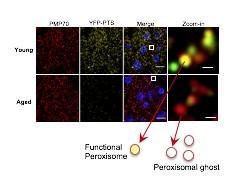
Much of the genetic work the researchers conducted focused on peroxisomes, understudied organelles inside cells that regulate key lipid metabolic processes and detoxification critical for brain and liver function.

“Looking at all the biology literature, we don’t know much about how peroxisome function changes in aged animals,” Bai said. “We show that peroxisomal protein import function is significantly impaired in aged flies. Research like ours could open up another new field to study how peroxisomes regulate tissue aging.”

Huang said although flies appear to be highly dissimilar to humans, human medicine still has much to gain from studying fly biology. For instance, the functions of a fly’s liver and heart share many similar functions with the human liver and heart.

Pharmaceutical companies have shown great interest in finding new avenues to treat age-related disease, Bai said. The relationship between peroxisomes, liver function and heart aging described in the new study might become a promising target for new therapies and drugs, he said.

###

Media Contact
Fred Love
[email protected]

Original Source

https://www.news.iastate.edu/news/2020/06/10/liverheart

Related Journal Article

http://dx.doi.org/10.1038/s41467-020-16781-w

Tags: BiologyCardiologyCell BiologyGenesGeneticsLiverMedicine/Health
Share13Tweet8Share2ShareShareShare2

Related Posts

Uncovering C. elegans Immunity via Genetic Screens — Biology

Uncovering C. elegans Immunity via Genetic Screens

May 16, 2026
Single mother must adapt swiftly — the survival of her colony depends on it — Biology

Single mother must adapt swiftly — the survival of her colony depends on it

May 15, 2026

Why Are Nearly Everyone Right-Handed? It Might Be Linked to How We Learned to Walk

May 15, 2026

Excessive Neuronal Activity Initiates Severe Autoimmune Brain Disorder

May 15, 2026
Please login to join discussion

POPULAR NEWS

  • Research Indicates Potential Connection Between Prenatal Medication Exposure and Elevated Autism Risk

    844 shares
    Share 338 Tweet 211
  • New Study Reveals Plants Can Detect the Sound of Rain

    730 shares
    Share 291 Tweet 182
  • Salmonella Haem Blocks Macrophages, Boosts Infection

    62 shares
    Share 25 Tweet 16
  • Breastmilk Balances E. coli and Beneficial Bacteria in Infant Gut Microbiomes

    58 shares
    Share 23 Tweet 15

About

We bring you the latest biotechnology news from best research centers and universities around the world. Check our website.

Follow us

Recent News

Uncovering C. elegans Immunity via Genetic Screens

Congenital Heart Disease’s Lasting Impact on Brain Health

Metabolic Stress Worsens Parkinson’s via Mitochondrial Ferroptosis

Subscribe to Blog via Email

Enter your email address to subscribe to this blog and receive notifications of new posts by email.

Join 82 other subscribers
  • Contact Us

Bioengineer.org © Copyright 2023 All Rights Reserved.

Welcome Back!

Login to your account below

Forgotten Password?

Retrieve your password

Please enter your username or email address to reset your password.

Log In
No Result
View All Result
  • Homepages
    • Home Page 1
    • Home Page 2
  • News
  • National
  • Business
  • Health
  • Lifestyle
  • Science

Bioengineer.org © Copyright 2023 All Rights Reserved.