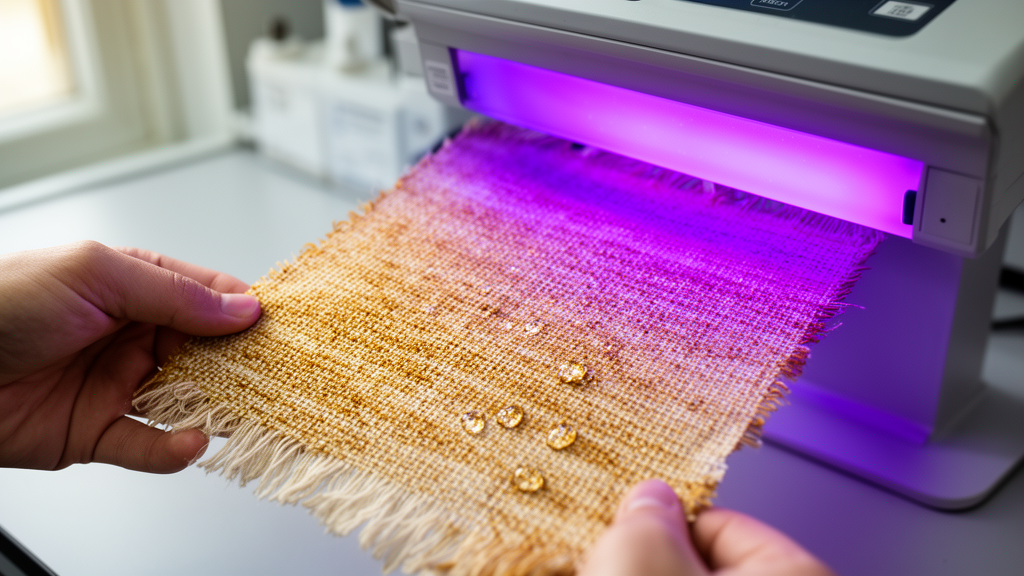
A laboratory study found that cotton fabric coated with natural alkali lignin, shellac and a blocked isocyanate crosslinker achieved very low ultraviolet transmittance across the measured 280–400 nanometer spectrum. The optimized formulation reduced UV transmittance to less than 0.6% and recorded an ultraviolet protection factor, or UPF, of 546.4 ± 0.6, based on three samples. The treatment, designated CF/S/AL/B, combined three components.
The optimized coating contained 120 grams per liter of shellac, 20 grams per liter of alkali lignin and a crosslinker dosage of 15 weight percent. Quantitative analysis of the coating’s components identified lignin as the dominant UV-absorbing functional component. Shellac served as the complementary film-forming matrix, while the blocked isocyanate supplied the crosslinking function.
The researchers also detected stable urethane bonds on the surfaces of the prepared samples, providing evidence that the coating developed a bonded structure on the cotton fabric. The strongest UV-protection result came from the optimized formulation. Its measured transmittance across the full tested UV band of 280–400 nanometers fell below 0.6%, while its mean UPF reached 546.4 with a standard deviation of 0.6.
These values were reported from three samples and describe the material under the study’s laboratory test conditions. The coated fabric also retained substantial UV protection after durability challenges. CF/S/AL/B samples recorded a UPF of 229.61 after 30 standard washing cycles.
In a separate abrasion test, samples retained a UPF of 475.43 after 80 abrasion cycles. These results show that the coating continued to provide high measured UV protection following the reported washing and abrasion procedures. Together, the experiments indicate that lignin can provide the principal UV-absorbing function in a biomass-based cotton coating, with shellac contributing the film-forming matrix and the blocked isocyanate enabling crosslinking.
The formation of a continuous, dense surface layer and the presence of stable urethane bonds were both observed as part of the optimized system. The work is a materials study rather than a human health trial. Its findings concern the optical and mechanical performance of laboratory-prepared textiles, not clinical outcomes.
The supplied study abstract does not report a life-cycle assessment, toxicity testing, certification of human sun protection, outdoor field trials or performance over years of use. The researchers described the CF/S/AL/B system as eco-friendly and presented it as a strategy for developing sustainable, long-lasting protective textiles from biomass materials. Within the evidence reported here, the central achievement is a laboratory-coated cotton fabric that combined strong UV blocking with resistance to washing and abrasion.
The abstract does not provide direct comparisons with untreated cotton or commercial UV-protective textile finishes.
Subject of Research: Laboratory development of lignin-shellac coatings for UV-protective cotton textiles
Article Title: Preparation and performance study of lignin-based UV-protective cotton fabrics
Article References: Guo, W., Xu, L., Zhao, H., Ding, Y., Xu, T., Yao, C., Pan, H., Wang, Y., & Zhang, Y. (2026). Preparation and performance study of lignin-based UV-protective cotton fabrics. Journal of Materials Science. https://doi.org/10.1007/s10853-026-13767-9
Image Credits: AI Generated
DOI: 10.1007/s10853-026-13767-9
Keywords: lignin, cotton textiles, UV protection, shellac, biomaterials, crosslinking, ultraviolet shielding, wash durability, abrasion resistance, Preparation, performance, lignin-based
News Source: Denise Maddox. (October 22, 2026). Lignin-Coated Cotton Shows Strong UV Protection and Durability. Scienmag.