• HOME
  • NEWS
  • EXPLORE
    • CAREER
      • Companies
      • Jobs
    • EVENTS
    • iGEM
      • News
      • Team
    • PHOTOS
    • VIDEO
    • WIKI
  • BLOG
  • COMMUNITY
    • FACEBOOK
    • INSTAGRAM
    • TWITTER
Sunday, May 10, 2026
BIOENGINEER.ORG
No Result
View All Result
  • Login
  • HOME
  • NEWS
  • EXPLORE
    • CAREER
      • Companies
      • Jobs
        • Lecturer
        • PhD Studentship
        • Postdoc
        • Research Assistant
    • EVENTS
    • iGEM
      • News
      • Team
    • PHOTOS
    • VIDEO
    • WIKI
  • BLOG
  • COMMUNITY
    • FACEBOOK
    • INSTAGRAM
    • TWITTER
  • HOME
  • NEWS
  • EXPLORE
    • CAREER
      • Companies
      • Jobs
        • Lecturer
        • PhD Studentship
        • Postdoc
        • Research Assistant
    • EVENTS
    • iGEM
      • News
      • Team
    • PHOTOS
    • VIDEO
    • WIKI
  • BLOG
  • COMMUNITY
    • FACEBOOK
    • INSTAGRAM
    • TWITTER
No Result
View All Result
Bioengineer.org
No Result
View All Result
Home NEWS Science News Chemistry

Lighting Hydrogels Via Nanomaterials

Bioengineer by Bioengineer
September 6, 2025
in Chemistry
Reading Time: 2 mins read
0
IMAGE
Share on FacebookShare on TwitterShare on LinkedinShare on RedditShare on Telegram

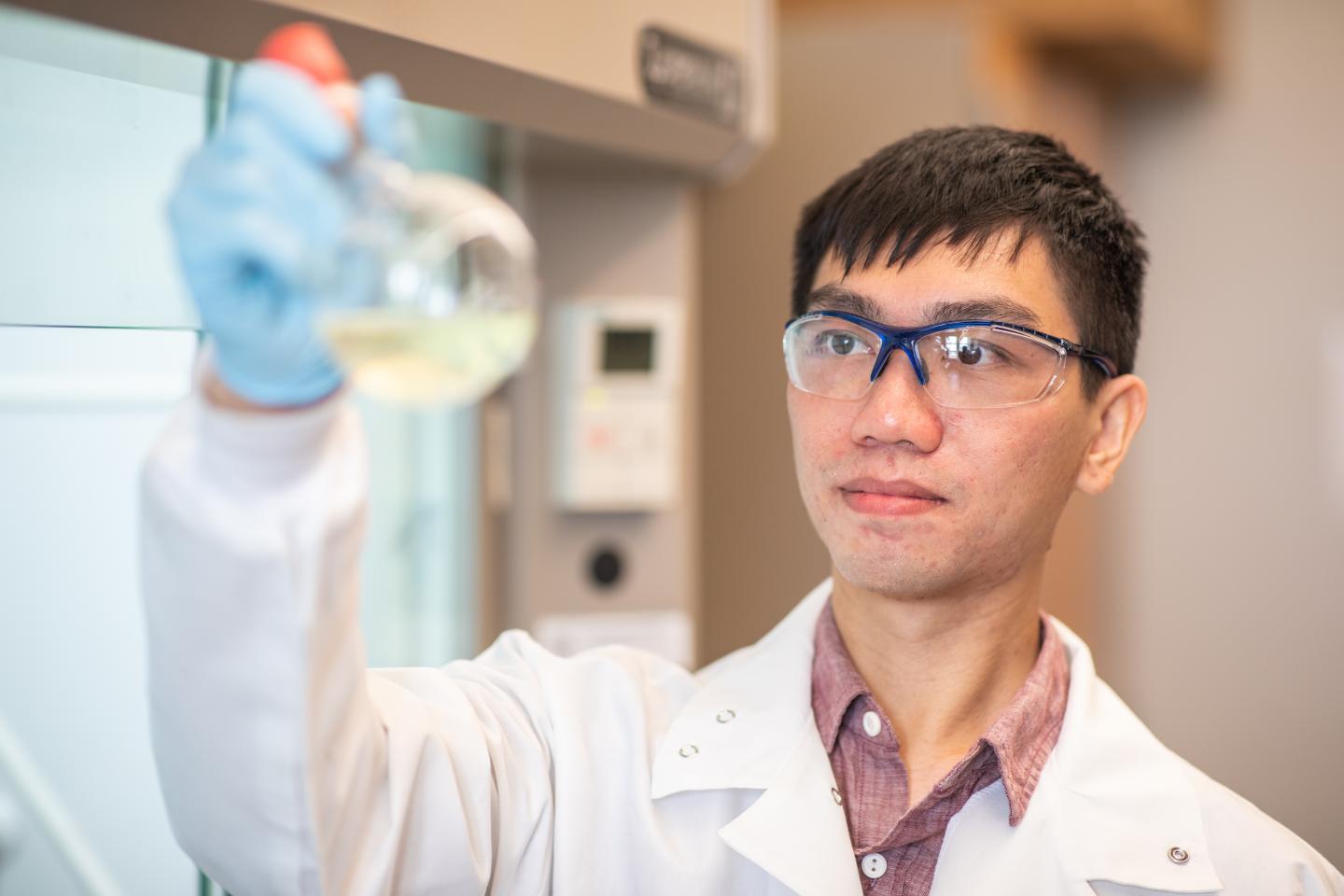
Texas A&M associate professor Akhilesh Gaharwar and graduate student Patrick Lee are developing a new class of hydrogels that can leverage light for drug delivery and regenerative medicine treatments.

Hydrogels are commonly used inside the body to help in tissue regeneration and drug delivery. However, once inside, they can be challenging to control for optimal use. A team of researchers in the Department of Biomedical Engineering at Texas A&M University is developing a new way to manipulate the gel — by using light.

Graduate student Patrick Lee and Dr. Akhilesh Gaharwar, associate professor, are developing a new class of hydrogels that can leverage light in a multitude of ways. Light is a particularly attractive source of energy as it can be confined to a predefined area as well as be finetuned by the time or intensity of light exposure. Their work was recently published in the journal Advanced Materials.

Light?responsive hydrogels are an emerging class of materials used for developing noninvasive, noncontact, precise and controllable medical devices in a wide range of biomedical applications, including photothermal therapy, photodynamic therapy, drug delivery and regenerative medicine.

Lee said light-responsive biomaterials are often used in biomedical applications; however, current light sources, such as ultraviolet light and visible light, cannot sufficiently penetrate the tissue to interact with the hydrogel. Instead, the team is researching near-infrared (NIR) light, which has a higher penetration depth.

The team is using a new class of two-dimensional nanomaterials known as molybdenum disulfide (MoS2), which has shown negligible toxicity to cells and superior NIR absorption. These nanosheets with high photothermal conversion efficiency can absorb and convert NIR light to heat, which can be developed to control thermoresponsive materials.

In the group’s previous study published in Advanced Materials, certain polymers react with MoS2 nanosheets to form hydrogels. Building on this discovery, the team further utilizes MoS2 nanosheets and thermoresponsive polymers to control the hydrogel under NIR light by photothermal effect.

NIR light allows internal formation of therapeutic hydrogels in the body for precise drug delivery. For cancer therapy, most of the drugs can be retained within the tumor, which will ease the side effects of chemotherapy. Moreover, NIR light can generate heat inside the tumors to ablate cancer cells, known as photothermal therapy. Therefore, a synergetic combination of photothermal therapy and chemotherapy has shown a higher efficacy in destroying cancer cells.

###

This study is funded by the New Innovator Award from the National Institutes of Health, as well as the Texas A&M President’s Excellence Fund through X?grant and T3.

Media Contact
Amy Halbert
[email protected]

Original Source

https://today.tamu.edu/2021/06/02/lighting-hydrogels-via-nanomaterials/

Related Journal Article

http://dx.doi.org/10.1002/adma.202101238

Tags: Biomedical/Environmental/Chemical EngineeringBiotechnologyMedicine/HealthNanotechnology/MicromachinesPolymer Chemistry
Share13Tweet8Share2ShareShareShare2

Related Posts

Miniature Sensor Uses Light to Detect Touch — Chemistry

Miniature Sensor Uses Light to Detect Touch

May 8, 2026
Iron Minerals Determine Whether Dissolved Organic Matter Fuels Microbes or Becomes Long-Term Carbon Storage — Chemistry

Iron Minerals Determine Whether Dissolved Organic Matter Fuels Microbes or Becomes Long-Term Carbon Storage

May 8, 2026

Kate Evans Appointed Associate Lab Director for Biological and Environmental Systems Science at ORNL

May 8, 2026

Advancing Multiscale Modeling and Overcoming Operational Challenges in Autothermal COâ‚‚-to-Methanol Reactors

May 8, 2026
Please login to join discussion

POPULAR NEWS

  • Research Indicates Potential Connection Between Prenatal Medication Exposure and Elevated Autism Risk

    840 shares
    Share 336 Tweet 210
  • New Study Reveals Plants Can Detect the Sound of Rain

    727 shares
    Share 290 Tweet 181
  • Scientists Investigate Possible Connection Between COVID-19 and Increased Lung Cancer Risk

    68 shares
    Share 27 Tweet 17
  • Salmonella Haem Blocks Macrophages, Boosts Infection

    61 shares
    Share 24 Tweet 15

About

We bring you the latest biotechnology news from best research centers and universities around the world. Check our website.

Follow us

Recent News

Urdu Fall Risk Questionnaire Adapted for Elderly

Key Pharmacological Markers for HIV Prevention in MSM

Taking 8,500 Steps Daily May Aid Long-Term Weight Management, Study Finds

Subscribe to Blog via Email

Enter your email address to subscribe to this blog and receive notifications of new posts by email.

Join 82 other subscribers
  • Contact Us

Bioengineer.org © Copyright 2023 All Rights Reserved.

Welcome Back!

Login to your account below

Forgotten Password?

Retrieve your password

Please enter your username or email address to reset your password.

Log In
No Result
View All Result
  • Homepages
    • Home Page 1
    • Home Page 2
  • News
  • National
  • Business
  • Health
  • Lifestyle
  • Science

Bioengineer.org © Copyright 2023 All Rights Reserved.