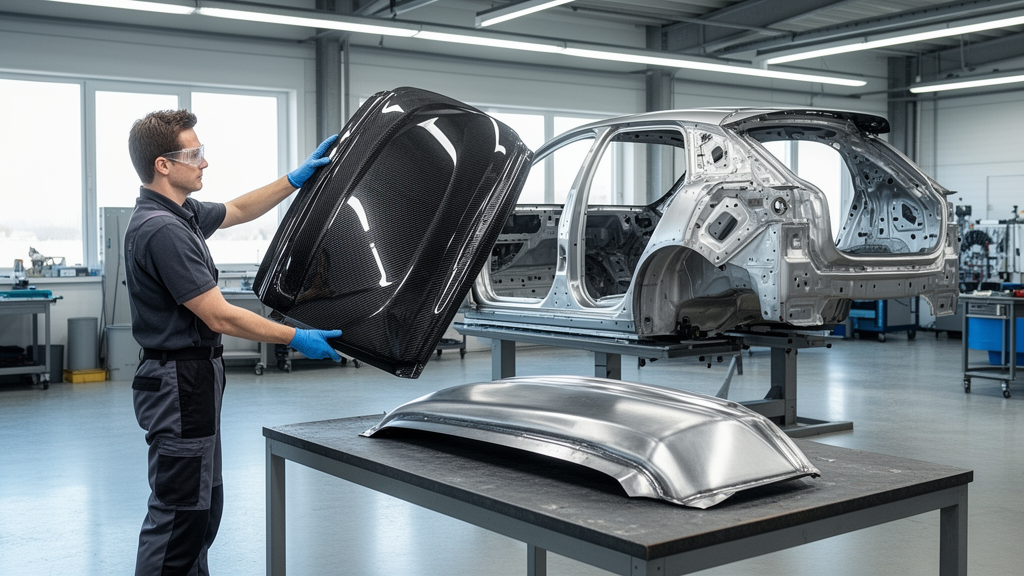
The transport sector is under growing pressure to help meet national and global carbon-neutrality targets, and a new review argues that vehicle lightweighting has become a core technical route for cutting energy use and CO₂ emissions. Published in the Springer Nature journal Carbon Neutral Systems, the paper moves beyond the traditional idea of simply making cars lighter. Instead, it frames lightweighting as an integrated “lightweight decarbonization process system” that links material selection, manufacturing, structural design, powertrain configuration and end-of-life recycling into a single carbon-management framework.
The physical logic is straightforward. A vehicle’s tractive force can be broken into four components: inertial resistance during acceleration and braking, rolling resistance from tires and road deformation, aerodynamic drag and grade resistance on climbs. Vehicle mass enters directly into the first three. When a car accelerates, a lighter mass needs less force to reach the same speed change; rolling resistance is roughly proportional to the normal load on the tires; and grade resistance scales with weight on a slope. Aerodynamic drag does not depend directly on mass, but lightweighting can indirectly influence body design, frontal area and packaging, especially when combined with platform optimization.
For conventional internal-combustion vehicles, less wheel power demand lets the engine and transmission operate closer to efficient regions and enables downsizing of components such as the engine, gearbox and cooling system. Under typical mixed driving cycles, a given percentage reduction in curb mass can translate into a larger percentage reduction in fuel consumption once these secondary effects are counted. The review cites engineering assessments indicating that a 10% reduction in vehicle mass can typically yield around a 6–8% improvement in fuel economy, and a comparable decrease in greenhouse gas emissions, when vehicle performance is maintained.
Battery electric vehicles obey the same physics but with different implications. A lighter electric vehicle needs less electrical energy per kilometre, extending range for a given battery capacity. Alternatively, for a fixed target range, the battery pack can be shrunk, which further lowers vehicle mass and creates what the authors call a virtuous “mass compounding effect.” Smaller batteries also reduce the embodied emissions of cell manufacturing and ease pressure on critical mineral supply chains. Regenerative braking partially recovers kinetic energy during deceleration, moderating the sensitivity of electric vehicles to mass in low-speed, stop-and-go conditions, but significant mass reduction still meaningfully lowers net electricity consumption, especially at higher speeds or in mixed driving.
The catch is that many lightweight materials are more energy-intensive to produce than conventional steels. Advanced high-strength steels, aluminum and magnesium alloys and fiber-reinforced polymer composites can all carry higher embodied emissions per kilogram. Life-cycle assessment therefore weighs the extra emissions from material production and component manufacturing against the emissions avoided during the use phase. The review introduces the concept of a “break-even mileage”: the cumulative distance at which use-phase CO₂ savings equal the extra manufacturing emissions. For a typical mid-size internal-combustion vehicle swapping 150 kg of mild steel for aluminum alloy in the body-in-white, break-even falls at roughly 50,000–70,000 km under EU driving cycles. For a battery electric vehicle with the same mass reduction, it shortens to 30,000–45,000 km thanks to higher electricity efficiency and battery downsizing effects.
Break-even performance depends on several factors. High annual mileage and frequent acceleration, as in urban delivery vehicles or intercity coaches, favor lightweighting because use-phase savings accumulate quickly. For electric vehicles, the carbon intensity of the electricity mix matters in both directions: a cleaner grid reduces the marginal benefit of operational savings but also lowers the embodied emissions of energy-intensive materials. Longer service life gives vehicles more distance over which to amortize manufacturing emissions, and high-quality recycling of metals can drastically cut the effective embodied emissions of aluminum and steel, making design for recycling and closed-loop scrap management crucial.
On the technology side, the review maps the main routes for mass reduction. In the body-in-white, advanced high-strength and ultra-high-strength steels allow thinner gauges and lower mass at equal or better crash performance, often with a favorable balance of cost, manufacturability and life-cycle carbon. Aluminum-intensive designs can cut body mass by 30–40% relative to all-steel structures, yielding total vehicle mass reductions of 150–250 kg in some segments, though they demand careful joint design to manage galvanic corrosion, stiffness differences and repairability. Magnesium alloys and composites offer even higher specific stiffness and strength but remain costly and energy-intensive to produce, so they belong where mass reduction yields large use-phase benefits or enables functional integration that would otherwise be impossible.
Structural optimization matters as much as material substitution. Topology optimization and multi-disciplinary design tools remove unnecessary material by reshaping load paths, integrate multiple parts into single components and introduce tailored stiffness to manage crash energy. The emergence of large integrated die castings, so-called mega castings, exemplifies the trend: one-piece aluminum structures replace dozens of stamped and welded parts, simplifying manufacturing and potentially lowering life-cycle emissions through fewer processing steps, provided casting quality and repair strategies are well controlled. In powertrains and chassis, aluminum and compacted-graphite iron reduce engine mass, hollow crankshafts cut reciprocating mass, and lightweight unsprung components improve ride comfort, road grip and transient response.
New energy vehicles add their own targets. Battery packs can be lightweighted through high-strength aluminum extrusions and castings, composite covers and cell-to-pack or cell-to-body concepts that let the enclosure serve as a structural member, cutting redundant mass and improving range or allowing smaller batteries. Thermal management systems benefit from optimized cooling plates, thin-wall extrusions and integrated circuits that reduce heat exchangers, pumps and piping. The review also highlights exhaust aftertreatment as a high-value opportunity: low thermal mass, high specific strength catalyst substrates can shorten light-off time, reduce cold-start emissions and fuel penalties, and lower system mass, while lightweight housings and integrated exhaust modules cut component count and heat loss.
Engineering practice shows that system-level lightweighting can routinely deliver single-digit to low double-digit percentage reductions in energy use and CO₂ emissions at the vehicle level, particularly in high-mileage and urban-duty applications. For delivery vans, pickups and urban buses, lightweight bodies, aluminum or composite panels and optimized chassis components can cut curb weight while preserving payload, producing fuel or electricity savings often exceeding 10% in urban duty cycles. The authors identify five core technology packages for future development, including a low thermal mass catalyst carrier with lightweight housing targeting 10–20% subsystem mass reduction and 5–8% cold-start emission reduction, a recycled-aluminum exhaust and cooling package aiming at 15–25% component mass reduction and 30–40% embodied CO₂ reduction, structural battery pack integration targeting 10–15% vehicle mass reduction and 8–12% battery capacity downsizing, a digital life-cycle-integrated design platform, and multi-material recyclable joining designed to ensure 90% or higher material recovery while maintaining structural performance. Realizing these gains, the review concludes, requires coordinated advances in low-carbon material preparation, advanced forming and casting, recyclable multi-material joining, durable surface protection and digital tools that embed life-cycle CO₂ as a design objective from the earliest stages.
Subject of Research: Vehicle lightweighting as a decarbonization strategy for road transport
Article Title: Vehicle lightweighting for carbon neutrality: decarbonization mechanisms, key processes and engineering applications
Article References: Wang, Y., Ma, Q., Wang, T., Zhang, B., Wang, D., Zhang, X., Nagaumi, H., Yang, B., Ren, X., Huang, J., Zhang, Y., Chen, X., Xiong, W., Wang, B., Li, Y., & Liu, X. (2026). Vehicle lightweighting for carbon neutrality: decarbonization mechanisms, key processes and engineering applications. Carbon Neutral Systems, 2(1), Article 2. https://doi.org/10.1007/s44438-026-00023-5
Image Credits: AI Generated
DOI: 10.1007/s44438-026-00023-5
Keywords: vehicle lightweighting, carbon neutrality, life-cycle assessment, advanced high-strength steel, aluminum alloys, battery electric vehicles, mass compounding, recycled aluminum, mega castings, multi-material joining, exhaust aftertreatment, thermal management
News Source: Sloane Callahan. (October 30, 2026). Lighter Cars, Lower Carbon: How Vehicle Lightweighting Powers Climate Goals. Scienmag.