• HOME
  • NEWS
  • EXPLORE
    • CAREER
      • Companies
      • Jobs
    • EVENTS
    • iGEM
      • News
      • Team
    • PHOTOS
    • VIDEO
    • WIKI
  • BLOG
  • COMMUNITY
    • FACEBOOK
    • INSTAGRAM
    • TWITTER
Friday, June 26, 2026
BIOENGINEER.ORG
No Result
View All Result
  • Login
  • HOME
  • NEWS
  • EXPLORE
    • CAREER
      • Companies
      • Jobs
        • Lecturer
        • PhD Studentship
        • Postdoc
        • Research Assistant
    • EVENTS
    • iGEM
      • News
      • Team
    • PHOTOS
    • VIDEO
    • WIKI
  • BLOG
  • COMMUNITY
    • FACEBOOK
    • INSTAGRAM
    • TWITTER
  • HOME
  • NEWS
  • EXPLORE
    • CAREER
      • Companies
      • Jobs
        • Lecturer
        • PhD Studentship
        • Postdoc
        • Research Assistant
    • EVENTS
    • iGEM
      • News
      • Team
    • PHOTOS
    • VIDEO
    • WIKI
  • BLOG
  • COMMUNITY
    • FACEBOOK
    • INSTAGRAM
    • TWITTER
No Result
View All Result
Bioengineer.org
No Result
View All Result
Home NEWS Science News Chemistry

Light burns with new acids

Bioengineer by Bioengineer
February 7, 2020
in Chemistry
Reading Time: 2 mins read
0
IMAGE
Share on FacebookShare on TwitterShare on LinkedinShare on RedditShare on Telegram

IMAGE

Credit: Tsuyoshi Kawai


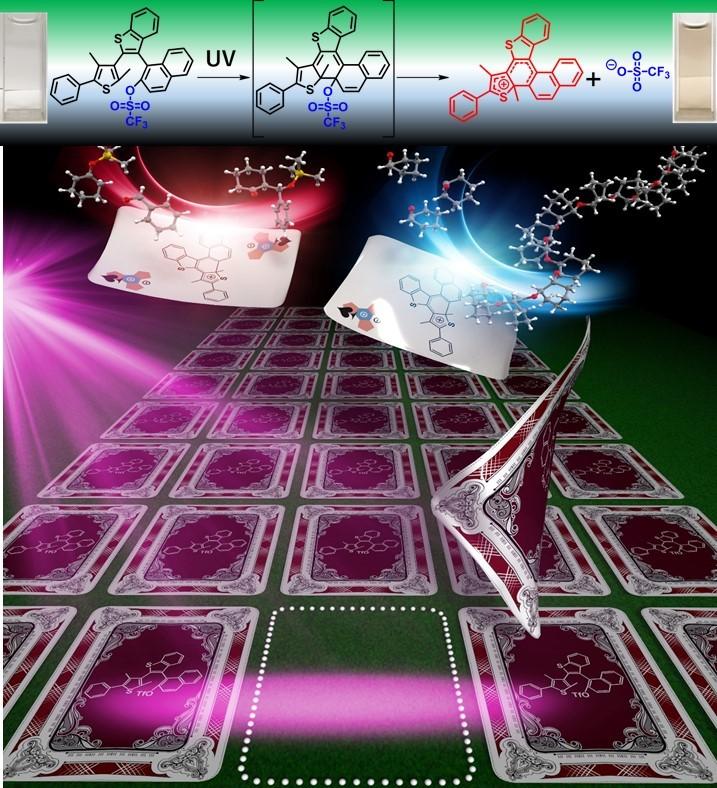
Researchers at Nara Institute of Science and Technology (NAIST) report a photo-acid generator (PAG) that generates Lewis acids with a quantum yield that is vastly superior to PAGs that generate Brønsted acids. The new PAG is based on photo-chemical 6π-percyclization and is demonstrated to initiate the polymerization of epoxy monomers and catalyze Mukaiyama-aldol reactions.

PAGs are chemical species that release strong acids, either in solution or solid state, upon exposure to light. These acids can then be used to activate various biological and photo-polymer systems.

Most PAGs form Brønsted acids and do so with great efficiency. However, Brønsted acids limit options in terms of substrates and reaction mechanisms, particularly for organic synthesis when compared to Lewis acids. Some of chemical substances are easily decomposed with Brønsted acids but not with Lewis acids.

“Lewis acid catalysts are much useful but often unstable and require careful introduction to reaction systems. Preferably, we would induce Lewis acid catalysts remotely, like optical exposure,” explains NAIST Associate Professor Takuya Nakashima, one of the lead researchers in the project.

The new PAG depends on the addition of a triflate group to terarylene. The triflate group showed a high propensity to release from the terarylene upon exposure to UV light.

“We have focused on terarylene because its very high light-sensitivity, compatibility into polymer films and no oxygen/moisture inhibition. We have also found non-linear responses that can be used to greatly enhance the light-sensitivity,” says NAIST Professor Tsuyoshi Kawai, another lead researcher. Indeed, the photo-chemical quantum yield was 0.5, which is much higher than standard PAGs.

The resulting Lewis acid was generated without any radical intermediate and sustained for more than 100 days. It was then used to initiate the polymerization of epoxy monomers, SU-8, and Mukaiyama-aldol reactions for benzaldehyde and silyl enolates to produce silyl aldols of different stereoisomers, that were not possible with Brønsted acids formed with PAGs.

“This system opens new opportunities for Lewis-acid reactions. It is the first to generate photo-activated Mukaiyama-aldol reactions,” says Kawai.

###

Resource

Title: Photo-Lewis acid generator based on radical-free 6π photo-cyclization reaction

Authors: Ryo Mizutsu, Ryosuke Asato, Colin J. Martin, Mihoko Yamada, Yoshiko Nishikawa, Shohei Katao, Miku Yamada, Takuya Nakashima & Tsuyoshi Kawai

Journal: Journal of the American Chemical Society

DOI: 10.1021/jacs.9b11821

Information about Prof. Kawai lab can be found at the following website:

https://mswebs.naist.jp/LABs/kawai/english/index.html

Media Contact
Takahito Shikano
[email protected]

Related Journal Article

http://dx.doi.org/10.1021/jacs.9b11821

Tags: Chemistry/Physics/Materials SciencesOpticsPolymer Chemistry
Share12Tweet8Share2ShareShareShare2

Related Posts

AI and Physics Collaborate to Design Advanced Hydrogen Storage Materials

June 25, 2026

International Team Including Dresden Scientists Develops Novel Designer Proteins for Advanced Study of Living Tissue

June 25, 2026

New Study Uncovers Key Factors Driving Water Chemistry in Nanoscale Environments

June 25, 2026

Plasma Technology Extends Catalyst Lifespan in Hydrogen Production

June 24, 2026
Please login to join discussion

POPULAR NEWS

  • Saying Goodbye to PGY-6: Pediatric Fellowship Realities

    103 shares
    Share 41 Tweet 26
  • Multi-Hospital Study Reveals Long Covid Burden Is Twice as High as Current Estimates

    92 shares
    Share 36 Tweet 23
  • Detection of EDCs in Breast Milk and Infant Urine Up to Six Months Highlights Early Exposure Risks

    77 shares
    Share 31 Tweet 19
  • New Drug Candidate Developed at McMaster Shows Potential for Treating Brain Cancer

    58 shares
    Share 23 Tweet 15

About

We bring you the latest biotechnology news from best research centers and universities around the world. Check our website.

Follow us

Recent News

Tracking Lanthanide-Labeled Microplastics in Plants

POSTECH Researchers Slash Cost of Reconstituted Cell-Free Systems by 95%

AI and Physics Collaborate to Design Advanced Hydrogen Storage Materials

Subscribe to Blog via Email

Success! An email was just sent to confirm your subscription. Please find the email now and click 'Confirm' to start subscribing.

Join 82 other subscribers
  • Contact Us

Bioengineer.org © Copyright 2023 All Rights Reserved.

Welcome Back!

Login to your account below

Forgotten Password?

Retrieve your password

Please enter your username or email address to reset your password.

Log In
No Result
View All Result
  • Homepages
    • Home Page 1
    • Home Page 2
  • News
  • National
  • Business
  • Health
  • Lifestyle
  • Science

Bioengineer.org © Copyright 2023 All Rights Reserved.