Three scientists whose work taught neuroscientists to control brain cells with beams of light have been awarded the 2026 Nobel Prize in Physiology or Medicine. Karl Deisseroth of the Howard Hughes Medical Institute and Stanford University, Peter Hegemann of the Humboldt University of Berlin, and Georg Nagel of the University of Würzburg in Germany received the prize for their discoveries concerning light-gated ion channels and optogenetics, a set of techniques that has fundamentally changed how researchers investigate the brain. The announcement, released on 5 October 2026 through the Society for Neuroscience, highlights not only the scientific weight of the discovery but also the deep roots all three laureates share with the neuroscience community: Deisseroth has been a member of SfN for 33 years, and Hegemann for 15 years.
The story behind this year’s prize begins with a single-celled green alga and a protein with unusual properties. Hegemann and Nagel discovered channelrhodopsin, a light-sensitive protein found on the surface of algal cells. Under the microscope of physics and chemistry, the protein behaves like a microscopic gate. When it is illuminated by blue light, a channel opens through its structure, and charged ions flow into the cell. That movement of ions creates an electrical impulse, the same kind of signal that nerve cells use to communicate. In other words, the algal protein converts light directly into electricity, a trick that evolution had refined over hundreds of millions of years in organisms that use light to steer their movement through water.
What made channelrhodopsin revolutionary was not simply that it existed, but that it worked anywhere it was placed. Hegemann and Nagel found that regardless of which cell they put the protein in, those cells became light sensitive. A protein from a pond-dwelling alga could, in principle, be installed in almost any living cell and turn that cell into a light-controlled machine. This portability transformed a curiosity of microbial physiology into a potential tool for biology at large. The discovery provided the raw material for what would soon become one of the most powerful methods in modern neuroscience.
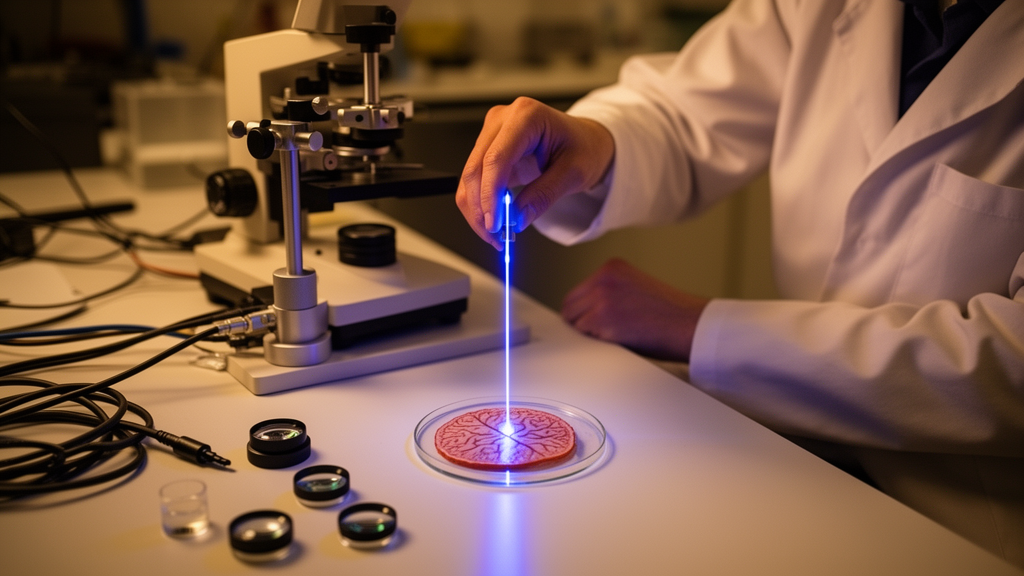
Karl Deisseroth built on that foundation with a decisive experiment. He introduced the gene for channelrhodopsin into nerve cells taken from rats. Once the neurons carried the algal gene, they manufactured the light-sensitive protein on their own surfaces. By illuminating the cells with blue light, Deisseroth was able to trigger a nerve signal on demand, switching individual neurons on with nothing more than a pulse of light. He published this breakthrough in 2005, and the paper quickly became a landmark, demonstrating that the algal channel could be genetically delivered into mammalian neurons and used as a remote control for their electrical activity.
The next step carried the technique out of the culture dish and into living animals. Two years after the 2005 publication, Deisseroth made this light-controlled switch for nerve cells work in the brains of living mice. The achievement solved a problem that had constrained neuroscience for more than a century. Electrical stimulation, the traditional method for probing brain function, activates everything in the path of the electrode, making it difficult to attribute an observed behavior to a specific type of cell. Pharmacological approaches act slowly and indiscriminately. Optogenetics, by contrast, allowed researchers to activate individual types of nerve cells within the intact brain, with millisecond precision, simply by shining light on cells that had been genetically tagged with a light-sensitive channel.
The consequences for neuroscience have been sweeping. With the ability to activate individual types of nerve cells in the brain, neuroscientists around the world have identified neural circuits governing pain, social behaviors, thirst, reward, attention and more. Questions that had resisted decades of study, such as which populations of neurons encode reward or drive social interaction, became experimentally addressable. A researcher could genetically restrict channelrhodopsin to one defined class of neurons, implant a tiny optical fiber, and observe what happens to an animal’s behavior when only those cells are switched on. The causal links between specific circuits and specific behaviors, once inferred indirectly, could now be tested directly.
The technique’s reach extends beyond basic research. Optogenetics has opened the door to new ways of understanding the brain that will inform both research and therapeutic efforts into the future. Because the method allows precise control over the cells involved in pathological circuits, it offers a blueprint for potential interventions in disorders of the nervous system, from chronic pain to conditions affecting reward and motivation. While clinical applications remain an ongoing endeavor, the conceptual shift is already complete: the brain is no longer an impenetrable tangle of wires but a circuit diagram whose components can be individually addressed, tested, and in principle corrected.
The prize itself carries institutional and historical weight. The Nobel Assembly, consisting of 50 professors at Karolinska Institutet in Sweden, awards the Nobel Prize in Physiology or Medicine, with its Nobel Committee evaluating the nominations. Since 1901, the Nobel Prize has been awarded to scientists who have made the most important discoveries for the benefit of humankind, and the physiology or medicine prize has repeatedly honored technologies that transformed biological research. The 2026 award follows that tradition, recognizing a discovery chain that runs from an algal protein through gene transfer into rat neurons to light-controlled circuits in living mammalian brains. The Nobel Prize amount for 2026 is set at Swedish kronor 12.0 million, roughly 1.2 million US dollars, per full Nobel Prize.
The recognition also underscores the collaborative and international character of modern science. Hegemann and Nagel, working in Germany, uncovered the fundamental properties of channelrhodopsin; Deisseroth, based at Stanford University and the Howard Hughes Medical Institute in the United States, converted those properties into a working technology for neuroscience. The prize in physiology or medicine for a tool-building achievement reflects how methodological breakthroughs can be as consequential as discoveries about disease mechanisms themselves. A technique that lets researchers interrogate the brain cell by cell has, in two decades, become part of the standard toolkit in laboratories worldwide, generating insights into circuits underlying perception, memory, mood, and behavior.
For the Society for Neuroscience, an organization of nearly 35,000 basic scientists and clinicians who study the brain and the nervous system, the award carries particular resonance, as two of the three laureates are longtime members whose careers have unfolded within the community the society convenes. The 2026 Nobel Prize in Physiology or Medicine thus honors both a specific discovery and a broader transformation: the moment when neuroscientists gained the ability to speak to the brain in its own electrical language, using light as the messenger. The work of Deisseroth, Hegemann, and Nagel stands as a demonstration that a humble protein from an alga, understood deeply and deployed imaginatively, can change how an entire field asks its questions and how future therapies for brain disorders may one day be designed.
Subject of Research: The 2026 Nobel Prize in Physiology or Medicine awarded for the discovery of light-gated ion channels and the development of optogenetics
Article Title: SfN members awarded the 2026 Nobel Prize in Physiology or Medicine
Article References: SfN members awarded the 2026 Nobel Prize in Physiology or Medicine. (n.d.). Original publication
Image Credits: AI Generated
DOI: Not provided
Keywords: Nobel Prize, optogenetics, channelrhodopsin, neuroscience, light-gated ion channels, Karl Deisseroth, Peter Hegemann, Georg Nagel, neural circuits, brain research, Society for Neuroscience, Karolinska Institutet
News Source: Cassandra Pierce. (October 19, 2026). Light-Activated Brain Switches Earn 2026 Nobel Prize in Physiology or Medicine. Scienmag.