• HOME
  • NEWS
  • EXPLORE
    • CAREER
      • Companies
      • Jobs
    • EVENTS
    • iGEM
      • News
      • Team
    • PHOTOS
    • VIDEO
    • WIKI
  • BLOG
  • COMMUNITY
    • FACEBOOK
    • INSTAGRAM
    • TWITTER
Wednesday, November 4, 2026
BIOENGINEER.ORG
No Result
View All Result
  • Login
  • HOME
  • NEWS
  • EXPLORE
    • CAREER
      • Companies
      • Jobs
        • Lecturer
        • PhD Studentship
        • Postdoc
        • Research Assistant
    • EVENTS
    • iGEM
      • News
      • Team
    • PHOTOS
    • VIDEO
    • WIKI
  • BLOG
  • COMMUNITY
    • FACEBOOK
    • INSTAGRAM
    • TWITTER
No Result
View All Result
Bioengineer.org
No Result
View All Result
Home NEWS Science News Health

Life expectancy crisis in the USA: The opioid crisis is not the decisive factor

Bioengineer by Bioengineer
March 17, 2020
in Health
Reading Time: 2 mins read
0
IMAGE
Share on FacebookShare on TwitterShare on LinkedinShare on RedditShare on Telegram

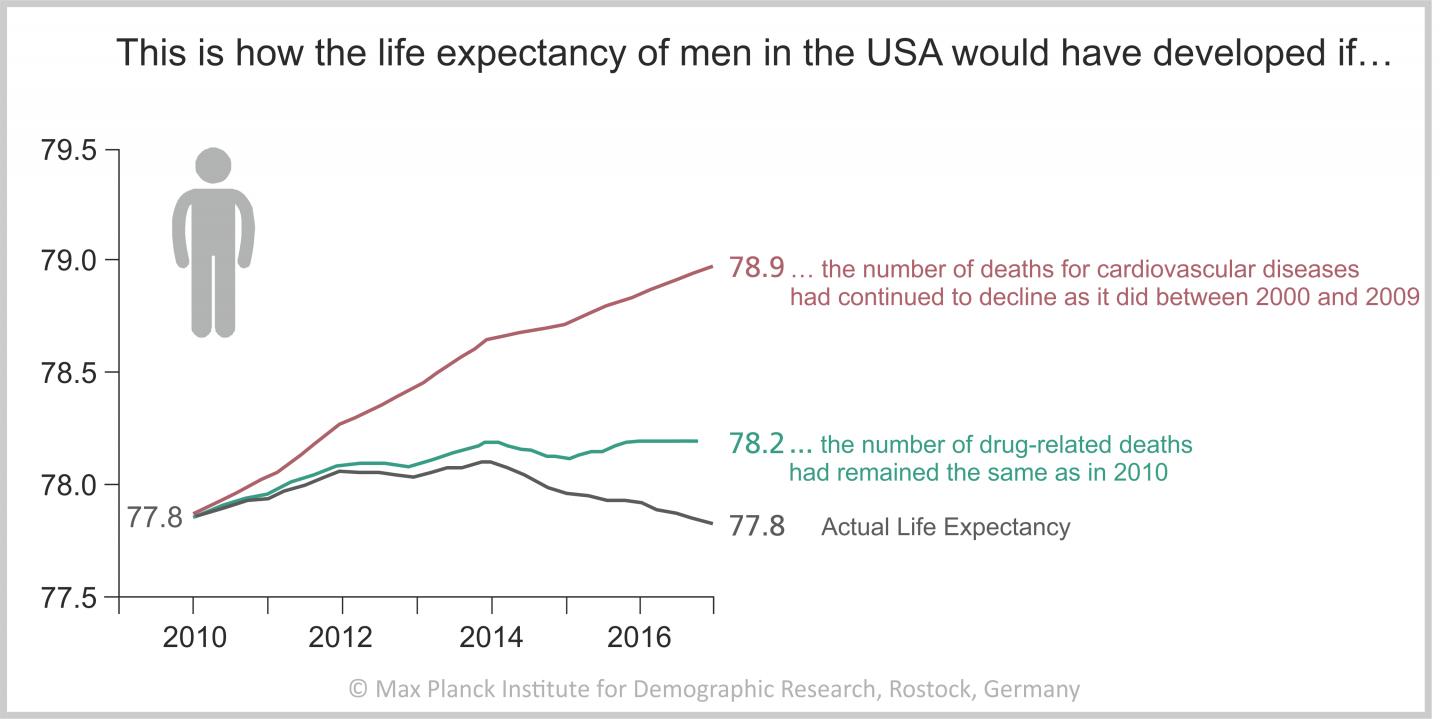
Cardiovascular diseases — rather than drug deaths due to the opioid crisis — have the greatest impact on stagnating life expectancy in the USA
IMAGE

Credit: MPIDR

Life expectancy in the USA is no longer rising. This stagnation has long been largely attributed to increasing numbers of drug deaths due to the opioid crisis. But Mikko Myrskylä and colleagues have now shown that deaths due to cardiovascular diseases are in fact having a much larger impact on life expectancy.

Over each decade of the past century, life expectancy in the USA rose by two years. This is no longer the case. Since 2010, life expectancy has not improved. Until now, this fact has mainly been attributed to the rising number of drug deaths due to the opioid crisis.

But Mikko Myrskylä, Director of the Max Planck Institute for Demographic Research in Rostock, together with Neil Mehta and Leah Abrams from University of Michigan have shown a stall in declining cardiovascular deaths is a more likely explanation for the end of stagnation of life expectancy. They have published their findings in the scientific journal PNAS.

Drug-related deaths have little influence on life expectancy

The remaining life expectancy of 25-year-old Americans would have risen by 1.1 years between 2010 and 2017 if deaths from cardiovascular diseases had declined as much over that period as they did between 2000 and 2009.

By contrast, the rising number of drug-related deaths had a much smaller influence on life expectancy. “If the number of drug-related deaths had remained constant after 2010, male life expectancy would have risen just 0.4 years, or by around five months,” Mikko Myrskylä explained. Thus, over the long run, reducing the number of drug-related deaths will not be sufficient to ensure that life expectancy in the USA resumes its upward trajectory.

###

Original publication

Mehta, N., Abrams, L., Myrskylä, M.: U.S. Life Expectancy Stalls Due to Cardiovascular Disease, not Drug Deaths. PNAS. (2020), DOI: https://doi.org/10.1073/pnas.1920391117

Media Contact
Mikko Myrskylä
myrskyla@demogr.mpg.de
49-381-208-1143

Original Source

https://www.demogr.mpg.de/en/news_events_6123/news_press_releases_4630/press/life_expectancy_crisis_in_the_usa_the_opioid_crisis_is_not_the_decisive_factor_7346

Related Journal Article

http://dx.doi.org/10.1073/pnas.1920391117

Tags: Medicine/Health
Share13Tweet8Share2ShareShareShare2

Related Posts

Carbon-Ion Radiotherapy Before Surgery Yields Strong Tumor Response in Advanced Pancreatic Cancer

Carbon-Ion Radiotherapy Before Surgery Yields Strong Tumor Response in Advanced Pancreatic Cancer

November 4, 2026
Simulation setting may not shape emergency team nontechnical skills

Simulation setting may not shape emergency team nontechnical skills

November 4, 2026

IFN-γ Restores Trauma-Dampened Monocytes but Fails to Prevent Ventilator-Associated Pneumonia

November 4, 2026

Blood Transfusion Volume During Emergency Aortic Dissection Surgery Tied to Prolonged Ventilation

November 4, 2026
Please login to join discussion

POPULAR NEWS

  • Carbon-Ion Radiotherapy Before Surgery Yields Strong Tumor Response in Advanced Pancreatic Cancer

    Carbon-Ion Radiotherapy Before Surgery Yields Strong Tumor Response in Advanced Pancreatic Cancer

    29 shares
    Share 12 Tweet 7
  • Simulation setting may not shape emergency team nontechnical skills

    29 shares
    Share 12 Tweet 7
  • IFN-γ Restores Trauma-Dampened Monocytes but Fails to Prevent Ventilator-Associated Pneumonia

    29 shares
    Share 12 Tweet 7
  • Research report: Leveraging pineapple-derived eco-enzyme for sustainable microbiome modulation to manage tomato leaf spot disease

    29 shares
    Share 12 Tweet 7

About

We bring you the latest biotechnology news from best research centers and universities around the world. Check our website.

Follow us

Recent News

Filler type barely moves the needle on ultra-high-performance concrete strength, database study finds

Deep learning model predicts wind-induced bridge vibrations from five years of monitoring data

Carbon-Ion Radiotherapy Before Surgery Yields Strong Tumor Response in Advanced Pancreatic Cancer

Subscribe to Blog via Email

Enter your email address to subscribe to this blog and receive notifications of new posts by email.

Join 86 other subscribers
  • Contact Us

Bioengineer.org © Copyright 2023 All Rights Reserved.

Welcome Back!

Login to your account below

Forgotten Password?

Retrieve your password

Please enter your username or email address to reset your password.

Log In
No Result
View All Result
  • Homepages
    • Home Page 1
    • Home Page 2
  • News
  • National
  • Business
  • Health
  • Lifestyle
  • Science

Bioengineer.org © Copyright 2023 All Rights Reserved.