


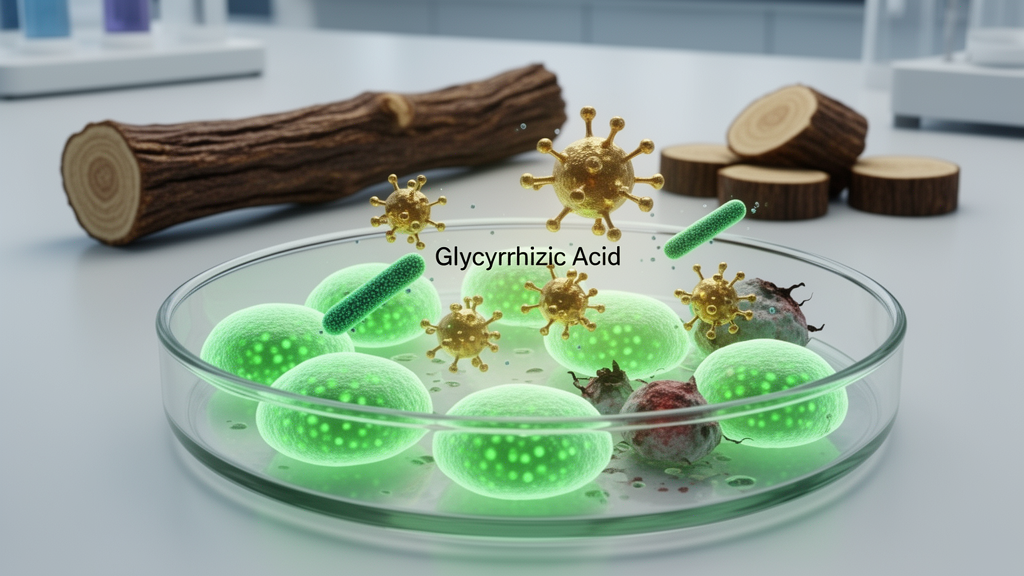
Glycyrrhizic acid, the main bioactive triterpenoid glycoside extracted from licorice root, substantially suppressed bovine viral diarrhea virus (BVDV) replication in laboratory cell cultures and reduced virus-induced liver damage in a mouse model, according to a new study published in Frontiers in Microbiology. In Madin-Darby bovine kidney (MDBK) cells treated with 10 micromolar GA, mRNA expression of two key viral genomic regions—the 5′ untranslated region and the NS5B polymerase gene—fell by more than 80 percent at 24 hours post-infection, while infectious viral titers dropped by 2.1-log at 24 hours and 2.3-log at 48 hours relative to infected untreated controls. The work, led by researchers at Ningxia University and the Ningxia Academy of Agricultural and Forestry Sciences, positions GA as a preclinical candidate against a virus for which no specific antiviral therapy is commercially available.
BVDV, a pestivirus in the family Flaviviridae, is among the most economically significant cattle pathogens worldwide. The authors cite global seroprevalence estimates of 60 to 90 percent in cattle herds and annual losses exceeding 3 billion dollars from reduced productivity, premature culling and trade restrictions. Infection produces acute diarrhea, fever and immunosuppression, and persistent infections in calves lead to reproductive failure and congenital defects. Current control relies on vaccination and identification and elimination of persistently infected animals; existing modified-live and inactivated vaccines are limited by viral genetic diversity and their inability to prevent fetal infection. These gaps motivated the search for a direct-acting antiviral drawn from natural products.
The experimental design combined an in vitro infection system with an in vivo mouse model. In MDBK cells infected with the cytopathic BVDV NADL strain at a multiplicity of infection of 0.1, four groups were compared: uninfected cells, infected controls, infected cells co-treated with 10 micromolar GA, and infected cells treated with 15 micromolar ribavirin as a positive control. Cells and supernatants were harvested at 6, 12, 24 and 48 hours post-infection, and viral RNA was quantified by qRT-PCR normalized to bovine beta-actin using the 2−ΔΔCt method. The 10 micromolar GA dose was chosen after CCK-8 cytotoxicity testing across nine concentrations showed that GA preserved more than 95 percent cell viability at or below 10 micromolar, with mild toxicity emerging above 15 micromolar and viability falling below 70 percent at 30 micromolar.
Time-course analysis showed a sustained antiviral effect. GA significantly reduced 5’UTR and NS5B mRNA at every measured time point compared with the infected control, and viral replication remained suppressed even at 48 hours post-infection, whereas the untreated control showed continuously rising viral load through 24 hours. Ribavirin performed comparably in vitro, inhibiting viral mRNA by roughly 78 percent and viral titer by 2.2-log, with no statistically significant difference between the two compounds. The safety margin, however, differed: 10 micromolar GA maintained above 95 percent viability while 15 micromolar ribavirin preserved about 90 percent, a modest but statistically significant advantage for GA.
The in vivo arm used 40 female BALB/c mice, six to eight weeks old, randomly assigned to four groups of ten: a PBS negative control, a BVDV-infected control receiving 1 × 10⁸ PFU of the NADL strain intraperitoneally, a GA-treated group given 5 or 20 mg/kg/day by oral gavage starting 24 hours after infection, and a ribavirin group receiving 20 mg/kg/day. Treatment continued for seven consecutive days, and mice were euthanized 24 hours after the final dose. Histopathological scoring of liver sections by two blinded pathologists revealed severe hepatic damage in infected controls—perivascular lymphocyte and neutrophil infiltration, hepatocyte edema and scattered necrosis—with a mean score of 7.2 ± 0.8. Low-dose GA reduced the score to 4.5 ± 0.6 and high-dose GA to 2.1 ± 0.3, close to the ribavirin group’s 2.3 ± 0.4, indicating a dose-dependent protective effect on liver architecture.
Immune profiling pointed to a second, immunomodulatory component of GA’s activity. In infected MDBK cells, GA downregulated TNF-α mRNA by 68 percent and IL-6 by 54 percent at 24 hours post-infection while raising the anti-inflammatory cytokine IL-10 by 2.1-fold, all statistically significant. ELISA measurements showed that GA-treated cell supernatants contained markedly less interferon-beta than infected controls: a peak of 75 ± 8 pg/mL versus 180 ± 15 pg/mL at 24 hours post-infection. In mouse serum at eight days post-infection, infected controls showed TNF-α elevated 2.8-fold and IL-6 3.1-fold over uninfected animals, whereas high-dose GA brought these down to 1.2-fold and 1.3-fold respectively and increased IL-10 by 1.8-fold. Serum IFN-β fell from 120 ± 10 pg/mL in infected controls to 55 ± 6 pg/mL with GA. The authors interpret the IFN-β reduction as a downstream consequence of suppressed viral replication rather than direct interference with interferon secretion, distinguishing GA from broadly immunosuppressive drugs.
A notable and somewhat counterintuitive strand of the study concerned the gut microbiota. Cecal contents collected at seven days post-infection from five mice per group were analyzed by 16S rRNA gene sequencing of the V4-V5 region. Contrary to the researchers’ initial hypothesis, BVDV infection produced only modest changes in alpha diversity: the Chao1 richness index was 275 ± 12 in infected mice versus 291 ± 11 in controls, and Shannon indices of 6.23 ± 0.17 and 6.37 ± 0.02 were not significantly different. GA treatment actually lowered the Shannon index to 5.65 ± 0.37, suggesting reduced community evenness, while ribavirin maintained diversity closest to uninfected levels. Principal coordinate analysis based on Bray-Curtis distances did show partial separation between infected and control groups (ANOSIM R = 0.68, P = 0.001), with GA-treated mice clustering intermediately—partially, but incompletely, restored toward the control structure—and ribavirin-treated mice resembling controls most closely.
Functional prediction using Tax4Fun2 and KEGG annotation added a metabolic dimension. BVDV infection was associated with a 42 percent reduction in the relative abundance of carbohydrate metabolism pathways, with declines in short-chain fatty acid synthesis subpathways—butanoate metabolism falling from 1.52 percent to 0.87 percent and propanoate metabolism from 1.21 percent to 0.63 percent—alongside enrichment of NF-κB-related inflammatory signaling. High-dose GA partially reversed these shifts, restoring butanoate metabolism to 1.38 percent and propanoate metabolism to 1.05 percent while reducing NF-κB pathway abundance to 1.12 percent. Ribavirin showed weaker restoration of butanoate metabolism at 1.15 percent and did not significantly normalize inflammatory pathway abundance. Because short-chain fatty acids such as butyrate can inhibit NF-κB-mediated inflammation, the authors propose a microbiota-metabolism-immune axis through which GA’s microbial and cytokine effects may reinforce each other, while stressing that these pathway figures rest on 16S-based prediction rather than direct metabolite measurement.
The authors are explicit about the study’s limitations, which temper any translation to livestock. The in vivo model used mice rather than cattle, the natural host, and species-specific differences in antiviral immunity could affect efficacy in the field. The mechanism remains partially unresolved: suppression of 5’UTR and NS5B expression was observed, but no direct binding between GA and viral proteins or host factors was demonstrated. Only the cytopathic NADL strain was tested in vitro, whereas non-cytopathic biotypes predominate in the field and drive persistent infection, so testing against non-cytopathic isolates is necessary. Only IFN-β was measured among type I interferons, the microbiota analysis captured a single timepoint with a small sample of five mice per group, and GA’s low oral bioavailability in free form will need formulation work. Future directions include validation in bovine-derived cells, cattle trials assessing pharmacokinetics and long-term safety, molecular binding studies, and development of livestock-suitable delivery forms. Within those boundaries, the findings establish GA’s dual activity—direct suppression of viral RNA synthesis combined with cytokine modulation—in preclinical models, and identify a safety profile the authors argue is favorable relative to ribavirin, which carries known risks of hemolytic anemia and teratogenicity in animals.
Subject of Research: Preclinical evaluation of glycyrrhizic acid as an inhibitor of bovine viral diarrhea virus replication in cell culture and a mouse model
Article Title: Antiviral mechanism of glycyrrhizic acid against BVDV: suppression of viral replication and immune regulation
Article References: Fang, Y., Yu, Y., Yu, Z., Wang, J., Zhao, Z., Guo, Y., Zhao, Y., Cai, D., Yang, Y., & Zhou, P. (2026). Antiviral mechanism of glycyrrhizic acid against BVDV: suppression of viral replication and immune regulation. Frontiers in Microbiology, 17, Article 1924475. https://doi.org/10.3389/fmicb.2026.1924475
Image Credits: AI Generated
DOI: 10.3389/fmicb.2026.1924475
Keywords: bovine viral diarrhea virus, glycyrrhizic acid, licorice, antiviral, MDBK cells, BALB/c mice, cytokines, interferon-beta, gut microbiota, 16S rRNA sequencing, short-chain fatty acids, ribavirin
News Source: Juliet Wilcox. (October 30, 2026). Licorice Compound Glycyrrhizic Acid Curbs BVDV in Cells and Mice. Scienmag.



