• HOME
  • NEWS
  • EXPLORE
    • CAREER
      • Companies
      • Jobs
    • EVENTS
    • iGEM
      • News
      • Team
    • PHOTOS
    • VIDEO
    • WIKI
  • BLOG
  • COMMUNITY
    • FACEBOOK
    • INSTAGRAM
    • TWITTER
Wednesday, May 13, 2026
BIOENGINEER.ORG
No Result
View All Result
  • Login
  • HOME
  • NEWS
  • EXPLORE
    • CAREER
      • Companies
      • Jobs
        • Lecturer
        • PhD Studentship
        • Postdoc
        • Research Assistant
    • EVENTS
    • iGEM
      • News
      • Team
    • PHOTOS
    • VIDEO
    • WIKI
  • BLOG
  • COMMUNITY
    • FACEBOOK
    • INSTAGRAM
    • TWITTER
  • HOME
  • NEWS
  • EXPLORE
    • CAREER
      • Companies
      • Jobs
        • Lecturer
        • PhD Studentship
        • Postdoc
        • Research Assistant
    • EVENTS
    • iGEM
      • News
      • Team
    • PHOTOS
    • VIDEO
    • WIKI
  • BLOG
  • COMMUNITY
    • FACEBOOK
    • INSTAGRAM
    • TWITTER
No Result
View All Result
Bioengineer.org
No Result
View All Result
Home NEWS Science News Chemistry

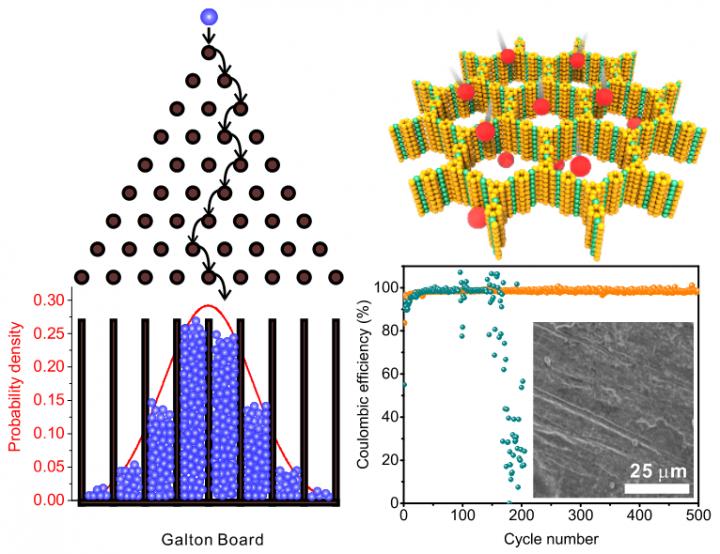
Li-ions transport across electrolytes and SEI like beads passing through a Galton Board

Bioengineer by Bioengineer
July 21, 2020
in Chemistry
Reading Time: 2 mins read
0
IMAGE
Share on FacebookShare on TwitterShare on LinkedinShare on RedditShare on Telegram

IMAGE

Credit: ©Science China Press

The kinetics of Li-ions transport across the electrolyte and the SEI is usually the rate-determining step in the Li plating-stripping process. Before electroplating on the anode surface, Li-ions migrate from a cathode to an anode through pores in a separator that is filled with electrolytes. The Li metal surface facing the pores in the separator becomes enriched with Li-ions due to their accumulation inside the pores. Thus, the fresh Li metal selectively deposits on these regions with a higher concentration of Li-ions, forming an uneven Li metal surface, as well as dendritic Li growth.

Recently, the research group of Professor Hengxing Ji of the University of Science and Technology of China presents a coating layer formed by COF-LZU1 particles on a commercial polypropylene (PP) separator to redistribute the Li-ions passing through the PP pores.

The interlayer comprises closely packed particles of a Schiff-base covalent organic framework (COF) COF-LZU1, which is an electronic insulator with a high chemical and thermal stability containing well-aligned channels of ~1.8 nm in diameter. The nanochannels in the COF-LZU1 particles in the coating layer hinder the migration of anions between the electrodes, leading to a high Li-ion transference number of 0.77±0.01, which has long been considered to increase the energy efficiency of Li batteries.

In addition, Li-ions move through the COF-LZU1 layer, analogous to beads passing through a Galton Board. This process, for a large number of beads, statistically approximates the normal distribution. In this regard, the COF-LZU1 layer serves to effectively redistribute the Li-ions that pass through the pores of the commercial separator so as to yield a uniform distribution, which can transform the mossy or dendritic Li to a smooth Li deposition, rendering improved battery performances. The mechanism of the behaviors of the COF-LZU1 layer can be extended to different types of porous materials to regulate ion distributions in different energy storage or conversion systems.

###

See the article: Xie H, Hao Q, Jin H, Xie S, Sun Z, Ye Y, Zhang C, Wang D, Ji H, Wan L-J. Redistribution of Li-ions using covalent organic frameworks towards dendrite-free lithium anodes: a mechanism based on a Galton Board. Sci. China Chem., 2020, DOI:10.1007/s11426-020-9796-9.

https://doi.org/10.1007/s11426-020-9796-9

Media Contact
Hengxing Ji
[email protected]

Related Journal Article

http://dx.doi.org/10.1007/s11426-020-9796-9

Tags: Chemistry/Physics/Materials Sciences
Share12Tweet8Share2ShareShareShare2

Related Posts

Liquid-like Behavior Observed in Gold Nanoparticles — Chemistry

Liquid-like Behavior Observed in Gold Nanoparticles

May 13, 2026
Vortex-Induced Triboelectric Nanogenerator Enables Efficient Multidirectional Wind Energy Harvesting in Low Wind and High Humidity Conditions — Chemistry

Vortex-Induced Triboelectric Nanogenerator Enables Efficient Multidirectional Wind Energy Harvesting in Low Wind and High Humidity Conditions

May 13, 2026

Enhanced Cancer Drug Targeting and Efficacy Through Molecular Grappling Hooks

May 13, 2026

Optimized Slurry Processing Paves the Way for Better Batteries

May 13, 2026
Please login to join discussion

POPULAR NEWS

  • Research Indicates Potential Connection Between Prenatal Medication Exposure and Elevated Autism Risk

    842 shares
    Share 337 Tweet 211
  • New Study Reveals Plants Can Detect the Sound of Rain

    728 shares
    Share 290 Tweet 182
  • Salmonella Haem Blocks Macrophages, Boosts Infection

    62 shares
    Share 25 Tweet 16
  • Breastmilk Balances E. coli and Beneficial Bacteria in Infant Gut Microbiomes

    57 shares
    Share 23 Tweet 14

About

We bring you the latest biotechnology news from best research centers and universities around the world. Check our website.

Follow us

Recent News

Effective Parental Support Strategies to Reduce Burnout in Pregnant and Postpartum Trainees

Two Regions, One Virus: Nipah’s Recurrence Unveiled

Machine Learning Predicts Hospital Stay in Pediatric Cardiology

Subscribe to Blog via Email

Enter your email address to subscribe to this blog and receive notifications of new posts by email.

Join 82 other subscribers
  • Contact Us

Bioengineer.org © Copyright 2023 All Rights Reserved.

Welcome Back!

Login to your account below

Forgotten Password?

Retrieve your password

Please enter your username or email address to reset your password.

Log In
No Result
View All Result
  • Homepages
    • Home Page 1
    • Home Page 2
  • News
  • National
  • Business
  • Health
  • Lifestyle
  • Science

Bioengineer.org © Copyright 2023 All Rights Reserved.