


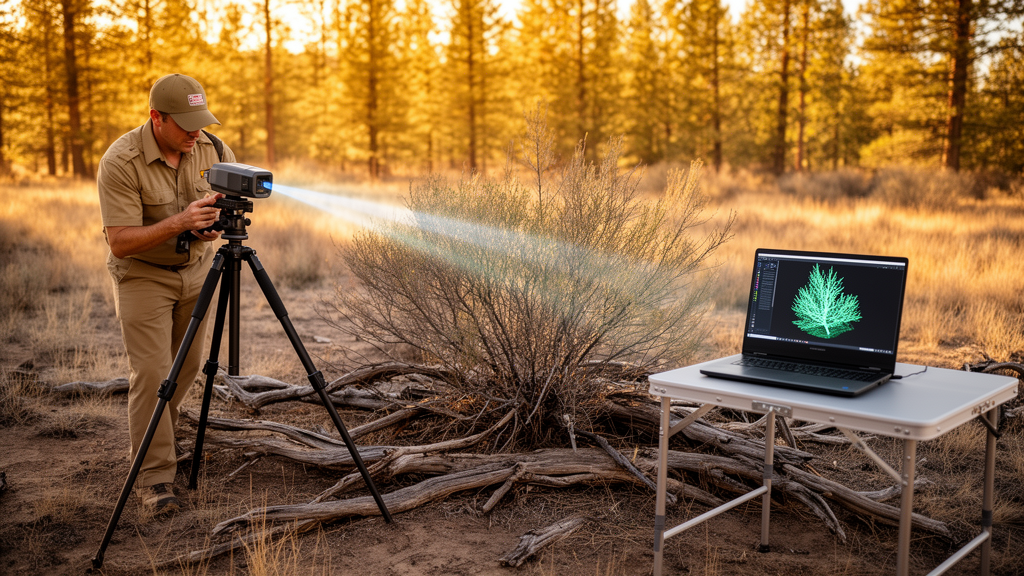
Wildland fire models are only as good as the fuel data that feed them, and for decades those data have been too coarse to capture the fine structure of the grasses, shrubs, litter, and seedlings that actually carry surface fires. A new study published in the journal Fire Ecology introduces a detailed scanning and meshing protocol designed to change that, by creating sub-millimeter-resolution three-dimensional digital models of individual fuel particles rather than entire forest scenes.
Field sampling took place in late September 2024, with point cloud processing and mesh generation completed over the following winter and spring. The team collected seedlings, shrubs, ferns, downed wood, cones, and other understory fuels representative of species found in areas of the Pinelands managed with prescribed burns.
Instead of using terrestrial laser scanning or photogrammetry, which typically require objects to be segmented out of broader environment-level point clouds, the researchers began with the object itself. They used a coordinate measuring machine, the FARO Design ScanArm 2.5C, a hybrid laser-contact system originally developed for industrial metrology and reverse engineering. This instrument allowed sub-millimeter resolution scans of plant materials without deforming them, while FARO’s RevEng software provided real-time visualization and enabled cleaning, meshing, and metric analysis of the resulting point clouds.
The protocol is divided into two phases. The scanning phase covers all steps involved in generating and quality-controlling a point cloud, while the meshing phase focuses on interpreting that point cloud as a three-dimensional surface mesh composed of fine-resolution triangles. A mesh is a digital representation of an object surface, built from a connected network of faces that approximate the object’s shape in 3D. Unlike raw point clouds, meshed models enable geometric and physical analyses such as estimating total surface area or enclosed volume.
Because wildland fuels vary enormously in size, configuration, and physical stability, the workflow classifies objects by structural complexity. Simple objects, such as individual leaves, twigs, and needles, are composed of a single three-dimensional shape, typically cylindrical rod segments or flat planes, and follow a streamlined process. Compound objects, such as foliated shrubs and seedlings, are composites of simple objects and are handled with a more detailed approach. The researchers identified three attributes that complicate processing compound objects: self-occlusion, as in pinecones; composition involving multiple types of simple objects, as in shrubs with both flat leaves and cylindrical stems; and deformation potential due to movement, as in ferns and fresh leaves.
The practical details of the scanning process reveal how demanding the work is. Objects were secured to a modified turntable using modeling clay, clamps, or foam, with a square of foam mounting tape placed at the turntable center to create stable tie points for post-scanning registration. Doors and windows were closed to minimize airflow, and additional personnel remained stationary to limit turbulence. The laser line probe was held between 45 and 90 degrees to the surface at a distance of roughly 15 centimeters, and the probe was rotated approximately 90 degrees to rescan sections perpendicular to the initial swath. A scan was deemed successful only if it showed full surface coverage with no missing elements; if an object moved or deformed during scanning, the scan was discarded and repeated.
Compound objects proved especially challenging. Small shifts in position caused duplication of components in the point cloud, particularly for small-diameter items such as grass blades and pine needles, while small branches and leaves created occluded areas that could not be scanned without disturbing the rest of the object. Occluded regions on compound objects were sometimes addressed by defoliating the object and rescanning the previously hidden branch architecture. Dense point clouds from compound objects also slowed processing, so the researchers used a consolidation tool on noisier clouds to filter them to a 0.1 millimeter resolution, producing a thinned cloud with roughly 60 percent of the original points and a much cleaner mesh.
To date, the case study has yielded 74 objects representing 10 fuel types and 23 species that were sampled, scanned, and weighed. Once scanned, objects could be digitally parsed into their simple components; an oak seedling scan, for example, could yield separate point clouds for the intact object, its leaves, and its stem. Some objects were scanned twice to capture both foliated and defoliated states. Each object was also associated with a dry weight value, obtained by oven drying samples at 70 degrees Celsius for 48 hours, or 72 hours for coarse wood, along with descriptive attributes including imagery, geospatial location, scientific name, and object type.
Deriving physical metrics from the meshes required additional care. For components that could be made into continuous meshes, such as stems and coarse wood, RevEng’s measure tool generated surface area and volume directly. For one-sided meshes, such as leaves so thin that the laser only recognized one surface, the researchers doubled the one-sided surface area value and modeled volume by multiplying by a standard thickness of 0.1 millimeters unless published species-specific leaf thickness values were available. The authors caution that plane-based objects thinner than the scanner’s minimum resolution cannot be easily represented by enclosed, watertight meshes, and that while deviations from true volume may be only on the order of millimeters, such errors could compound when modeled across all the leaves on a shrub or all the shrubs in a forest stand. They recommend that future studies coordinate scanning with field measurements of leaf thickness to reduce this uncertainty.
The researchers are explicit that the Design ScanArm is not proposed as a replacement for terrestrial or airborne laser scanning, but as a complementary approach that adds a new level of ecological fidelity to fuel modeling. The instrument has a limited physical range in terms of maneuverability and distance from the target, making it unsuitable for some fuel types such as plants with dense outer leaf architecture, and both the scanner and its software are costly and proprietary. The authors also recommend exploring more accessible laser-based, photo-based, and hybrid methods, noting that given the sheer variability of wildland fuels, a range of scanning and analytical approaches will be required. The datasets and project metadata are being archived with the Open Science Framework and are available upon request from the primary author. The ultimate aim, according to the study’s conclusions, is that these digital twins of individual fuel particles can serve as building blocks for integration with machine learning techniques, improving wildland fuelbed classification and providing more realistic inputs to three-dimensional fire behavior and smoke models such as QUIC-Fire, with implications for fire behavior prediction, emissions estimation, and ecological modeling.
Subject of Research: An object-centered laser scanning and meshing protocol for creating high-resolution 3D digital models of individual wildland fuel particles
Article Title: Building blocks for 3D fuelbeds: object-centered scanning and meshing protocol
Article References: Mire, I. C., Thoreson, J., Prichard, S. J., Gallagher, M. R., Patterson, M. M., & Skowronski, N. S. (2026). Building blocks for 3D fuelbeds: object-centered scanning and meshing protocol. Fire Ecology, 22(1), Article 153. https://doi.org/10.1186/s42408-026-00573-6
Image Credits: AI Generated
DOI: 10.1186/s42408-026-00573-6
Keywords: wildland fire, fuelbeds, laser scanning, terrestrial laser scanning, 3D meshing, digital twins, fire behavior modeling, prescribed burning, point clouds, fuel characterization, New Jersey Pinelands, remote sensing
News Source: Mallory Mcbride. (October 29, 2026). Laser Scanning Protocol Builds Digital Twins of Individual Wildland Fuels. Scienmag.



